
Description
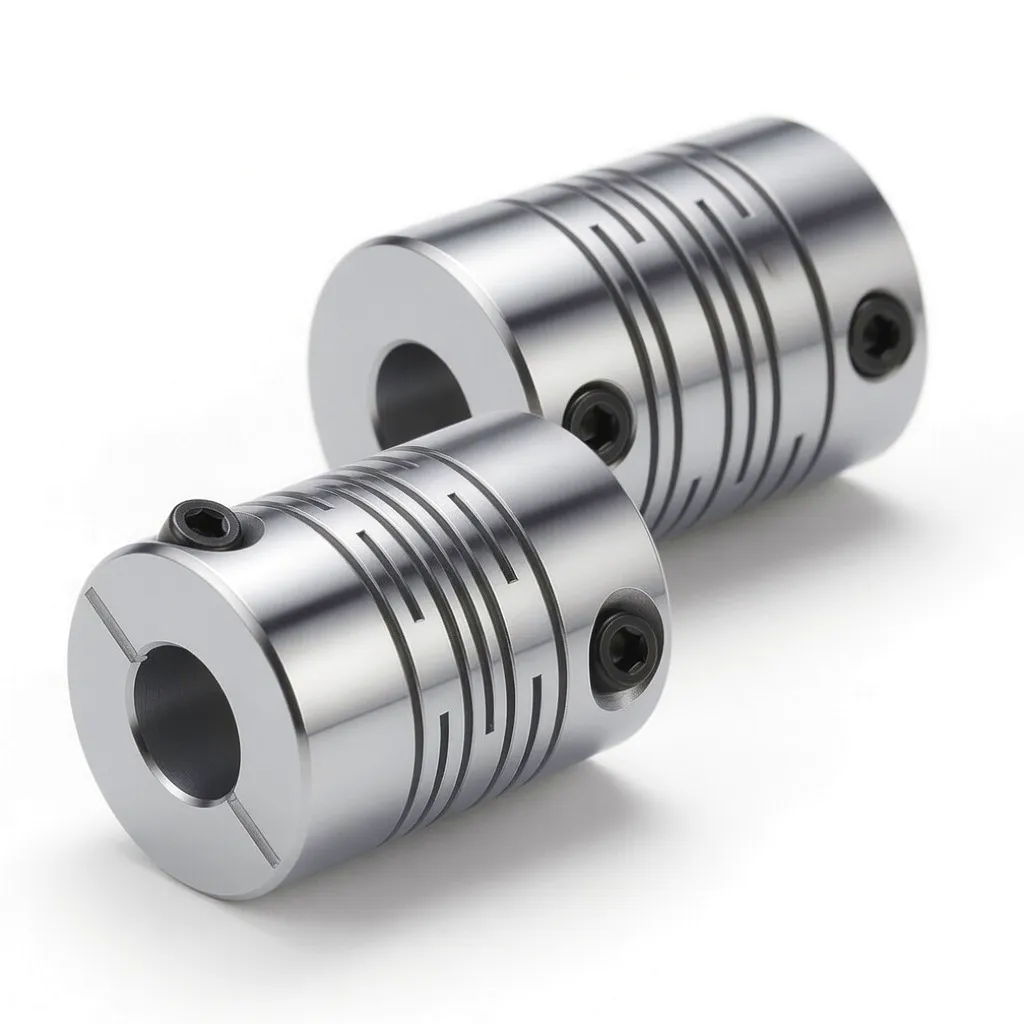
Material Specification & Working Principle
How the Beam Coupling Works
The helical slots machined into the coupling body create a series of interconnected beam elements that act as individual leaf springs. When torque is applied, these beams deflect uniformly in torsion, distributing stress across the entire length of the coupling rather than concentrating it at a single point. The result is a component that is simultaneously stiff enough to transmit precise motion and compliant enough to absorb shaft offsets and dynamic shock loads. The number of starts (single, double, or triple helix) and the pitch of the cuts determine the balance between torsional stiffness and flexibility, allowing the flexible beam coupling to be tuned for specific drive system requirements.
Materials Used
| Material | Grade | Typical Use |
|---|---|---|
| Aluminium Alloy | 6061-T6 | General servo/automation |
| Stainless Steel | 303 SS | Food/pharma/marine |
| Titanium Alloy | Grade 5 | Aerospace / high-temp |
Custom material specifications available on request. Contact our team for non-standard alloy or surface treatment options including hard anodising and electroless nickel plating.
Technical Specifications — Flexible Beam Coupling Size Table
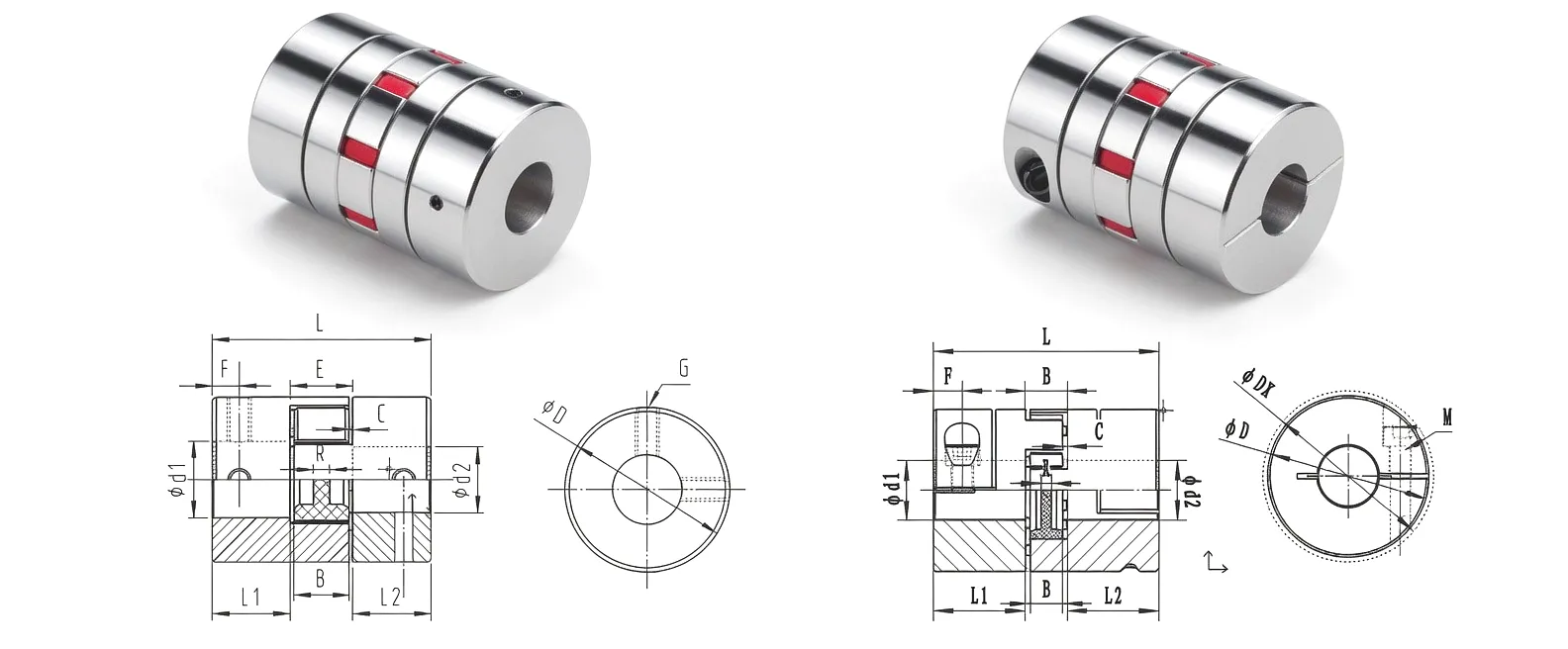
Dimensional reference drawing — all units in mm
| Model No. | d1 min (mm) | d2 max (mm) | D (mm) | L (mm) | L1 (mm) | L2 (mm) | TKN (N·m) | TK max (N·m) | Torsional Stiffness (N·m/rad) | Dynamic Stiffness (N·m/rad) | Weight (g) |
|---|---|---|---|---|---|---|---|---|---|---|---|
| JM1-14 | 3 | 7 | 14 | 22.0 | 7.0 | 7.0 | 2.0 | 4.0 | 22.9 | 69.0 | 6.7 |
| JM2-14 | 3 | 6 | 14 | 22.0 | 7.0 | 7.0 | 2.0 | 4.0 | 22.9 | 69.0 | 6.7 |
| JM1-20 | 4 | 10 | 20 | 30.0 | 10.0 | 10.0 | 5.0 | 10.0 | 51.6 | 155.0 | 19.8 |
| JM1-25 | 4 | 12 | 25 | 34.0 | 11.0 | 11.0 | 9.0 | 18.0 | 240.7 | 718.0 | 37.0 |
| JM1-40 | 8 | 24 | 40 | 66.0 | 25.0 | 25.0 | 17.0 | 34.0 | 1512 | 2540 | 156.0 |
| JM1-55 | 10 | 28 | 55 | 78.0 | 30.0 | 30.0 | 60.0 | 120.0 | 3640 | 5980 | 362.0 |
| JM1-65 | 12 | 38 | 65 | 90.0 | 35.0 | 35.0 | 160.0 | 320.0 | 6410 | 9920 | 583.0 |
| JM1-80 | 16 | 45 | 80 | 114.0 | 45.0 | 45.0 | 325.0 | 650.0 | 11800 | 17160 | 966.0 |
| JM1-95 | 20 | 55 | 95 | 126.0 | 50.0 | 50.0 | 450.0 | 900.0 | 21594 | 37692 | 1820.0 |
| JM1-120 | 20 | 74 | 120 | 160.0 | 65.0 | 65.0 | 685.0 | 1370.0 | 42117 | 61550 | 4530.0 |
Full series from JM1-14 to JM1-135 available. Custom dimensions and bore combinations produced to specification. Contact our UK sales team for pricing.
Application Scenarios Across UK Industry
The flexible beam coupling is not a niche component — it appears in virtually every sector that relies on precision shaft interconnection. In UK-based robotic assembly lines, the flexible beam coupling connects servo motors to ballscrew drive shafts, ensuring that the high-resolution encoder feedback loop is not corrupted by mechanical play. In laboratory and medical equipment manufactured in Oxfordshire, Cambridgeshire, and the wider Midlands technology corridor, miniature flexible beam couplings in the JM1-14 and JM1-16 size range couple micro-stepper motors to optical stage actuators where bore misalignment tolerance is under 0.05 mm. Packaging machine builders across Yorkshire and Lancashire specify the JM1-40 and JM1-55 series for their horizontal form-fill-seal drive trains, appreciating the coupling’s ability to absorb the periodic shock loads generated during jaw cycling without transmitting vibration to the servo amplifier. In the offshore and marine sector, stainless steel flexible beam couplings are used in below-deck instrumentation panels and steering actuator assemblies where salt air corrosion would rapidly degrade an aluminium component.
Customer Success Cases
Collaborative Robot Integrator — West Midlands, England
A collaborative robotics systems integrator based in Coventry was experiencing premature encoder failure in a 6-axis palletising cell. After investigation, the root cause was traced to backlash in the jaw couplings connecting the servo motors on joints 4 and 5. The team switched to JM1-40 flexible beam couplings throughout the drive train. Over the following 12 months of continuous production operation, encoder replacement frequency dropped by more than 85%, machine downtime was reduced significantly, and the customer reported measurably improved positional repeatability at the robot end-effector. The flexible beam coupling’s zero-backlash characteristic eliminated the incremental position error that had been propagating through the joint chain. The customer now specifies our flexible beam coupling as standard on all new robot builds leaving their Coventry facility.
“We specified the JM1-25 series for a batch of new optical positioning stages built for a pharmaceutical client in Cambridge. Lead time was short, dimensional accuracy was exactly on drawing, and after six months in service we have had zero coupling-related failures. Good value for the performance level delivered.”
“Our CNC router spindle drives run continuously on two shifts. The stainless flexible beam couplings we ordered handled the coolant environment without any corrosion after eight months. Torsional stiffness figures matched the published data sheet closely, which made our servo tuning straightforward. Will be ordering again.”
“Placed a mixed order including standard and custom bore sizes. The custom bores arrived correctly machined on the first attempt with no back-and-forth on tolerances. Communication from the sales team was responsive and the quote came through quickly. Solid supplier for ongoing projects.”
Manufacturing Capability & Product Customisation
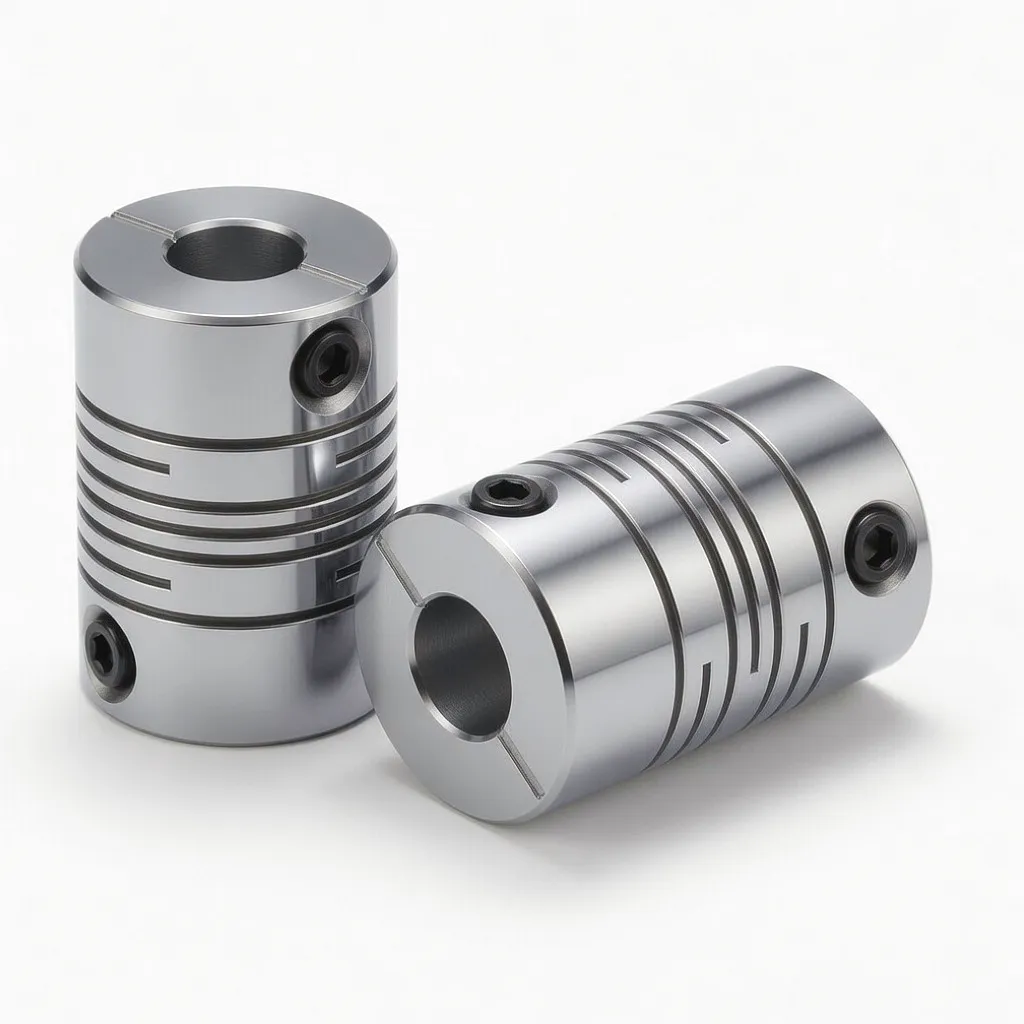
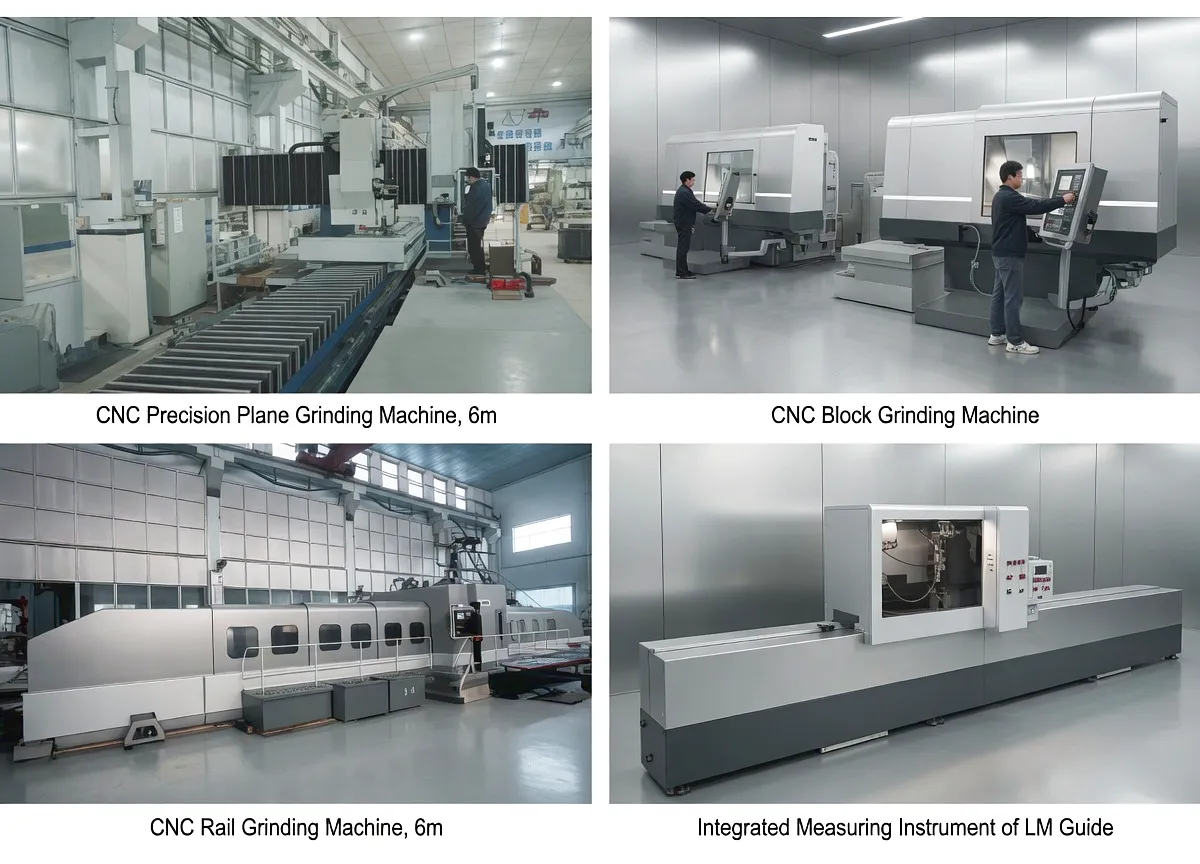
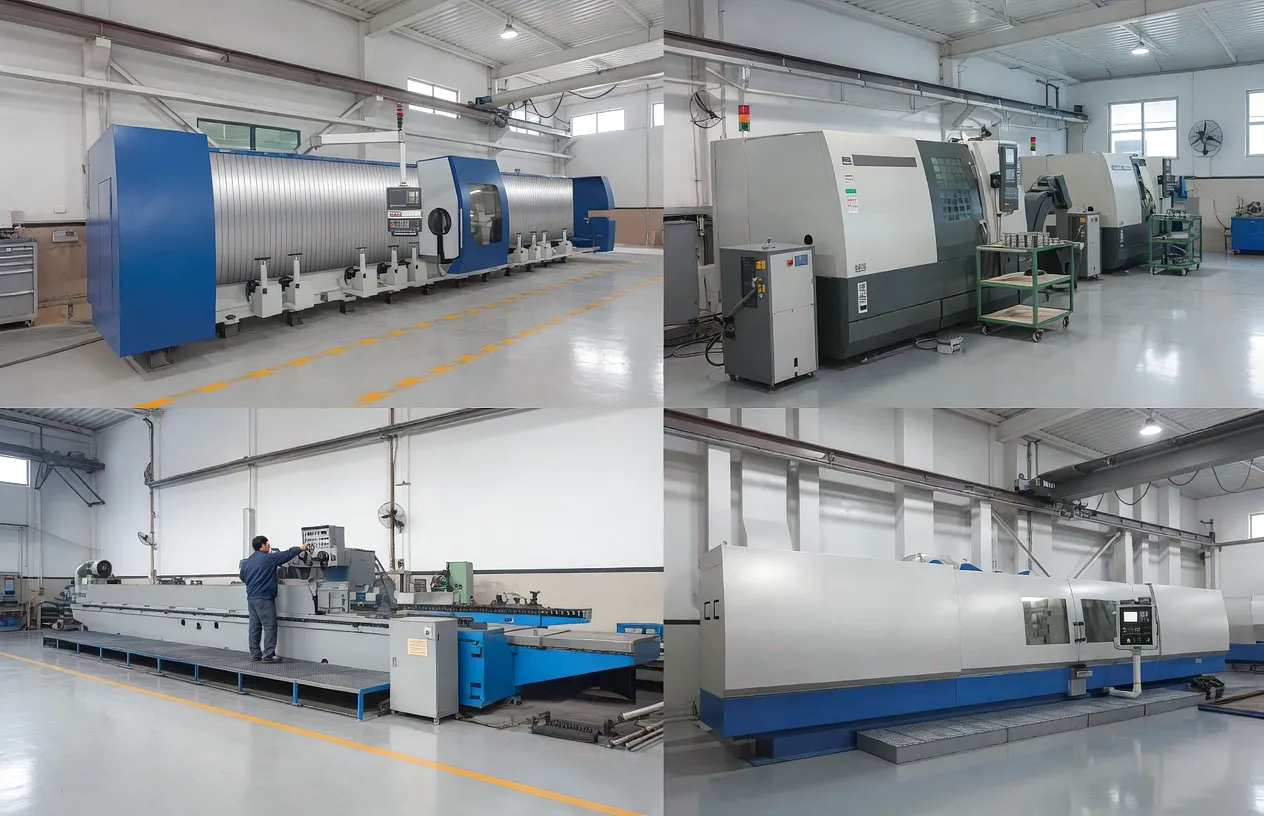
Ever Power’s flexible beam coupling production facility operates CNC turning and milling centres with live tooling, enabling us to hold bore tolerances of H7 as standard and tighter on request. Our engineering team works directly with UK customers from the initial specification stage, reviewing shaft dimensions, speed profiles, torque requirements, and environmental conditions before recommending or designing the most appropriate coupling configuration. We offer single-start, double-start, and triple-start helix variants as well as non-standard outer diameters, extended lengths, and keyway or flat-clamp hub configurations. For OEM customers placing regular volume orders, we provide dedicated inventory management and scheduled call-off agreements, removing lead time uncertainty from the supply chain. Custom engravings, coloured anodising, and full material traceability documentation are all available on request. Whether your application requires five pieces for a prototype build or five thousand for a production series, our capacity and processes scale without compromising dimensional consistency or surface finish quality.
| Customisation Option | Details | Lead Time |
|---|---|---|
| Custom bore diameter | Any bore within OD limits, H7 std. | 10–15 days |
| Non-standard OD / length | To customer drawing | 15–20 days |
| Stainless steel body | 303 / 316 SS available | 10–15 days |
| Keyway hub | DIN 6885 or custom key profile | 12–18 days |
| Coloured anodising | Black, red, blue, gold, natural | +3–5 days |
| Material cert. / traceability | Full mill cert. on request | With order |
Get a Quote for Custom Flexible Beam Coupling
Email: [email protected] · Response within 24 hours for UK enquiries
Frequently Asked Questions
What is the best flexible beam coupling supplier in the UK for servo motor shaft connections?
For UK buyers sourcing flexible beam couplings to connect servo motor shafts, the key criteria are zero-backlash performance, verified torsional stiffness data, and short lead times for both standard and custom bore sizes. Ever Power supplies aluminium and stainless flexible beam couplings with published stiffness values and dimensional drawings, ready to quote within 24 hours for UK enquiries sent to [email protected]. Standard sizes ship in 7–10 days, and custom bore machining typically adds 5–8 working days.
How much does a custom bore flexible beam coupling cost when ordering from a UK engineering company?
The price of a flexible beam coupling with a custom bore depends on the outer diameter, material, bore size, and order quantity. Miniature aluminium units (JM1-14 series) typically carry the lowest unit cost, while large stainless steel couplings with keyways are priced higher per unit but become very competitive at volumes above 50 pieces. The most efficient route to an accurate price is to submit your shaft dimensions and required quantity using our Get a Quote email. Custom bore flexible beam coupling orders are available from single prototype quantities with no minimum order surcharge on most standard sizes.
Which type of flexible beam coupling should I choose for a CNC machine tool application in the UK manufacturing sector?
For CNC applications, a double-start helical flexible beam coupling in the JM1 series is generally the correct choice. The double-start cut pattern delivers a balanced combination of torsional stiffness and angular compliance — critical when the coupling sits between a servo motor and a ballscrew in a feed axis drive. If the machine uses flood coolant, a 303 stainless steel body is advisable to prevent corrosion. For dry-cut or enclosed spindle applications, anodised aluminium offers adequate protection while reducing rotational inertia. Always verify that the coupling’s rated nominal torque (TKN) exceeds your worst-case peak motor torque by a factor of at least 1.5.
Where can I get a quick quote for flexible beam couplings with non-standard bore sizes for a robotics project in England?
The fastest way to get a quote for non-standard bore flexible beam couplings is to email [email protected] with your shaft diameter (both input and output if different), the coupling outer diameter and length you need, the material preference, and your estimated quantity. Our engineering team reviews technical drawings and returns a verified quotation within one working day for enquiries from England, Scotland, and Wales. We have supplied custom flexible beam couplings to robotics integrators in Bristol, Birmingham, Cambridge, and Manchester.
When should I use a flexible beam coupling instead of a jaw coupling or bellows coupling in a precision drive system?
The flexible beam coupling is the preferred choice when zero backlash is non-negotiable — typically in servo drives, encoder feedback axes, and optical positioning equipment. Jaw couplings use a polyurethane spider element that introduces a small amount of backlash and degrades over time, making them unsuitable for closed-loop high-resolution applications. Bellows couplings offer zero backlash but are more fragile under radial load and more expensive. The flexible beam coupling sits between these two in terms of cost and robustness — it handles moderate misalignment, resists vibration, and is machined from a single piece of metal, making it the most reliable long-term choice for most UK industrial servo applications.
How do I calculate what size flexible beam coupling I need for my motor shaft dimensions and torque requirements?
Start with your motor shaft diameter and driven shaft diameter — both must fall within the d1 minimum and d2 maximum bore range of a single coupling size. Next, calculate your peak torque in N·m; this must be below the TKN rated value for the selected model, with a safety factor applied. Check the coupling outer diameter (D) and length (L) against your mechanical envelope constraints. Finally, verify that the torsional stiffness (N·m/rad) is compatible with your servo bandwidth requirements. If you are uncertain about any step, send your motor specification and application brief to our team at [email protected] and we will recommend a model with full technical justification.
Ready to Source Flexible Beam Couplings for Your UK Project?
Custom bore sizes · Stainless steel options · OEM volume pricing · 24-hour quote response for UK enquiries
cardancoupling.top · [email protected] · edit by gzl