Cardan Coupling for Solar Concentrating Power Systems: Precision Drive Solutions for CSP Tracker Arrays
How universal joints and cardan shaft assemblies solve the toughest mechanical alignment challenges in parabolic trough and dish/Stirling solar tracking systems — with real-world engineering insights from Ever Power’s UK-based application team.
|
🕒 14 min read
|
Ever Power — UK Cardan Coupling Specialists
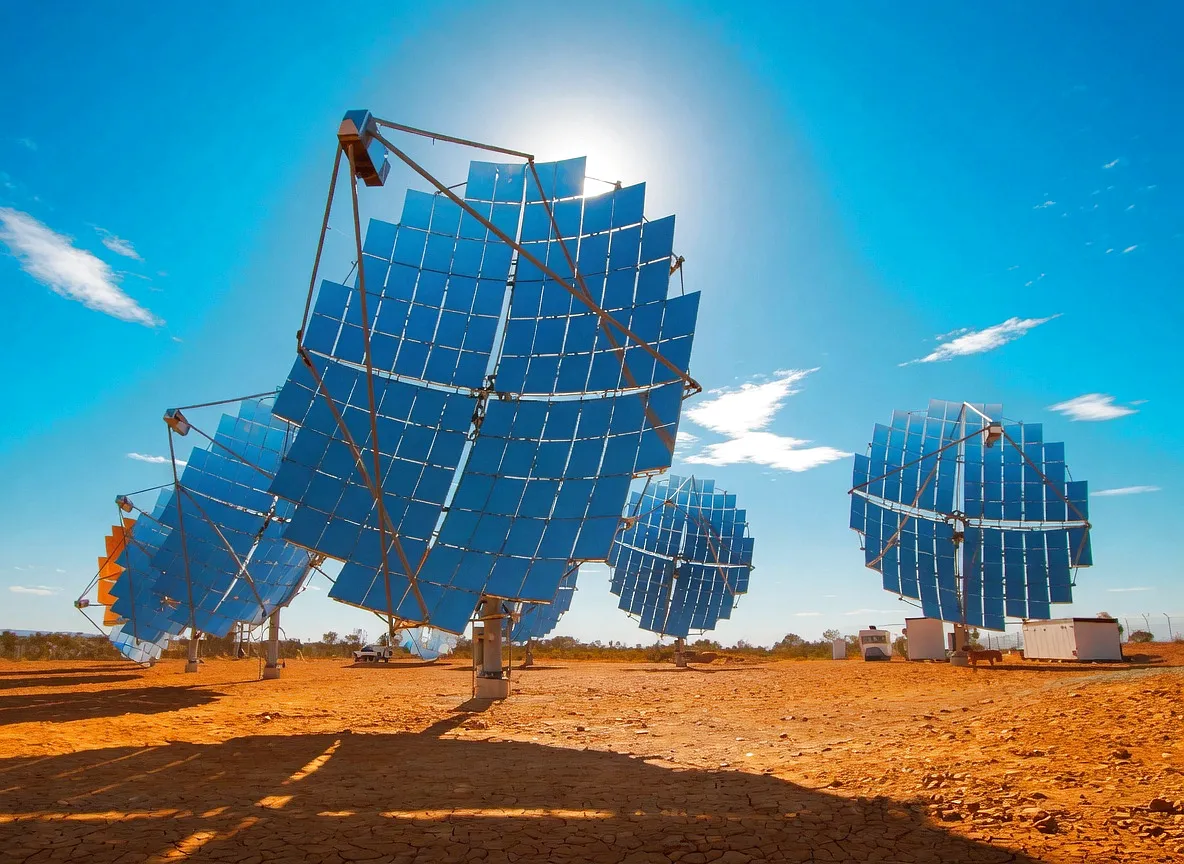
 Concentrated solar power plants — whether parabolic trough collectors stretching 150 metres across a Spanish plain or dish/Stirling units spinning quietly on a Scottish hillside — share one relentless mechanical truth: the drive train never stops moving. Every degree the sun travels across the sky demands a matching degree of rotation from collectors that may weigh several tonnes, span hundreds of metres, and must stay aligned to within a tenth of a degree. Getting that motion from a fixed motor to a constantly shifting axis is, without exaggeration, one of the most demanding power-transmission problems in renewable energy engineering. The cardan coupling — in its various double-joint, telescoping, and high-angle configurations — is the component that makes it possible.
This article explores the specific mechanical demands of both parabolic trough CSP systems and dish/Stirling dual-axis trackers, explains why cardan coupling technology is the preferred power-transmission choice for these environments, and shows how Ever Power’s manufacturing capabilities translate into reliable, customised solutions for CSP developers and EPC contractors operating in the UK and across Europe.
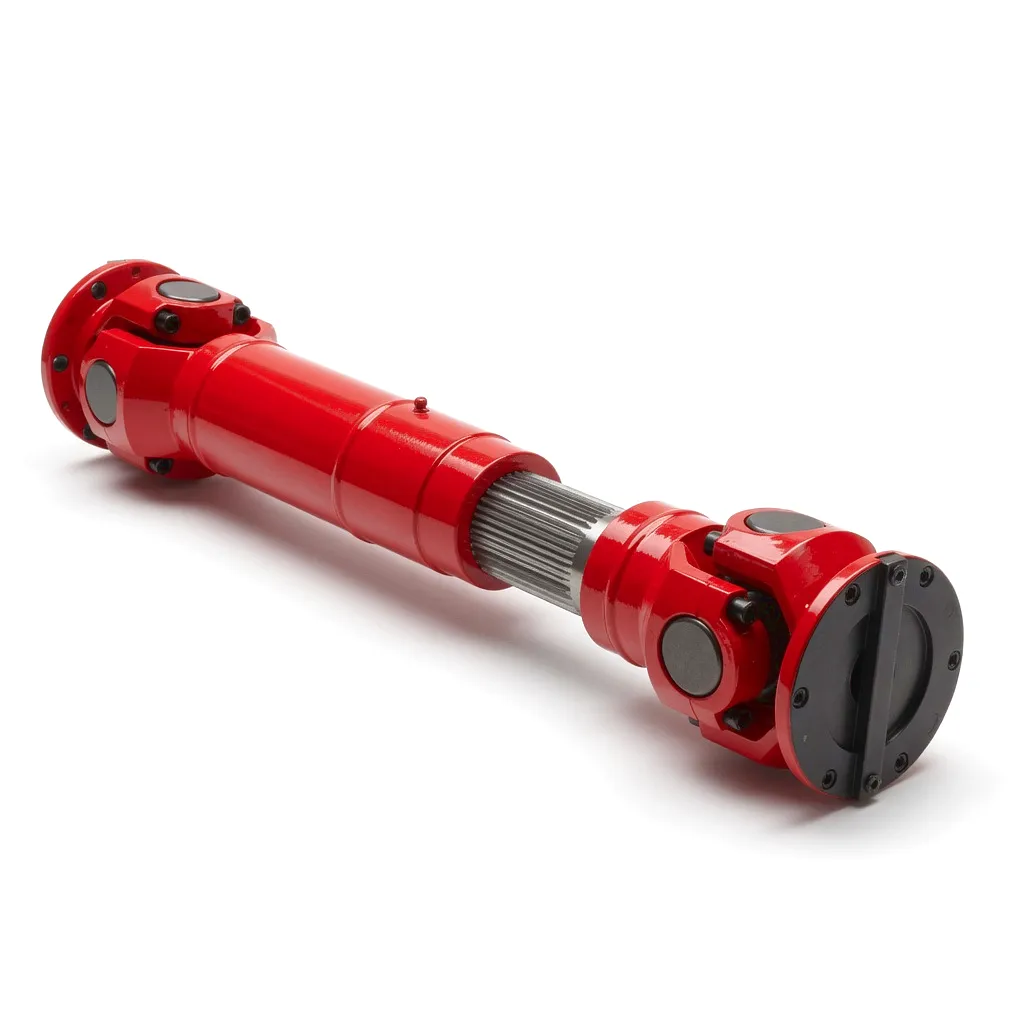
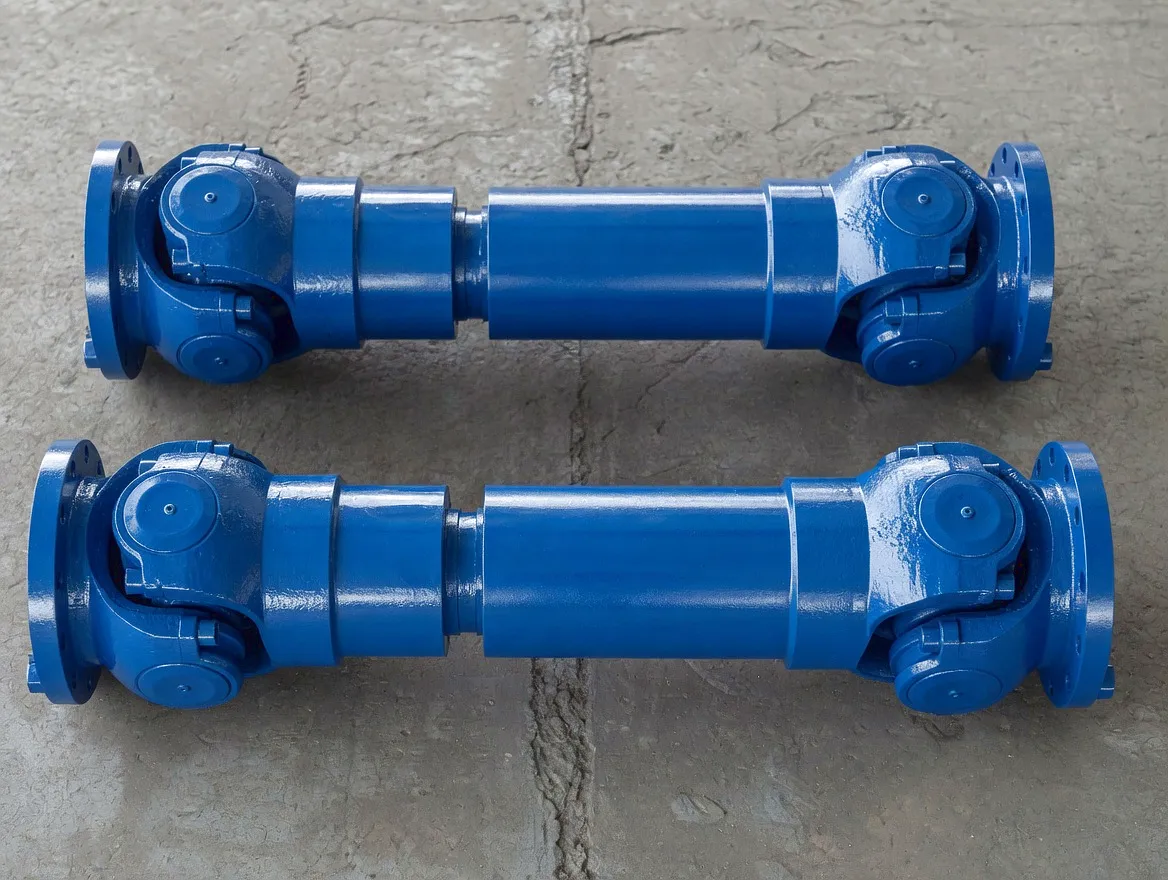
Ever Power heavy-duty cardan coupling assembly — designed for continuous outdoor service in solar tracking drive trains
What Is a Cardan Coupling and Why Does CSP Engineering Demand It?
A cardan coupling — also called a universal joint coupling, Hooke’s joint coupling, or cardan shaft — is a mechanical device that transmits rotary motion between two shafts whose centrelines are not co-axial and may not remain in a fixed angular relationship to one another. The classic single-joint universal joint introduces velocity irregularity at any working angle above a few degrees. For precision solar tracking, where the driven output must rotate smoothly and predictably, this is unacceptable. That is why solar CSP applications overwhelmingly use double-cardan configurations: two universal joints phased so that the velocity error of the first joint is precisely cancelled by the second, delivering a constant angular velocity (CAV) output regardless of working angle.
In a parabolic trough plant, each Solar Collector Assembly (SCA) is a rigid structural unit — typically 12 metres long — linked to its neighbours by drive connections that must accommodate the inevitable misalignment caused by differential thermal expansion, foundation settlement, and manufacturing tolerances. The cardan coupling does this without inducing any side load on the bearing housings of either the driving or the driven shaft. In a dish/Stirling system, the geometry is even more demanding: as the dish tilts from horizon to zenith, the elevation drive shaft changes its angle relative to the fixed motor frame continuously from 0° to 90°, and must do so under the full torque required to hold and move a dish assembly that may weigh over a tonne.
Parabolic Trough CSP: The Inter-SCA Drive Challenge
A typical large parabolic trough CSP plant uses solar collector assemblies arranged in loops, with each loop containing multiple SCAs linked end-to-end. The entire loop rotates around a horizontal north-south axis to track the sun from east to west throughout the day. The central drive station — usually a hydraulic motor or servo motor — provides the motive force, and this torque must be distributed evenly along a collector row that might extend 400 metres or more. Each inter-SCA connection point is a cardan coupling node.
The engineering tolerances here are severe. The tracking accuracy specification for modern parabolic trough plants is typically better than 0.1° — if the focal line deviates by more than this, the concentrated flux misses the receiver tube, heat transfer fluid temperature drops, and the plant’s thermal efficiency falls sharply. At the same time, a 100-metre collector row experiences approximately ±30 mm of axial thermal displacement over its daily and seasonal temperature cycle, and angular misalignment between adjacent SCAs of up to ±0.3° is considered normal due to differential heating across the structural frame.
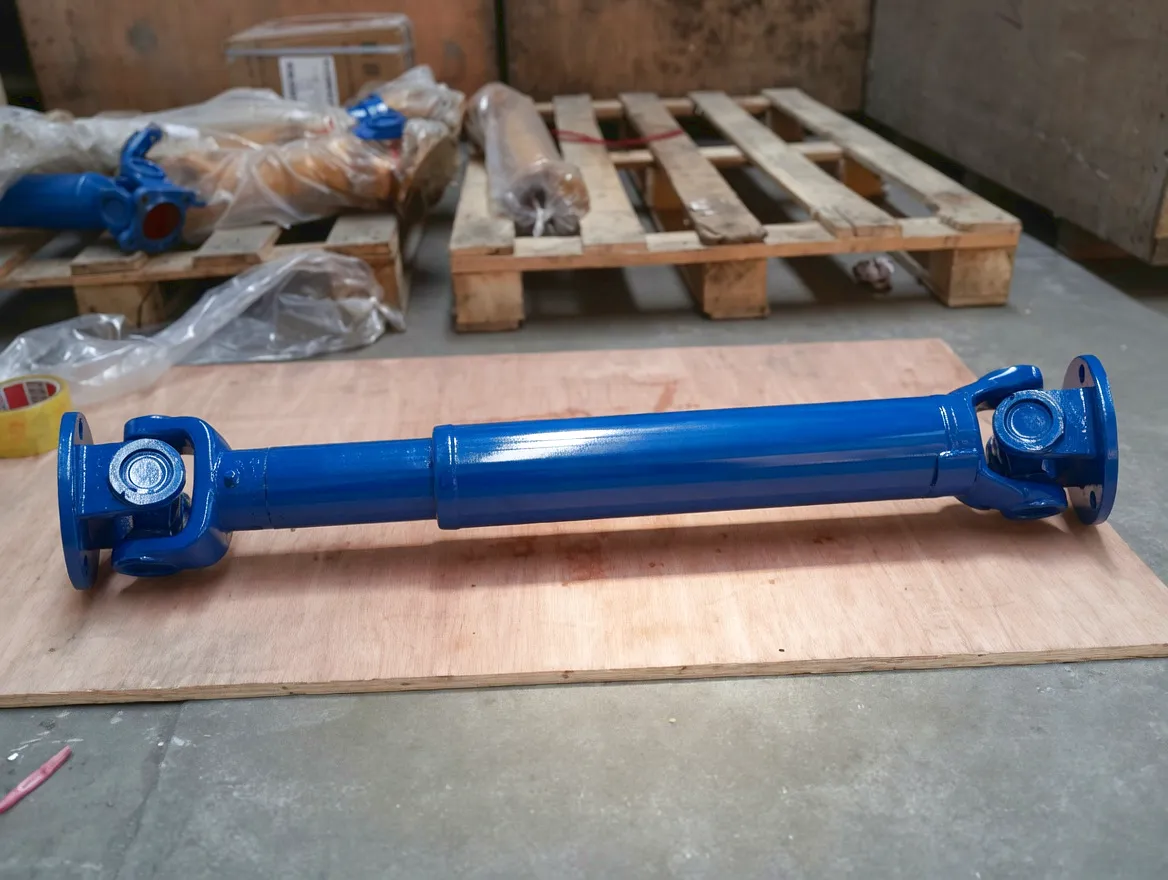
The cardan coupling connecting adjacent SCAs must therefore do three things simultaneously: transmit the drive torque without slip or backlash, accommodate the axial displacement without transmitting it as a compressive or tensile force into the SCA bearings, and allow the angular misalignment without transmitting it as a bending moment into either SCA’s structural spine. A well-specified telescoping double-cardan shaft with splined intermediate tube handles all three requirements in a single compact assembly. The splined tube provides the axial degree of freedom; the two universal joints handle the angular offset; and because the joints are correctly phased, the output rotation is smooth and constant.
Dish/Stirling Systems: High-Angle Double-Cardan for Elevation Drive
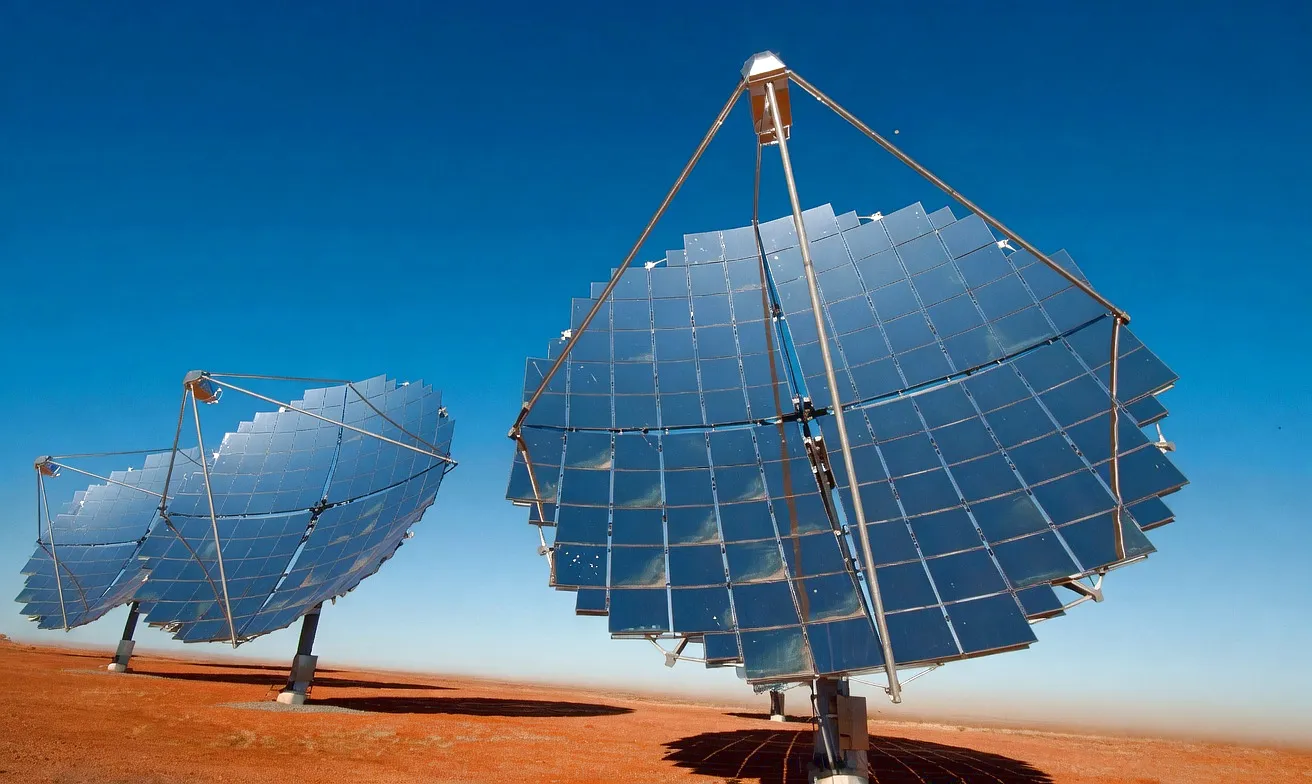
 The dish/Stirling concentrating solar system presents the most geometrically complex drive scenario in the CSP family. Unlike a parabolic trough that rotates around a single horizontal axis, a dish system must continuously position a large parabolic reflector — typically 10 to 25 metres in diameter — in two axes simultaneously. The azimuth axis rotates the entire assembly like a compass needle, while the elevation axis tilts the dish upward from the horizon as the sun climbs through its arc. The Stirling engine or photovoltaic receiver sits at the focal point of the dish, always pointing directly at the sun.
The elevation drive motor is fixed to the support structure. As the dish tilts, the shaft connecting that motor to the elevation gearbox changes its angle relative to the fixed motor frame — continuously, smoothly, through a full range of 0° to 90° and back. No rigid coupling can accommodate this. A single universal joint would introduce a severe velocity ripple at high working angles. The solution adopted by advanced dish/Stirling system designers is the double-cardan constant-velocity joint in its widest working-angle configuration, with a maximum design angle of 45° per joint for a total assembly capability of up to 90°.
At large dish diameters, the elevation drive torque requirement can exceed 8,000 N·m, making the cardan coupling’s ability to transmit high torque at high working angles — without generating bending loads on motor or gearbox shafts — commercially essential. The needle-roller cross-kits used in heavy-duty ever power cardan couplings are individually ground and matched to tight tolerance pairs, ensuring that even at maximum working angle, the joint friction and wear rate remain within the design life envelope for a 25-year plant lifecycle.
Technical Performance Parameters: Ever Power CSP Cardan Couplings
The table below summarises the key performance data for Ever Power’s main cardan coupling series as configured for solar CSP tracker drive applications. All figures represent standard catalogue options; custom specifications are available on request through our UK engineering office.
| Parameter | Light-Duty SCA Link (SWC Series) | Medium-Duty SCA / Elevation (WS Series) | Heavy-Duty Dish/Stirling (WSD Series) |
|---|---|---|---|
| Nominal Torque (Tn) | 250 – 800 N·m | 800 – 3,200 N·m | 3,200 – 12,500 N·m |
| Peak Torque (Tmax) | 1.6 × Tn | 1.6 × Tn | 1.6 × Tn |
| Max. Working Angle (per joint) | 25° | 35° | 45° |
| Total Assembly Angle | Up to 50° | Up to 70° | Up to 90° |
| Axial Compensation (telescoping) | ±35 mm | ±60 mm | ±80 mm |
| Operating Speed (max.) | 1,500 rpm | 1,000 rpm | 600 rpm |
| Bearing Type | Sealed needle roller | Sealed needle roller | Ground needle roller (matched pairs) |
| Cross-Kit Material | 20CrMnTi carburised | 42CrMo4 hardened | 42CrMo4 / EN30B forged |
| Surface Protection | Zinc phosphate + paint | Hot-dip galvanised option | Epoxy powder coat / HDG |
| Sealing Rating | IP54 | IP65 | IP65 (boot + face seal) |
| Design Life (solar environment) | 15 years | 20 years | 25 years |
* Custom torque ranges, shaft bore sizes, flange patterns and coating specifications available. Contact our engineering team for a full technical datasheet.
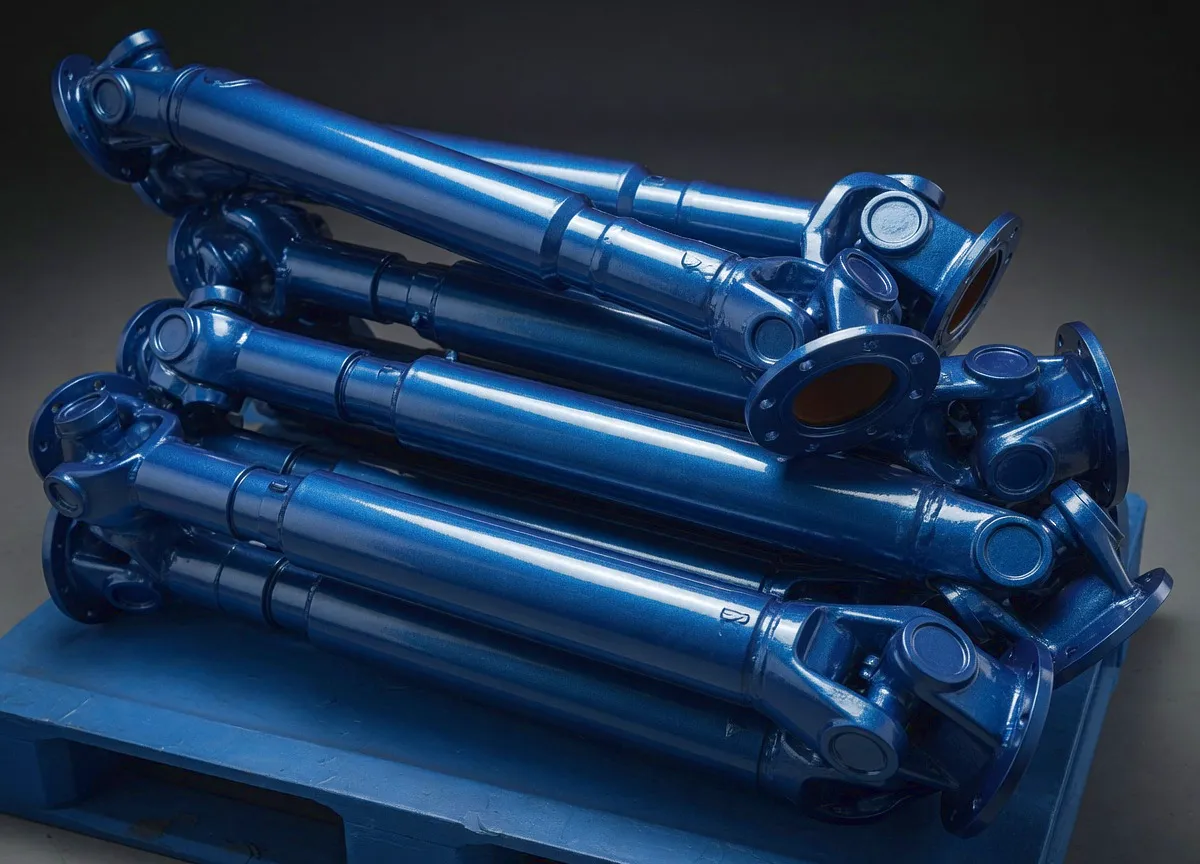
Ever Power Cardan Coupling Product Range
Materials, Construction and Surface Treatment for Outdoor Solar Service
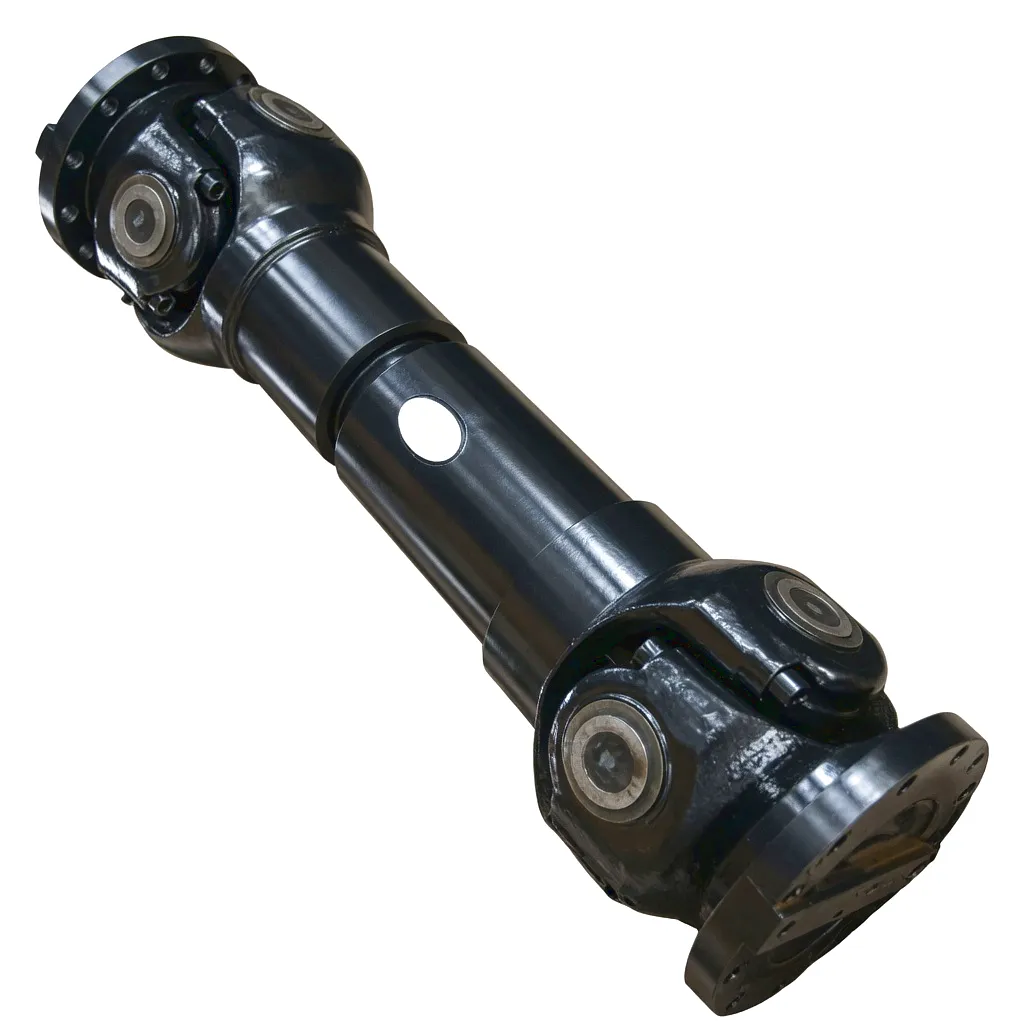 The solar field environment is uniquely hostile to mechanical components. In a Moroccan or Middle Eastern CSP plant, ambient temperatures range from near freezing on winter nights to above 50°C on summer afternoons. In a UK-based or northern European demonstration installation, the challenges shift toward sustained moisture, salt-laden coastal air, and freeze-thaw cycling. Ever Power designs its solar-grade cardan couplings to address both extremes through a combination of material selection, heat treatment, sealing architecture, and surface protection.
The spider (cross-kit) — the central load-bearing element of every universal joint — is manufactured from 42CrMo4 alloy steel for medium and heavy-duty applications. This material, also designated as EN 1.7225 under British Standards, is through-hardened and tempered to achieve surface hardness in the range of 58–62 HRC at the journal bearing surfaces, combined with a tough core that resists impact loading during stall events. For the lightest SCA inter-drive applications, 20CrMnTi case-carburised steel is used, providing excellent fatigue resistance at lower cost. The yoke bodies are forged — not cast — from the same alloy families, and machined to tight dimensional tolerances on CNC equipment: bore concentricity within 0.015 mm, face perpendicularity within 0.02 mm per 100 mm of diameter.
Why CSP Engineers Specify Ever Power Cardan Couplings
Seven tangible engineering advantages — each one validated in live project deployments.

Application Scenarios: Where Cardan Couplings Are Deployed in CSP Plants
The cardan coupling’s application within a CSP solar field is not limited to a single drive point. Engineering practice has identified at least four distinct connection nodes within a typical parabolic trough plant and two in a dish/Stirling system where the cardan coupling delivers demonstrable advantages over alternative coupling types.
→ WS or SWC telescoping double-cardan▶ Drive station to loop, trough
→ WS fixed-length double-cardan▶ Elevation axis, dish/Stirling
→ WSD high-angle double-cardan▶ Azimuth axis, dish (low angle)
→ WS series or rigid flange coupling
Customer Success: How a Leading UK EPC Contractor Solved a Persistent Drive Train Failure Problem
Background: A UK-registered engineering contractor managing a 50 MW parabolic trough CSP refurbishment project in southern Spain was experiencing recurring inter-SCA drive coupling failures on a plant that had been in operation since 2012. The original coupling specification — a proprietary flexible disc coupling that was no longer available from the original manufacturer — was failing at a rate of approximately 18 units per year, causing unplanned O&M downtime that the plant’s offtake agreement penalised heavily. Each failure required a two-man team and a half-day of work to replace, plus the coupling itself.
Engineering Analysis: The Ever Power application engineering team reviewed the failure data and identified that the disc couplings were failing in fatigue in the disc pack, driven by a combination of angular misalignment that had increased as the plant foundations settled over 12 years, and axial displacement from thermal cycling that the original coupling was not designed to handle simultaneously at that magnitude. The solution was a direct-fit replacement using Ever Power’s WS-series telescoping double-cardan coupling, machined to match the existing flange bolt circles and shaft bores. The new coupling’s needle-roller cross-kit design eliminated the fatigue failure mode, and its ±60 mm axial travel absorbed the thermal displacement that had previously loaded the disc pack.
Results: A phased replacement programme replaced all 480 inter-SCA couplings over two winter maintenance outages. In the 18 months following completion, the coupling failure rate dropped to zero. The client’s O&M team reported an annual saving of approximately £86,000 in replacement parts and labour costs, and an estimated additional £140,000 per year in recovered generation revenue from reduced downtime. The project has since been referenced as an industry case study in the UK Solar Trade Association’s guidance on CSP maintenance best practice.
What Our Clients Say
We’ve used Ever Power cardan couplings on three CSP retrofit projects now. The level of engineering support — the willingness to review our existing drawings and propose a drop-in replacement rather than just ship a catalogue item — is genuinely unusual in this market. The couplings themselves have been completely problem-free.
Our dish/Stirling prototype had an elevation drive that was causing vibration at high tilt angles — something we’d been unable to resolve with three previous coupling suppliers. Ever Power’s WSD high-angle double-cardan resolved it immediately. The velocity output was measurably smoother at all angles, and we haven’t had a tracking anomaly attributable to the drive train since.
Lead time and documentation were the deciding factors for us. We needed UKCA-compliant documentation and a 4-week delivery on 240 custom cardan shafts with non-standard bore sizes. Ever Power delivered in 5 weeks with a full 3.1 material pack. The procurement team will definitely use them again.
Manufacturing Capabilities and Custom Engineering Services
Ever Power operates a dedicated manufacturing facility equipped with CNC turning centres, CNC machining centres, coordinate measuring machines (CMM), and hardness testing equipment. Every cardan coupling cross-kit is inspected to drawing dimensions before assembly, and every completed assembly is torque-tested before despatch. The production quality system is certified to ISO 9001:2015, and the facility holds capability approvals for the defence and aerospace supply chains — a level of process discipline that carries directly into the quality standards applied to solar CSP components.
The custom engineering capability is where Ever Power genuinely differentiates itself from catalogue distributors. The engineering team works directly with CSP developers, EPC contractors, and maintenance operators to specify cardan couplings that are a true engineered solution rather than a compromise with a standard product. Typical customisation requests include: non-standard shaft bores from 20 mm to 280 mm diameter; keyway and spline profiles to DIN, BS, or customer-specific standards; flange bolt circles from 4-bolt to 12-bolt in any PCD; custom overall lengths including non-standard telescoping stroke lengths; surface coatings beyond the standard range, including Xylan PTFE-blend dry-film lubricant for desert environments; and integrated vibration damping elements for particularly resonant drive train configurations. Minimum order quantities for custom work are discussed case by case — for CSP projects, a single prototype evaluation quantity is readily accommodated.
✅ Torque range: 50–50,000 N·m
✅ Working angle: up to 90° (double-cardan)
✅ Telescoping stroke: 20–200 mm
✅ Flange PCD: any (4-bolt to 12-bolt)
✅ Keyway: DIN / BS / customer spec
✅ Coating: paint / HDG / PTFE / anodised
✅ Sealing: IP54 / IP65 / IP67 optional
✅ Cert.: EN 10204 3.1 / CE / UKCA
✅ Delivery: 4–8 weeks from drawing approval
Serving the UK and European Solar Energy Industry
UK and European CSP developers, EPC contractors, and O&M service providers need cardan coupling suppliers who understand the procurement and documentation requirements of European renewable energy projects — not just the mechanical engineering. UKCA and CE marking, third-party inspection options, COSHH data sheets for lubricants, and compliance with the UK’s supply chain due diligence requirements are all standard parts of the Ever Power documentation package.
We supply cardan couplings to UK-based solar projects and EPC teams managing projects across Spain, Morocco, the Middle East, South Africa, and Australia. For UK buyers, DDP (Delivered Duty Paid) shipping eliminates customs complexity, and all invoices are in GBP with UK VAT applied where appropriate. Technical telephone support is available during UK business hours, and site visits by application engineers to UK project locations can be arranged for complex or large-volume requirements. We work regularly with procurement teams in London, Bristol, Birmingham, and Edinburgh, and with engineering offices across the UK’s growing renewable energy cluster.
Frequently Asked Questions
Questions answered by our application engineering team
Ready to Solve Your CSP Drive Train Challenge?
Send us your project specifications — torque, angle, bore, environment — and receive a detailed engineering proposal and price within 24 hours. Ever Power: the cardan coupling specialists trusted by UK and European CSP developers.
✉ Get a Quote — [email protected]
Ever Power • Cardan Coupling Specialists • Supplying UK and European Renewable Energy Projects • ISO 9001:2015 Certified
edit by gzl