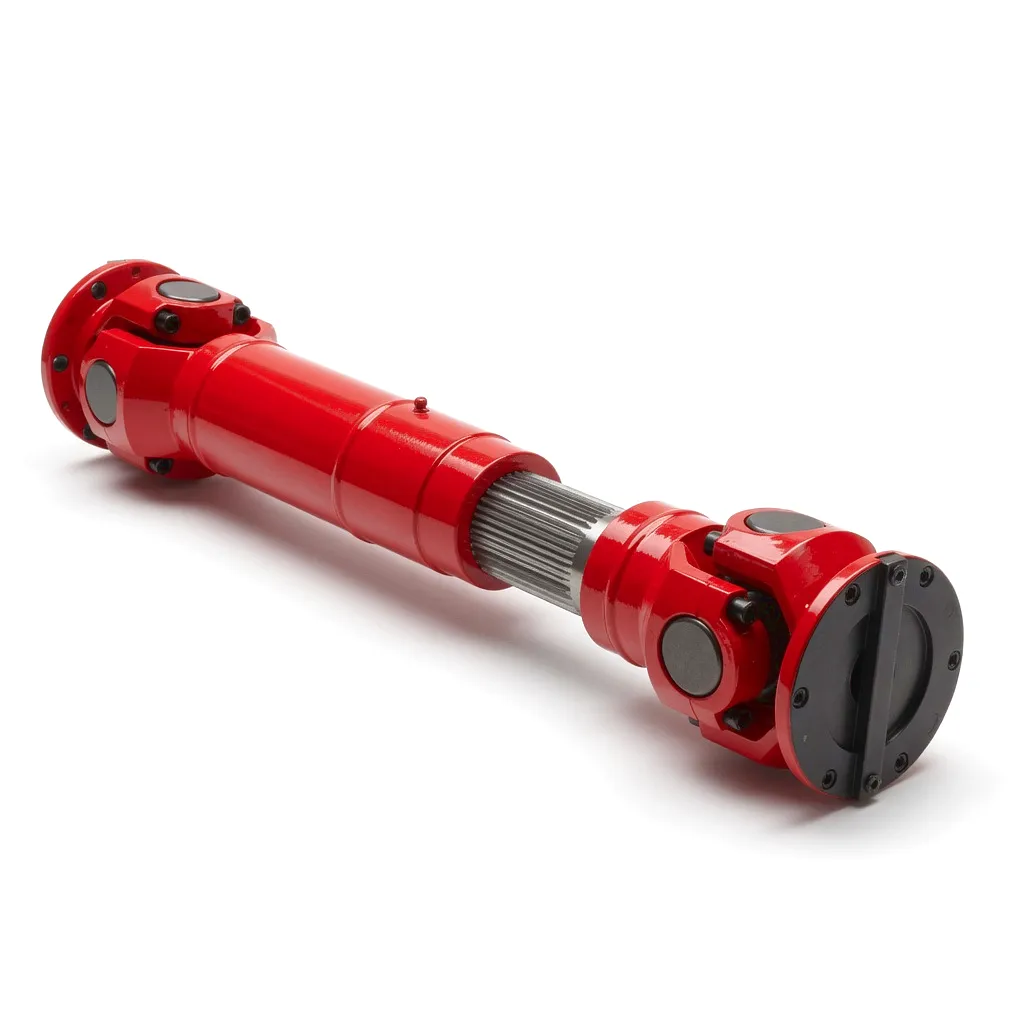
 Every vessel that sails from Southampton, Aberdeen, or the Clyde relies on one mechanical truth: the engine must transfer rotational power to the propeller with near-perfect reliability, regardless of what the sea throws at the hull. Waves flex the keel. Thermal cycles shift alignment between the gearbox output flange and the propeller shaft. Torsional vibrations from diesel or gas-turbine prime movers pulse through the drivetrain at frequencies that can fatigue conventional rigid joints in a matter of months. A cardan coupling — specifically a marine-grade telescopic cardan shaft fitted with a multi-layer corrosion-resistant coating — absorbs every one of those variables while transmitting torques that routinely exceed 50,000 Nm on medium-displacement commercial hulls. For UK shipyards building fishing trawlers on the Scottish coast or refit yards upgrading passenger ferries in Belfast, this is not optional equipment; it is the structural link between propulsion intent and propulsion reality.
This article explores the engineering rationale, material science, selection criteria, and real-world performance data behind cardan coupling technology purpose-built for marine propulsion. We draw on nearly two decades of application engineering across hundreds of vessel installations, from 12-metre inshore patrol boats to 90-metre bulk carriers, to give you the kind of detail that specification sheets alone cannot provide.
Why Marine Propulsion Systems Demand Cardan Couplings
A ship’s drivetrain is nothing like a stationary industrial line. On land, a pump or conveyor sits on a concrete plinth that rarely moves. At sea, the entire foundation — the hull itself — is a living, breathing structure. Wave-induced hogging and sagging can shift the centreline of an engine bed relative to the stern tube bearing by several millimetres during heavy weather. Add to that the thermal expansion of a steel hull exposed to equatorial sun on one voyage and North Atlantic sleet on the next, and you begin to understand why rigid flange couplings crack, why rubber-bush couplings degrade, and why classification societies such as Lloyd’s Register and the American Bureau of Shipping (ABS) increasingly accept or recommend cardan-type universal joints for propulsion shaft applications.
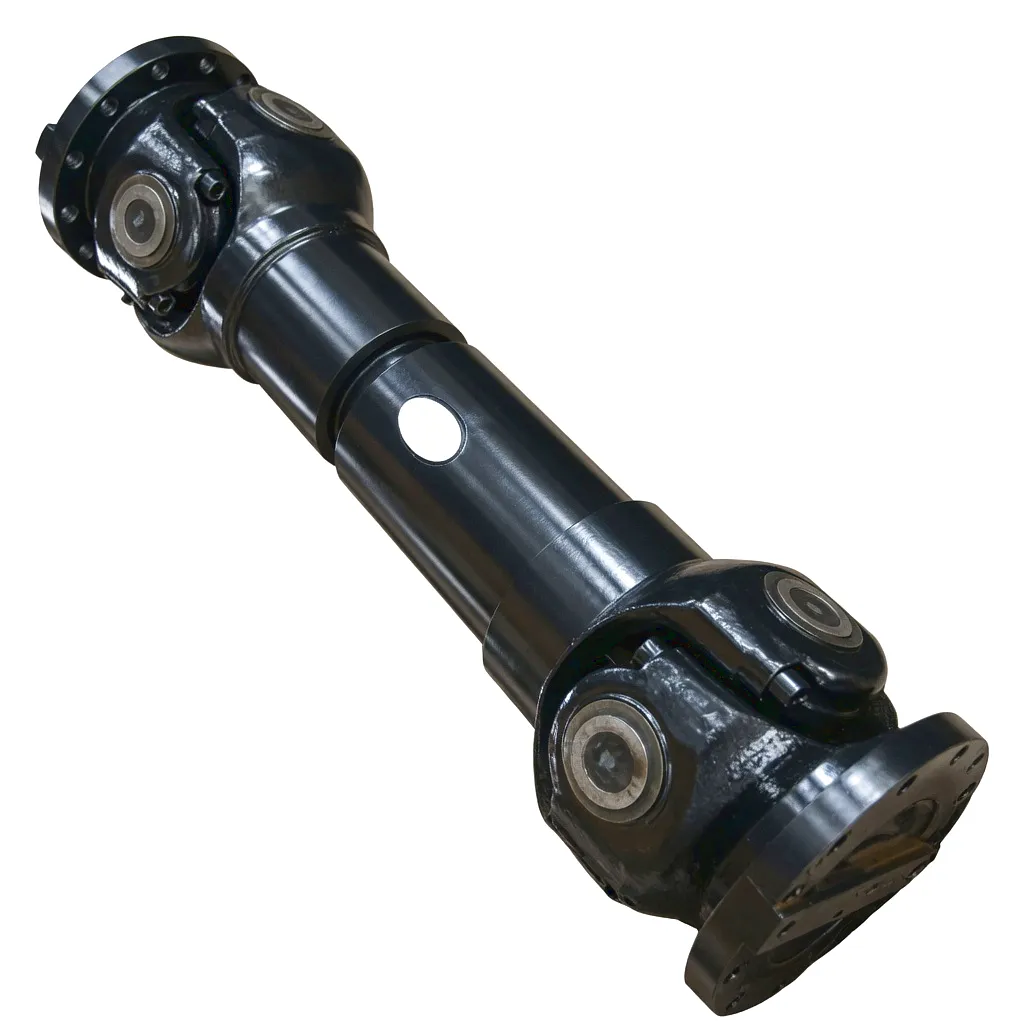
A cardan coupling operates on the principle of two yokes connected by a cross-shaped journal bearing — the universal joint geometry first formalised by Gerolamo Cardano in the sixteenth century. In its modern marine-grade incarnation, this mechanism is extended with a telescopic splined section that permits axial displacement alongside angular misalignment. The result is a single component that simultaneously handles three degrees of freedom: angular offset (typically ±2° to ±8° depending on shaft speed), axial plunge (up to 80 mm on larger shafts), and torsional transmission (rated torques from 5,000 Nm to well over 200,000 Nm for heavy-displacement vessels). No other coupling topology offers this combination within a compact, maintenance-friendly envelope that mounts directly between the gearbox output flange and the intermediate or tail shaft.

Operating Principle: How a Marine Cardan Coupling Transfers Power
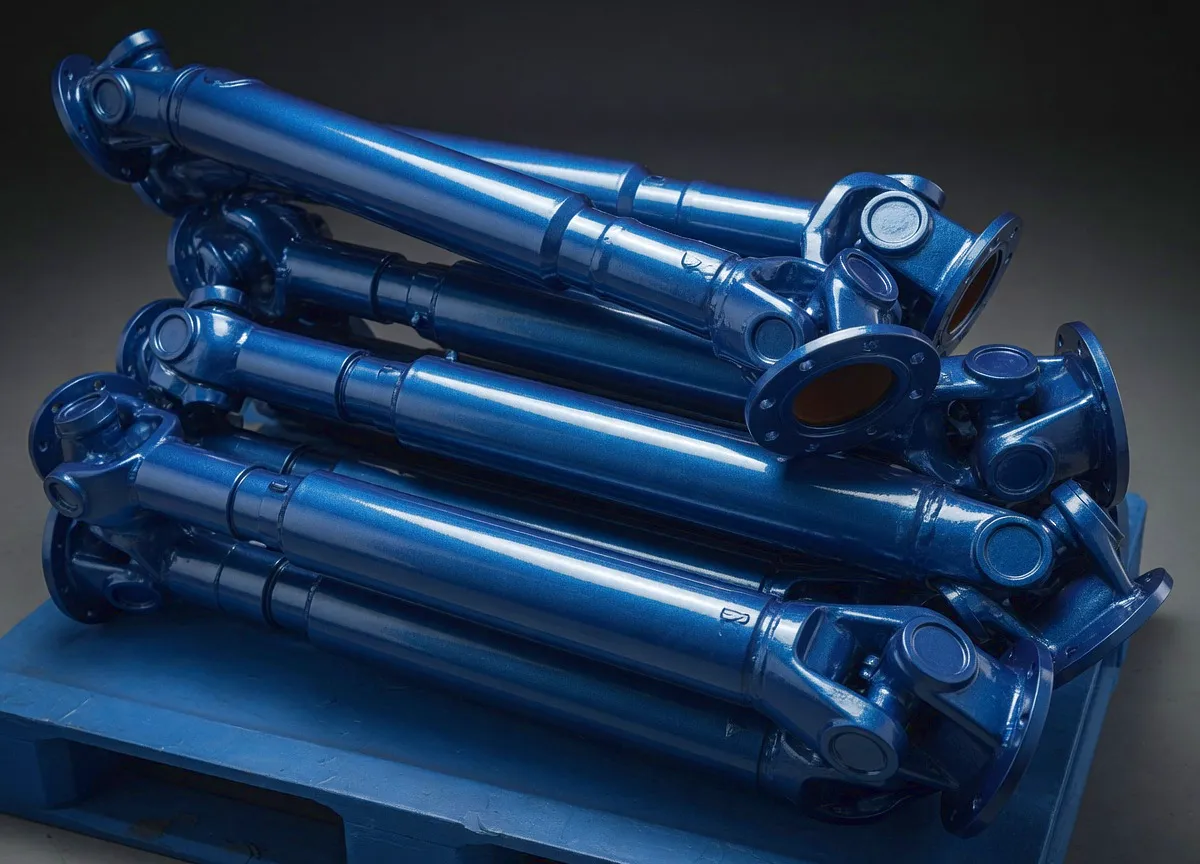 At the heart of every cardan coupling sits the cross journal — four precision-ground trunnions pressed into needle-roller or cylindrical-roller bearing cups. When the input yoke rotates, the cross journal transmits that rotation to the output yoke even when the two yokes sit at an angle to one another. Because a single universal joint introduces a cyclic velocity variation proportional to the tangent of the operating angle, marine installations frequently use a double-cardan (also called a constant-velocity cardan) arrangement that pairs two joints phased 90° apart on a centre yoke. This cancels the second-order harmonic and delivers near-constant output velocity — critical on propeller shafts where speed fluctuations translate directly into cavitation, noise, and accelerated blade erosion.
The telescopic section uses an involute-spline profile machined from case-hardened alloy steel, typically 20CrMnTi or 42CrMo4 depending on the torque class. A PTFE-composite liner between the male and female spline surfaces provides dry-film lubrication that remains effective even when the grease nipple is inaccessible during extended sea passages. This means the shaft can plunge axially under hull deflection without metal-on-metal galling — a failure mode that would seize a conventional spline joint within a few hundred operating hours in a wet bilge environment. The entire assembly is then finished with a duplex coating system: a zinc-rich primer over grit-blasted steel, followed by a high-build marine epoxy, and topped with a polyurethane topcoat rated to ISO 12944 C5-M for offshore and marine immersion zones. Some operators in particularly aggressive environments, like the sulphur-heavy waters around certain North Sea oil installations, specify an additional thermally-sprayed aluminium (TSA) interlayer for cathodic protection.
Technical Specifications: Marine Cardan Coupling Range
The table below summarises the key performance parameters across Ever Power’s marine cardan coupling portfolio. Each series is available with optional ABS, Lloyd’s Register (LR), Bureau Veritas (BV), or DNV type-approval certification, which dramatically accelerates vessel classification surveys for UK-based shipbuilders and refit yards.
| Parameter | EP-MC 100 | EP-MC 250 | EP-MC 500 | EP-MC 800 |
|---|---|---|---|---|
| Rated Torque (Nm) | 10,000 | 25,000 | 55,000 | 120,000 |
| Peak Torque (Nm) | 15,000 | 37,500 | 82,500 | 180,000 |
| Max Angular Misalignment | ±4° | ±6° | ±6° | ±8° |
| Axial Plunge (mm) | 30 | 50 | 65 | 80 |
| Max Speed (RPM) | 3,000 | 2,200 | 1,800 | 1,200 |
| Shaft Diameter Range (mm) | 60–100 | 100–160 | 160–250 | 250–400 |
| Coating System | ISO 12944 C4 | ISO 12944 C5-M | ISO 12944 C5-M | C5-M + TSA |
| Weight (kg) | 38 | 95 | 210 | 480 |
| Classification Options | ABS / LR | ABS / LR / BV | ABS / LR / BV / DNV | ABS / LR / BV / DNV |
Materials and Corrosion Engineering for Saltwater Service
Material selection separates a cardan coupling that lasts eight years in the engine room of a North Sea supply vessel from one that fails after eighteen months. The yoke forgings on Ever Power’s marine range are produced from 42CrMo4 (EN 10083-3), vacuum-degassed and normalised to achieve a minimum yield strength of 750 MPa while retaining impact toughness above 27 J at –20 °C. That low-temperature requirement is not arbitrary — it reflects the real operating conditions inside unheated machinery spaces on vessels trading between the Shetland Islands and Norwegian waters during winter months. The cross journals are induction-hardened to 58–62 HRC on the trunnion surfaces, with a case depth of 1.2 mm minimum, ensuring the needle rollers track on a surface hard enough to resist brinelling under shock loads generated by sudden throttle changes or propeller blade strikes against debris.
Sealing is arguably more important than metallurgy in a marine cardan coupling. Every bearing cup is fitted with a triple-lip seal arrangement: the inner lip retains grease, the middle lip acts as a labyrinth excluder, and the outer lip faces seawater spray. The seal material is hydrogenated nitrile rubber (HNBR) rather than standard NBR, providing superior resistance to ozone, saltwater, and the elevated temperatures found near exhaust manifolds in compact engine rooms. For shafts running through partially flooded bilge compartments — common on older vessel conversions — we offer an optional face-seal upgrade with a tungsten-carbide running face that maintains integrity even when submerged intermittently.
Key Advantages of Marine Cardan Couplings
⚙️ Three-Axis Misalignment Absorption
Unlike rigid flange or gear couplings that handle only angular offset, the marine cardan coupling absorbs angular, axial, and parallel misalignment simultaneously. Hull flexion, thermal growth, and mounting tolerance stack-ups are all compensated within a single component, eliminating the need for separate expansion joints or flexible mounts that add weight and maintenance burden to the shaft line.
🔇 Vibration Damping and Noise Reduction
Torsional pulses from the engine are partially isolated by the rolling-element joints, preventing resonance from propagating into the hull structure. For passenger ferries and luxury yachts — where cabin noise levels directly affect commercial viability — this damping effect measurably reduces structure-borne noise by 3 to 6 dB compared to solid or gear-type alternatives, according to comparative vibration surveys conducted on twin-screw vessels.
🛡️ Proven Saltwater Corrosion Resistance
The multi-layer coating system — zinc-rich primer, marine epoxy, polyurethane topcoat, and optional TSA layer — is tested to ISO 12944 C5-M, the most demanding category for marine and offshore environments. In accelerated salt-spray testing (ASTM B117), samples achieved over 4,000 hours without coating breakdown, equivalent to roughly 10 years of service in a bilge or engine-room environment with periodic seawater ingress.
📋 Classification Society Approval
Holding type-approval certificates from ABS, Lloyd’s Register, Bureau Veritas, and DNV means that specifying an Ever Power marine cardan coupling does not add weeks of survey delay to a new-build programme. The classification society surveyor can verify the coupling against an existing certificate rather than requiring a bespoke design appraisal — a practical benefit that shipyards in Glasgow, Plymouth, and Tyneside appreciate when build schedules are tight.
Application Scenarios Across the UK Maritime Sector
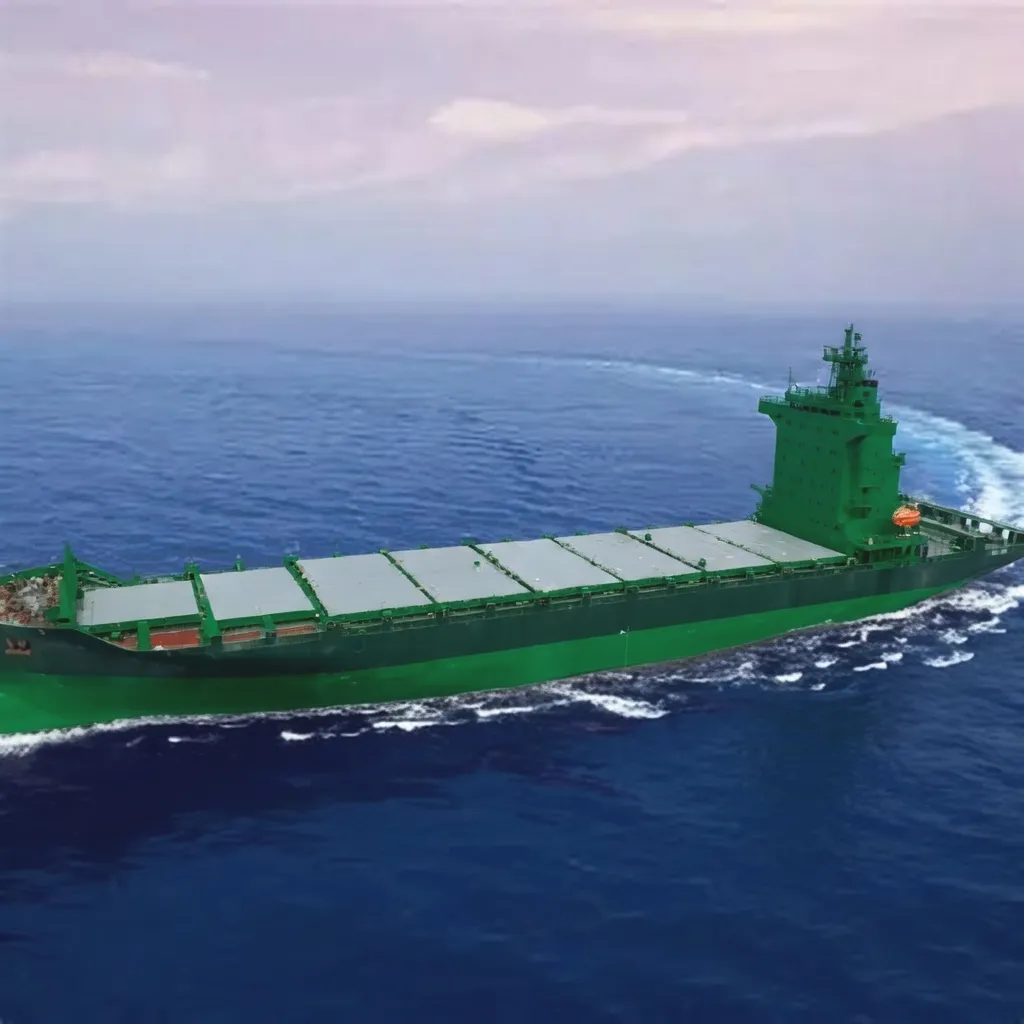
The versatility of a marine-grade cardan coupling makes it suitable for virtually every propulsion layout found in UK waters. Below are the scenarios where this technology delivers its greatest return on investment.
Commercial Fishing Trawlers — North Sea and Irish Sea
A typical stern trawler operating out of Peterhead or Fleetwood runs its main engine at varying loads — full ahead when steaming to the grounds, slow ahead or astern when shooting and hauling nets. These transient load cycles generate torsional shock that hammers conventional couplings. The cardan coupling’s needle-roller bearings distribute these loads across a larger contact area than plain-bushing alternatives, extending service life between overhauls. Fishermen also value the compact length; engine rooms on trawlers are notoriously cramped, and every millimetre saved on shaft-line length is a millimetre gained for fish-hold capacity or crew accommodation.
Passenger Ferries — English Channel, Solent, and Scottish Isles
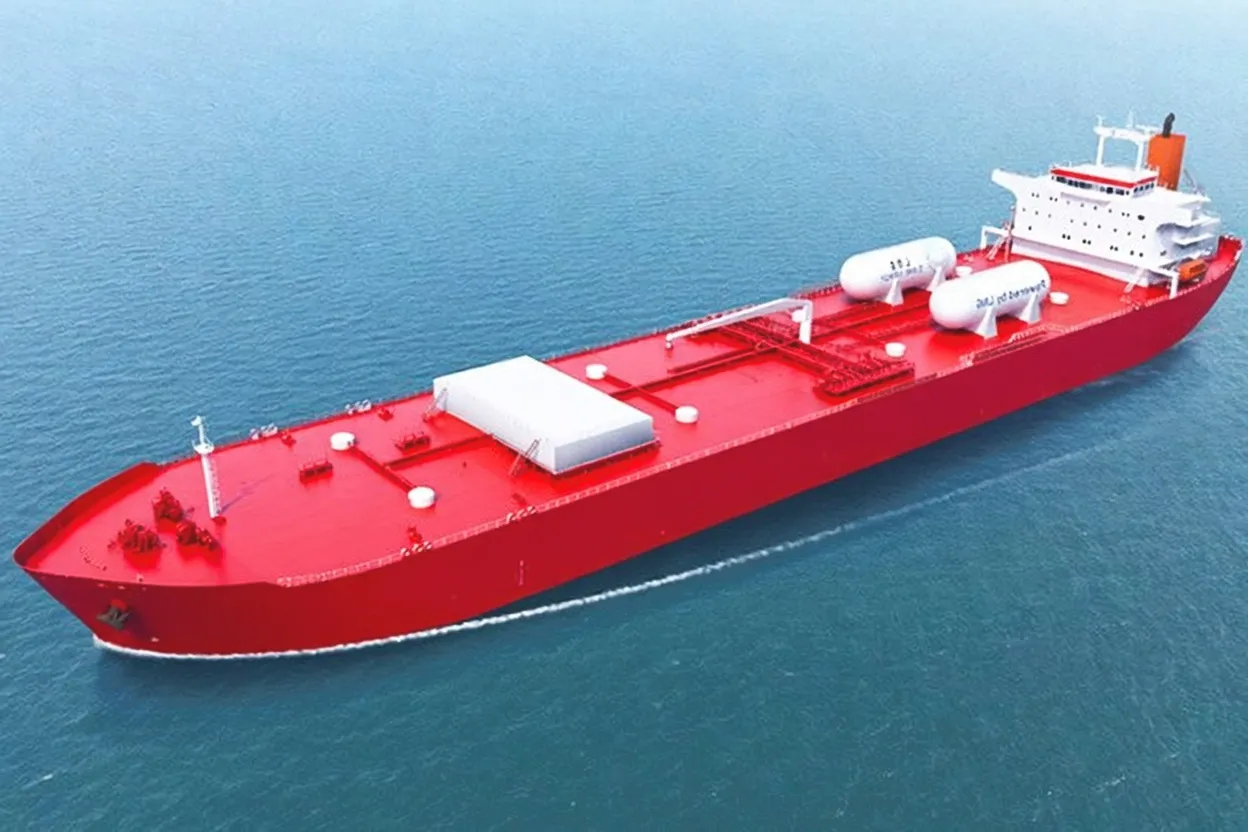
Passenger comfort is a revenue driver for ferry operators. Structure-borne vibration from the propulsion train transmits through the hull and into cabin floors, seats, and dining areas. By decoupling the engine from the shaft line with a cardan coupling, operators report measurable improvements in onboard noise-vibration-harshness (NVH) scores. A double-cardan configuration on the main shaft of a Solent-class vehicle ferry reduced measured vibration amplitudes at the first-blade-pass frequency by 38% compared to the previous rigid-coupling arrangement, according to trials documented by the operator’s chief engineer.
Luxury Motor Yachts — South Coast and Mediterranean Delivery
Yacht builders around the Hamble and Lymington corridors demand components that marry engineering rigour with aesthetic finish. Exposed shafts in open engine bays need to look as good as they perform. Ever Power’s marine cardan couplings are available with a polished stainless-steel shroud over the telescopic section, protecting the spline from bilge contamination while presenting a showroom-quality appearance during sea trials and owner handovers. The vibration-isolation properties also protect sensitive electronics — navigation instruments, entertainment systems, and stabiliser control units — from drivetrain-induced electrical noise.
Offshore Support Vessels — North Sea Energy Sector
Platform supply vessels (PSVs) and anchor-handling tugs (AHTs) operate with dynamic positioning systems that place extreme demands on shaft-line components. Constant speed and direction changes, combined with the high bollard-pull torques during anchor handling, require a cardan coupling rated for sustained peak-torque operation rather than just intermittent overload. The EP-MC 800, with its 180,000 Nm peak torque capacity and ±8° angular misalignment range, is engineered specifically for these punishing duty cycles. The thermally-sprayed aluminium coating option provides additional corrosion defence in the splash zone, where offshore structures are most vulnerable.
Customer Success Stories
Real-world results from UK and European maritime operators
Featured Case Study
North Sea Supply Vessel Fleet Upgrade — Aberdeen, Scotland
A leading offshore logistics company based in Aberdeen operated a fleet of eight platform supply vessels servicing oil and gas installations in the UK Continental Shelf. Their existing gear-type couplings were failing every 14 to 18 months, primarily due to tooth-surface pitting accelerated by misalignment drift as the vessels’ hulls aged. Each coupling failure cost approximately £22,000 in replacement parts, drydock time, and lost charter revenue — amounting to over £140,000 per year across the fleet.
The company’s technical superintendent contacted Ever Power in late 2023 to evaluate marine cardan couplings as a replacement. Following a shaft-alignment survey and torsional vibration analysis (TVA) on the lead vessel, our engineering team specified the EP-MC 500 with C5-M coating and LR type-approval. The installation was carried out during a scheduled drydocking at a Tyneside repair yard, requiring only minor modifications to the gearbox output flange — the coupling’s modular hub design accepted the existing bolt-hole pattern.
Results after 18 months of continuous operation: zero unscheduled coupling-related maintenance events across all eight vessels. Vibration readings at the stern-tube bearing dropped by 28%, and crew feedback noted a perceptible reduction in engine-room noise during full-power transits. The fleet operator estimated cumulative savings of over £180,000 in the first year alone, factoring in avoided drydock visits and extended bearing-replacement intervals. The technical superintendent approved a roll-out of EP-MC 500 units to the company’s three newbuild vessels currently under construction at a Polish shipyard.
“We retrofitted EP-MC 250 cardan couplings to both shafts on our 28-metre passenger catamaran operating Solent crossings. Engine-room noise dropped noticeably, and our maintenance engineer hasn’t touched the couplings in over two years. Passengers have actually commented that the ride feels smoother — that’s an endorsement you can’t buy.”
— James Hartley, Fleet Operations Manager, Solent Marine Transport, Southampton
“Our yard builds custom fishing vessels for the Scottish fleet. The Ever Power team provided a complete torsional analysis and recommended the EP-MC 100 within 48 hours of receiving our shaft drawings. The coupling arrived with Lloyd’s Register paperwork already in order — that saved us at least ten days on the classification schedule.”
— Ewan MacLeod, Chief Naval Architect, Highland Marine Engineering, Inverness
“We operate a fleet of harbour tugs in the Port of Liverpool. The constant start-stop-reverse cycles were destroying our old flexible couplings every eight months. Since switching to Ever Power’s marine cardan coupling three years ago, we have replaced precisely zero units. The cost-per-hour of the drivetrain has essentially halved.”
— Patrick Donnelly, Engineering Director, Mersey Harbour Towage Ltd, Liverpool
Selecting the Right Marine Cardan Coupling: Engineering Considerations
 Choosing a cardan coupling for a ship propulsion shaft is not a catalogue exercise — it requires a system-level approach that accounts for the entire drivetrain, from the engine flywheel to the propeller hub. The rated torque of the coupling must exceed the maximum continuous rating (MCR) of the engine by a service factor that reflects the vessel’s operating profile. For a steady-running cargo ship, a service factor of 1.5 may suffice; for a harbour tug with frequent reversals and shock loading, 2.0 or higher is appropriate. Ever Power’s application engineers work from the vessel’s torsional vibration analysis — or produce one in-house if none exists — to identify critical speeds and confirm that the coupling’s stiffness characteristics do not introduce new resonance points into the system.
Angular misalignment capacity is the next critical parameter. Static misalignment — the offset that exists when the shaft line is cold and the vessel is floating at an even keel — is typically modest, perhaps 0.5° to 1.5°. But dynamic misalignment during heavy weather can double or triple that figure as the hull flexes. Specifying a coupling with insufficient angular range forces the cross-journal bearings into their endstop condition, dramatically accelerating roller fatigue. We recommend selecting a coupling whose rated angular capacity exceeds the calculated maximum dynamic misalignment by at least 30% as a margin against unknown loading events such as grounding or collision impacts.
Axial plunge must also be carefully matched to hull deflection data. Naval architects typically provide hogging and sagging deflection curves as part of the structural analysis package; these translate directly into the axial displacement envelope that the coupling’s telescopic section must accommodate. On an 80-metre vessel, peak-to-peak axial movement between the engine bed and the stern tube can reach 40 mm in extreme sea states — well within the 65 mm capacity of the EP-MC 500, but beyond the range of many smaller couplings. Under-specifying axial plunge results in bottoming out the spline, which at best introduces a metallic knock audible throughout the hull and at worst strips the involute teeth entirely.
Ever Power: Custom-Engineered Cardan Couplings from Our Manufacturing Base
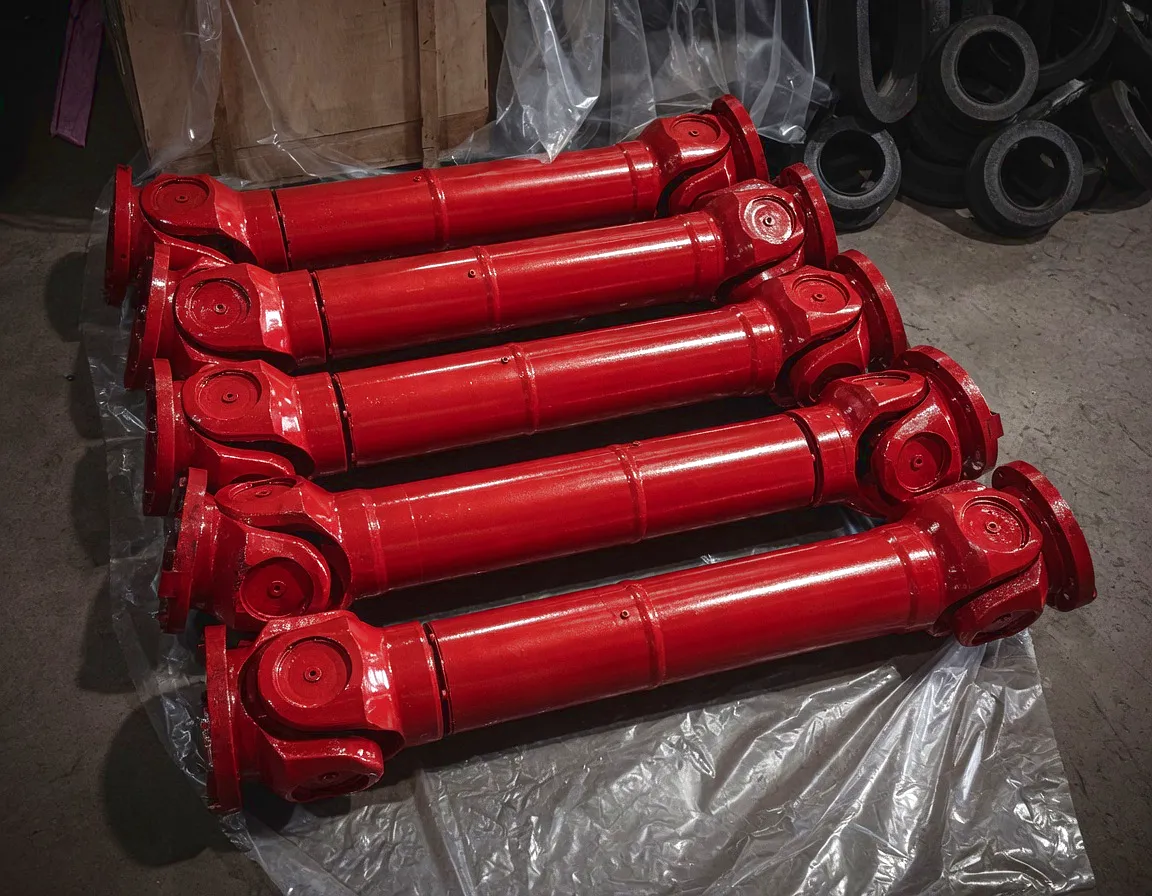
Not every shaft line fits a standard catalogue size, and marine propulsion is one of the sectors where bespoke dimensions are the rule rather than the exception. Ever Power operates a dedicated heavy-machining facility with CNC lathes capable of turning yoke blanks up to 1,200 mm swing diameter and spline-grinding machines accurate to DIN 5480 Class 7. Our in-house heat-treatment furnace handles case-hardening, through-hardening, and stress-relieving processes under controlled atmosphere, ensuring consistent metallurgical properties across production batches. Every marine cardan coupling leaves the factory with a material test certificate (EN 10204 Type 3.1), a dimensional inspection report, and a dynamic balancing certificate to ISO 1940 Grade G6.3 — or G2.5 for high-speed yacht applications.
Our engineering team supports UK customers throughout the specification, design, and commissioning process. Whether you need a drop-in replacement for an obsolete coupling on a 1990s-built hull or a clean-sheet design for a new hybrid-electric propulsion system, we provide full 3D modelling, FEA stress analysis, and torsional-vibration compatibility checks as part of our quotation package — at no additional charge. Delivery to major UK ports including Southampton, Felixstowe, Immingham, and Greenock typically takes four to six weeks from order confirmation for standard marine sizes, with expedited three-week options available for urgent refit schedules.
Installation Best Practices and Ongoing Maintenance
Proper installation is the single biggest factor in determining how long a marine cardan coupling will last. The shaft line should be laser-aligned at the cold-set condition with the vessel afloat at an even trim, using either a bore-sighting telescope or a modern laser alignment system. The target cold offset should incorporate the calculated thermal-growth vector so that alignment converges toward zero when the engine reaches operating temperature. Our installation manual provides vessel-class-specific thermal offset tables derived from finite-element thermal modelling of common engine-bed configurations.
Once installed, maintenance is straightforward. The grease nipples on each bearing cap should be serviced at 500-hour intervals using a marine-grade lithium-complex grease rated to NLGI 2 consistency. A single pump stroke per nipple is sufficient; over-greasing forces grease past the seal lips and attracts abrasive particles. The telescopic spline section should be visually inspected for coating integrity during routine engine-room rounds. Any chips or scratches in the topcoat should be touched up with the supplied repair compound before corrosion can initiate beneath the coating. With these simple measures in place, operators can expect 8,000 to 12,000 hours of continuous service between major overhauls — roughly four to six years on a vessel running 2,000 hours per annum.
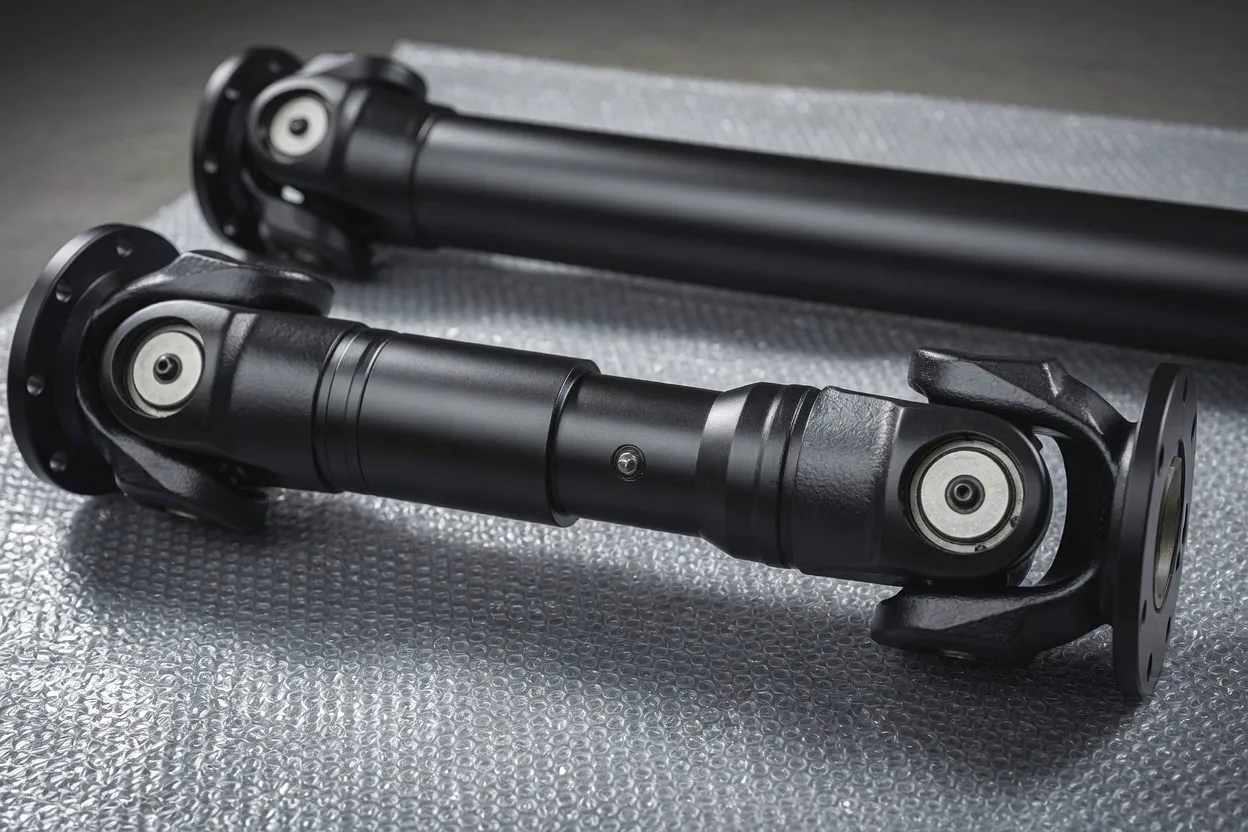
Marine Cardan Coupling vs. Alternative Coupling Types
Understanding how a cardan coupling compares to other commonly specified marine shaft couplings helps clarify why more UK shipyards are moving in this direction.
| Feature | Cardan Coupling | Gear Coupling | Rubber Flexible | Rigid Flange |
|---|---|---|---|---|
| Angular Misalignment | ±2° to ±8° | ±0.5° to ±1.5° | ±1° to ±3° | 0° |
| Axial Plunge | Up to 80 mm | Limited (5–10 mm) | Moderate (10–20 mm) | None |
| Vibration Isolation | Good (3–6 dB) | Poor | Excellent | None |
| Torque Capacity | Very High | Very High | Moderate | Very High |
| Saltwater Durability | Excellent (C5-M) | Moderate | Good | Moderate |
| Maintenance Interval | 8,000–12,000 hrs | 3,000–5,000 hrs | 2,000–4,000 hrs | Minimal (inspect bolts) |
| Classification Approval | ABS/LR/BV/DNV | ABS/LR/BV/DNV | Varies | ABS/LR/BV/DNV |
Serving the United Kingdom’s Maritime Industry
The UK remains one of Europe’s most significant shipbuilding and ship-repair markets, with active yards stretching from Appledore in Devon to Ferguson Marine on the Clyde, and a concentration of offshore-vessel expertise around Aberdeen and Lowestoft. Ever Power maintains dedicated logistics partnerships that enable direct delivery to any UK port or boatyard, with customs-cleared DDP (Delivered Duty Paid) pricing that simplifies procurement for both large shipbuilders and independent marine engineers.
For operators attending the annual Seawork exhibition in Southampton, or the Offshore Europe conference in Aberdeen, our marine applications team is available for on-site technical consultations. We carry sample cross-section models and cutaway display units that let specifying engineers physically inspect the bearing arrangement, seal configuration, and coating build-up — because there is no substitute for holding the product in your hands when the decision affects vessel safety. UK customers can also arrange a virtual engineering review via video conference, where our team walks through the shaft-line model on shared-screen CAD sessions, discussing fit checks, interference zones, and service-access clearances in real time.
Foire aux questions
What is the typical cost of a marine cardan coupling for a UK commercial vessel?
Pricing depends on the torque class, shaft diameter, coating specification, and classification-society approval required. A standard EP-MC 250 suitable for a medium fishing vessel typically falls in the £3,800 to £6,200 range delivered to a UK port. Larger units for offshore support vessels or bulk carriers range from £9,500 to £28,000. Ever Power provides itemised quotations within 48 hours of receiving shaft-line data — contact [email protected] for a precise figure.
Where can I find a reliable cardan coupling supplier for shipbuilding projects in Scotland?
Ever Power supplies marine cardan couplings directly to shipyards across Scotland, including yards in Glasgow, Inverness, and Aberdeen. Our logistics partners deliver DDP to any Scottish port within five working days of dispatch. We also support on-site technical consultations for new-build projects and can attend classification surveys on your behalf to expedite the approval process.
How long does a cardan coupling last on a North Sea offshore supply vessel?
With proper installation alignment and the recommended 500-hour grease interval, Ever Power marine cardan couplings achieve 8,000 to 12,000 operating hours before requiring major overhaul. On a North Sea PSV running approximately 2,500 hours annually, that translates to a service life of three to five years between bearing replacements — significantly longer than the 14 to 18 months typical of gear couplings in the same duty cycle.
Which classification societies approve cardan couplings for marine propulsion use in the UK?
The four major classification societies active in UK shipbuilding — Lloyd’s Register (LR), the American Bureau of Shipping (ABS), Bureau Veritas (BV), and DNV — all offer type-approval certification for cardan couplings used in propulsion shaft systems. Ever Power holds current type-approval certificates from all four bodies, which means our couplings can be specified without requiring individual design-appraisal submissions that delay the build schedule.
Can I get a custom cardan coupling quote for a yacht refit project in Southampton?
Absolutely. Southampton is one of the UK’s busiest yacht refit centres, and Ever Power regularly supplies bespoke cardan couplings to yards in the Hamble and Ocean Village areas. Send your shaft-line general arrangement drawing and engine specification to [email protected], and our marine team will return a detailed quotation including 3D fit-check model, torsional analysis summary, and delivery schedule — typically within two working days.
What makes a telescopic cardan shaft better than a gear coupling for ferry propulsion?
A telescopic cardan shaft handles angular misalignment up to ±8° and axial plunge up to 80 mm — far beyond the capabilities of a standard gear coupling. For ferries, this matters because hull flexion under passenger and vehicle loads creates dynamic misalignment that exceeds gear-coupling tolerances, leading to premature tooth wear. The cardan shaft also provides superior vibration isolation, reducing cabin noise by 3 to 6 dB, which directly improves passenger experience and commercial appeal.
How quickly can Ever Power deliver a marine cardan coupling to a UK shipyard?
Standard marine cardan coupling sizes with C5-M coating and classification certification ship within four to six weeks from order confirmation. For urgent refit situations — a common scenario at yards handling emergency drydockings — we offer an expedited three-week programme. Delivery is DDP to any major UK port, with inland freight to boatyards arranged on request.
Ready to Specify a Marine Cardan Coupling for Your Next Vessel?
Share your shaft-line drawings and engine data with our marine applications team. Detailed quotation with 3D fit-check, TVA compatibility report, and classification documentation — delivered within 48 hours.
Contact Ever Power — [email protected]
edit by gzl | Supplying marine cardan couplings to UK shipyards, refit yards, and offshore operators since 2006.