
Mechanical Drivetrain Engineering · UK Industrial Guide · Ever Power
The Mathematics Behind Cardan Shaft Efficiency and Power Loss
A rigorous technical guide for mechanical engineers, plant managers, and procurement specialists selecting cardan coupling systems in heavy industrial applications across the UK and internationally.
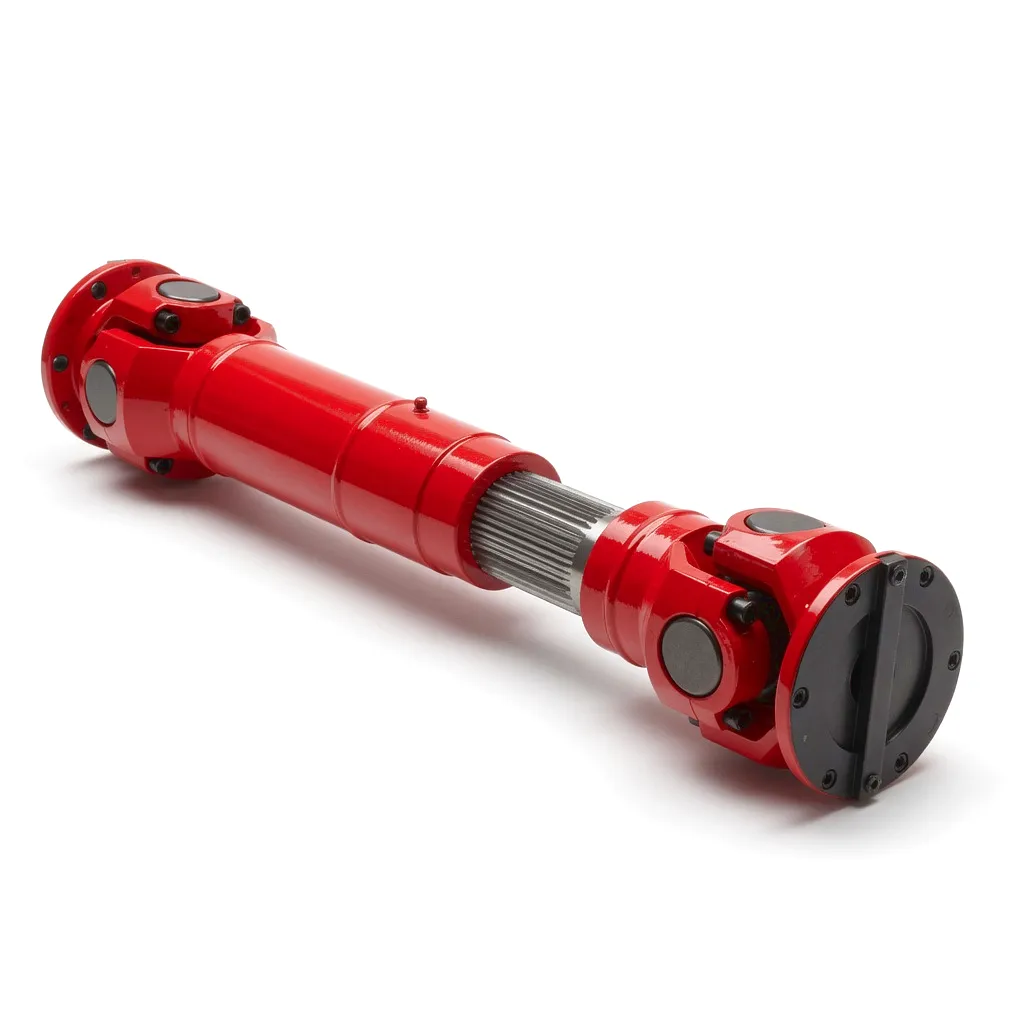 The cardan coupling — known interchangeably as a universal joint, propeller shaft coupling, or Hooke’s joint — ranks among the most widely deployed power transmission devices across global heavy industry. Its architecture is deceptively spare: two forged-steel yoke assemblies bridged by a precision-machined cross trunnion, capable of transmitting continuous rotary torque across a defined shaft misalignment angle. Yet beneath this structural economy lies a genuinely fascinating body of kinematics and tribology. The geometry of the joint produces a set of trigonometric relationships that govern everything from instantaneous output velocity to cyclic bearing loads — and ultimately to how efficiently mechanical energy passes from the driving shaft into the driven machine.
This is not an abstract concern. From the continuous hot strip rolling mills of Sheffield and the heavy-press lines of Birmingham, to the offshore wind nacelles operating over the Hornsea and Dogger Bank fields and the large paper machines running around the clock in Scotland, drivetrain efficiency translates into energy cost, maintenance frequency, and component service life. A cardan shaft operating at an unmanaged joint angle of 18° in a continuous steel rolling application can introduce enough torsional vibration to degrade downstream gearbox life by 30–40%, while generating measurable and avoidable power losses. The financial consequences accumulate rapidly — particularly where UK industrial electricity prices mean that every kilowatt of loss adds hundreds of pounds per year to the energy bill of a single machine.
This article walks through the complete mathematical framework: the fundamental single-joint velocity equation and its direct consequences for velocity fluctuation, the formulas governing instantaneous and average power loss, the elegant double-cardan solution to kinematic non-uniformity, and the quantitative impact of material selection and manufacturing precision on real-world system efficiency. Whether you are specifying a new drivetrain, troubleshooting existing vibration problems, or building a business case for a coupling upgrade, the analysis here gives you both the theory and the practical tools.
How a Cardan Coupling Transmits Rotary Motion
Before the mathematics can be interpreted correctly, the physical mechanism behind it deserves a clear account. A cardan coupling connects two rotating shafts that share an intersection point but diverge from it at an angle β — the joint operating angle. The cross-shaped trunnion sits at that intersection, its four pin journals fitting into needle roller bearings within the cups of each yoke. As the driving shaft rotates, the driving yoke arms push and pull the trunnion through their arc, and the trunnion transfers this force through its perpendicular journals into the second yoke, which drives the output shaft.
The physical insight that generates all the interesting mathematics is this: the force transfer between the two yokes is not geometrically uniform throughout one complete rotation. Because the planes of the two yoke forks are separated by angle β, the mechanical advantage changes continuously as the input shaft turns. When the input yoke plane contains the centrelines of both shafts — at a rotation angle φ₁ of 0° or 180° — the geometry creates a velocity ratio greater than 1:1 (the output shaft runs faster than the input). When the input yoke plane is perpendicular to the plane of the two shaft axes — at φ₁ = 90° or 270° — the velocity ratio drops below 1:1 (the output runs slower). The output velocity therefore oscillates continuously, completing two full cycles of fluctuation for every one revolution of the input shaft. This kinematic non-uniformity is the central performance challenge of the single cardan joint, and every practical efficiency limitation traces back to it.
The Fundamental Velocity Equation of a Single Cardan Joint
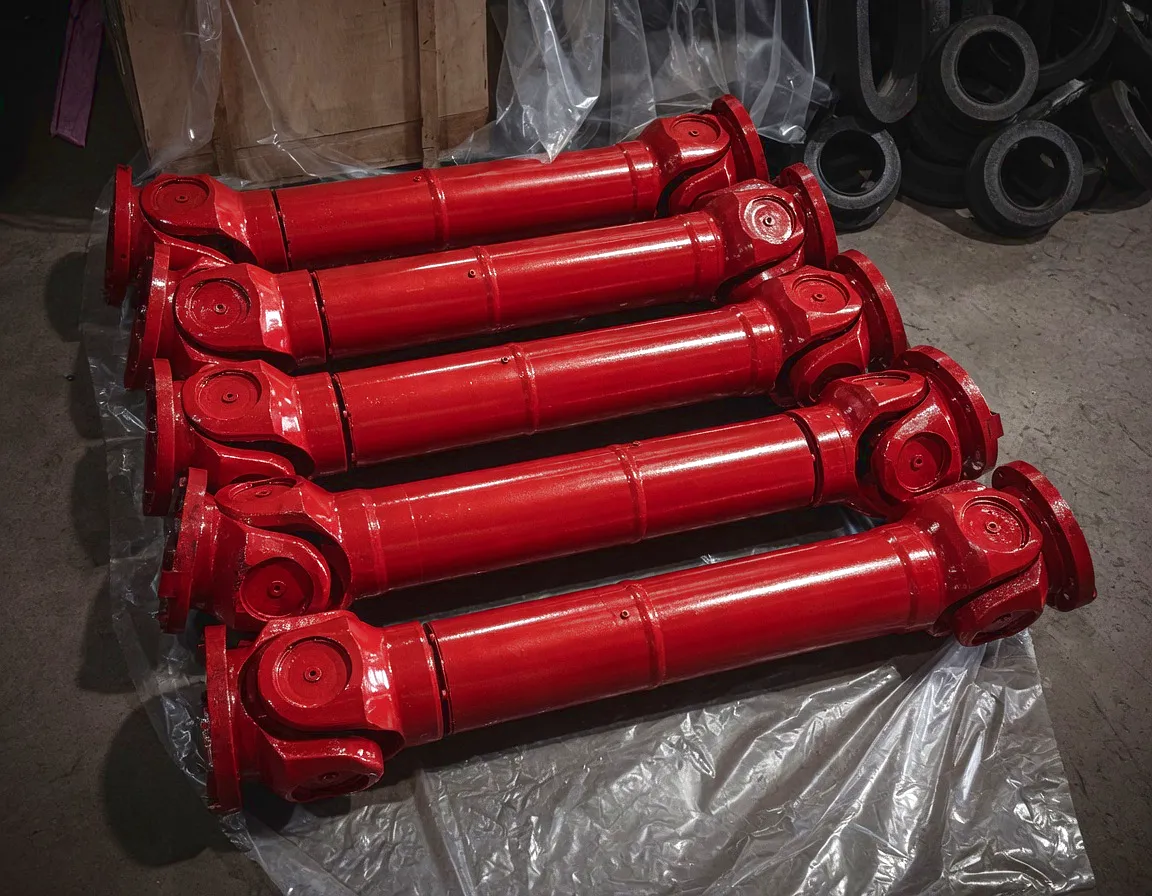
The relationship between input angular velocity ω₁ and output angular velocity ω₂ at any given instant is described by the following expression, derived from the three-dimensional geometry of the joint. This is the foundation equation — everything else in cardan coupling efficiency mathematics flows from it:
ω₂ = ( ω₁ × cos β ) / ( 1 − sin²β × cos²φ₁ )
β = joint operating angle | φ₁ = input shaft rotation angle measured from the joint plane | ω₁ = input angular velocity (rad/s) | ω₂ = output angular velocity (rad/s)
Examining the bounds of this equation clarifies the physical picture. ω₂ reaches its maximum when cos²φ₁ = 1, i.e. when φ₁ = 0° or 180°. It reaches its minimum when cos²φ₁ = 0, i.e. when φ₁ = 90° or 270°:
ω₂_max = ω₁ / cos β (output exceeds input speed)
ω₂_min = ω₁ × cos β (output lags input speed)
These deviations might initially seem minor. A cardan shaft at 10° produces a maximum output ratio of 1.015 and a minimum of 0.985 — a 3% spread. But the critical context is the frequency at which this fluctuation occurs: twice the shaft rotational speed. A spindle rotating at 1,500 rpm generates this velocity oscillation at 50 Hz. At that frequency, every downstream component experiences fifty complete cycles of velocity variation — and corresponding torque variation — every second. Over an 8-hour production shift, that accumulates into twenty-four million oscillation cycles. The fatigue implications for gearbox gear teeth, coupling flanges, and work roll bearing housings are substantial and well-documented in the rolling mill maintenance literature.
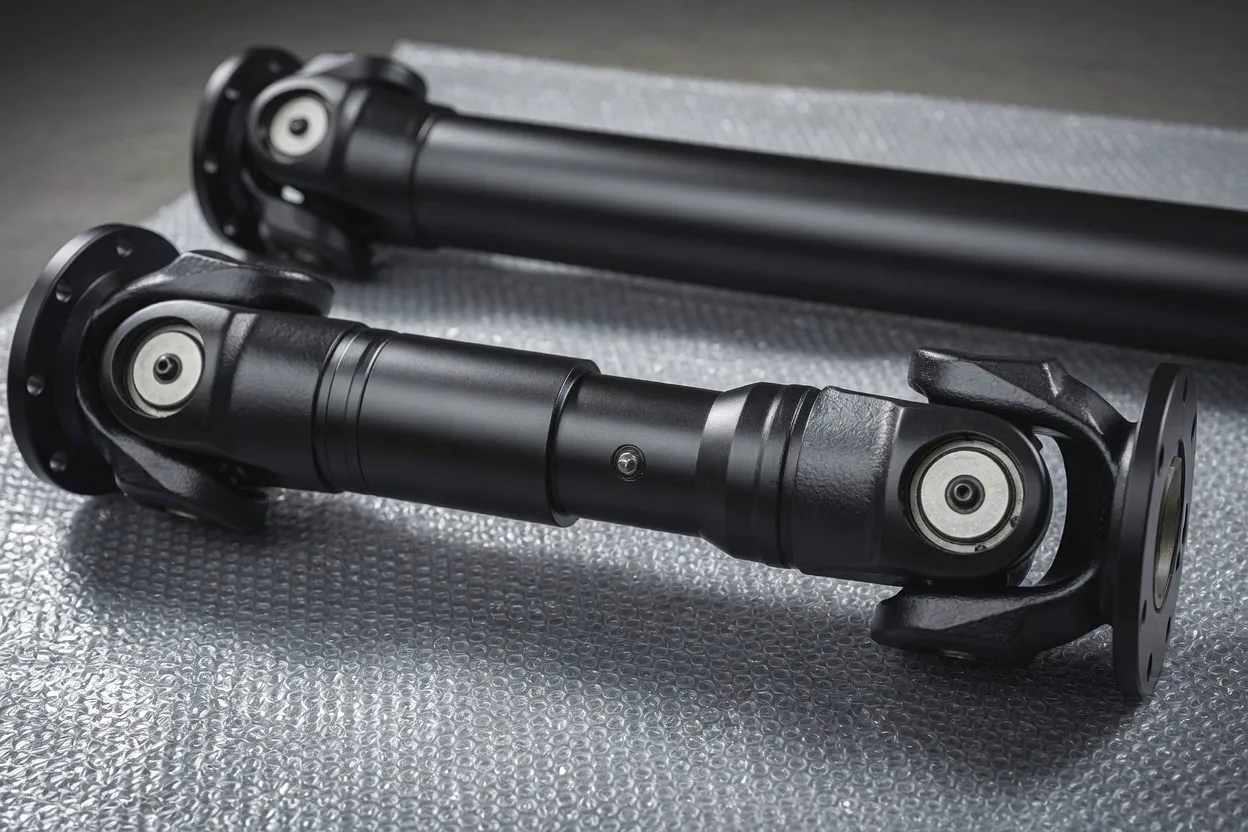
The coefficient of velocity variation δ provides a single numerical measure of this non-uniformity:
δ = ( ω₂_max − ω₂_min ) / ω₁
δ = (1/cos β) − cos β = sin²β / cos β = tan β × sin β
The nonlinearity of this expression is the most important single fact in cardan coupling specification. At β = 5°, δ is approximately 0.0076 — barely detectable instrumentation noise. At β = 15°, it climbs to 0.069, representing a ±3.5% velocity swing around the mean. At β = 25°, δ reaches 0.197 — nearly ±10% variation. Doubling the joint angle from 10° to 20° increases δ by a factor of roughly four, because both sin²β and tan β grow nonlinearly with angle. Engineers who apply a single angle-limit rule without calculating δ systematically underestimate the problem at higher operating angles, which is precisely where the damage is most costly.
Sources of Power Loss in a Cardan Coupling
Power loss in a cardan shaft assembly arises from three physically distinct mechanisms. Separating these is important both for accurate efficiency prediction and for identifying which design or operational changes will deliver the greatest improvement.
Bearing Friction at the Trunnion Interface
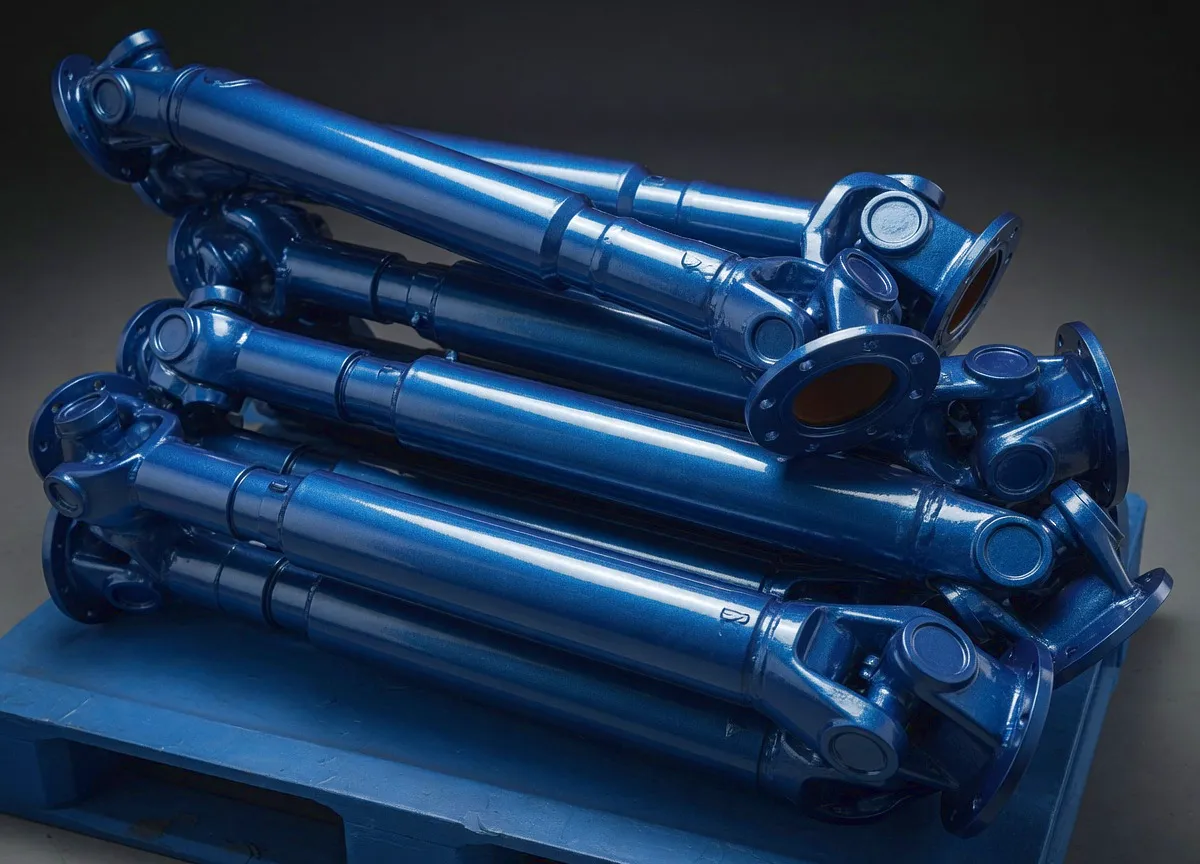
The four trunnion pin journals, each running in a needle roller bearing cup, are the dominant friction site in any well-maintained cardan joint. Under transmitted torque, the radial load on each bearing varies with the input rotation angle, reaching a maximum in the plane containing both shaft centrelines. The friction torque at each bearing equals the radial force multiplied by the journal radius and the coefficient of friction (μ = 0.005–0.015 for quality needle roller bearings). Summed across all four bearings and integrated over a full rotation, this gives the mean frictional power loss — the largest single contribution to total coupling energy loss in properly maintained assemblies.
Seal Drag and Grease Churning
Elastomeric seals on the bearing cups contribute a speed-dependent drag torque that is measurable at all temperatures but most significant during cold starts when grease viscosity is high. Above 2,000 rpm, grease churning within the bearing cup creates an additional viscous dissipation term that scales with the square of rotational speed. Selecting the correct NLGI grade grease for the application’s actual operating temperature range — rather than simply the highest-viscosity grease available — is therefore a genuine efficiency decision. Poor grease specification is a common and underappreciated source of elevated effective friction coefficients in service.
Kinematic Torque Variation Effects
In a theoretically frictionless joint, the velocity fluctuation described above does not produce net energy loss over a complete cycle — the kinematic distortion is conservative. However, in real installations with significant rotational inertia on the driven side, the cyclic acceleration and deceleration of connected masses creates brief periods of power storage and release that interact with friction losses to produce an effective efficiency below the pure friction-only calculation. At higher operating angles and higher inertia loads, this interaction becomes increasingly significant and accounts for the divergence between simplified formula predictions and measured values in physical test rigs at β > 15°.
The Power Loss Formula and a Worked Example
The efficiency of a single cardan coupling accounting for all frictional contributions is practically expressed as:
η ≈ 1 − μ_eff × tan β
P_loss = P_input × μ_eff × tan β
μ_eff = effective assembly friction coefficient (0.010–0.030 including seals and lubrication losses) | β = joint angle | P_input = input power (W)
Using μ_eff = 0.030 — a representative value for a well-maintained industrial assembly including seal drag and lubrication losses — and a 50 kW drive operating at β = 15°:
= 50,000 × 0.030 × 0.2679
= 402 Wη = 1 − 0.030 × 0.2679 = 99.2%
At 50 kW, 402 W of loss may feel inconsequential. Scale the same geometry to a continuous 500 kW rolling mill drive and the loss becomes 4,020 W — over 4 kW dissipated as heat through the bearing assemblies at every moment the mill is running. At 8,000 operating hours per year and a UK industrial electricity rate of approximately £0.18/kWh, that single coupling is costing roughly £5,800 per year in wasted energy. A multi-stand reversing mill with six such spindle couplings represents over £34,000 in annual losses attributable purely to cardan coupling angle management. The investment case for a drivetrain review is compelling at those numbers, and it is precisely the kind of analysis that Ever Power’s engineering team conducts for prospective customers during the pre-order technical consultation process.
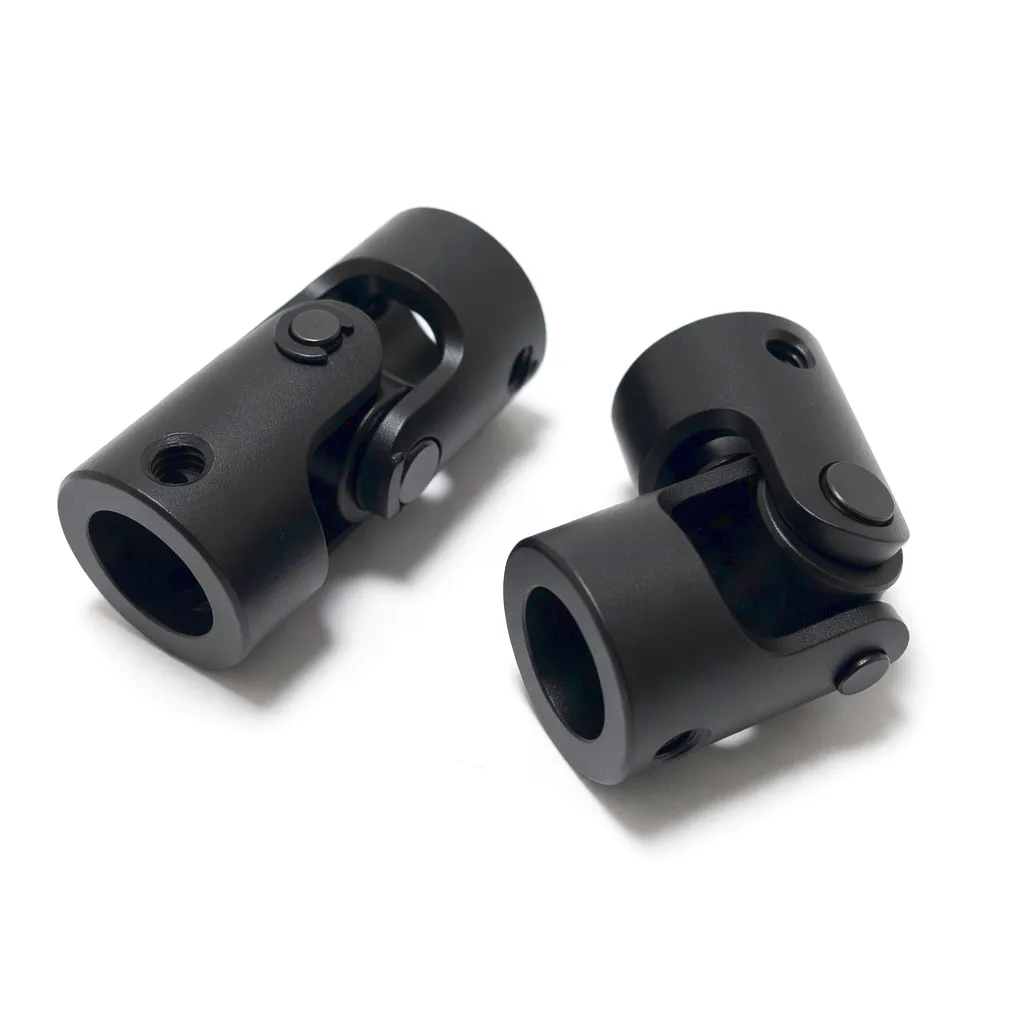
Engineering Reference: Joint Angle vs. Efficiency and Velocity Variation
The table below provides calculated performance parameters across the practical operating angle range for a single cardan coupling. Values use μ_eff = 0.030, representative of a well-maintained industrial assembly under standard operating conditions. The application suitability guidance reflects industry practice and the combined effect of efficiency loss and velocity non-uniformity at each angle.
| Angle β | ω₂_max / ω₁ | ω₂_min / ω₁ | Variation δ | Efficiency η | Application Guidance |
|---|---|---|---|---|---|
| 3° | 1.001 | 0.999 | 0.0027 | ≥99.8% | Machine tools, precision drives |
| 5° | 1.004 | 0.996 | 0.0076 | ≥99.7% | General industrial drives, pumps |
| 10° | 1.015 | 0.985 | 0.030 | ≥99.5% | Rolling mills, compressors, conveyors |
| 15° | 1.035 | 0.966 | 0.069 | ≥99.2% | Heavy conveyors, steel handling |
| 20° | 1.064 | 0.940 | 0.124 | ≥98.9% | Agricultural PTO, special purpose |
| 25° | 1.103 | 0.906 | 0.197 | ≥98.6% | Double-cardan design recommended |
| 30° | 1.155 | 0.866 | 0.289 | ≥98.3% | Double-cardan strongly required |
Efficiency calculated using η = 1 − μ_eff × tan β, μ_eff = 0.030 (accounts for needle roller bearing friction, seal drag, and grease churning). Practical values in poorly lubricated or high-speed assemblies may be 0.5–2% lower. δ = tan β × sin β.
Double-Cardan Configuration: The Mathematical Case for Constant-Velocity Output
The mathematical solution to single-joint velocity non-uniformity is both elegant and practical. When two identical single cardan joints are arranged in series — with an intermediate shaft between them — with the yoke planes of both joints rotated 90° relative to each other, and with the total misalignment angle equally divided between the two joints, the velocity fluctuation introduced by the first joint is exactly cancelled by the second. The output shaft velocity becomes constant at the input shaft velocity. This is the double-cardan (or phased-twin) arrangement, and the mathematics of why it works are worth understanding explicitly.
Denoting the three shaft angular velocities as ω₁ (input), ω₂ (intermediate shaft), and ω₃ (output), and applying the single-joint velocity equation twice:
ω₂ / ω₁ = cos β / (1 − sin²β × cos²φ₁)
ω₃ / ω₂ = cos β / (1 − sin²β × cos²(φ₁ + 90°)) = cos β / (1 − sin²β × sin²φ₁)
ω₃ / ω₁ = cos²β / [(1 − sin²β × cos²φ₁)(1 − sin²β × sin²φ₁)]
For equal joint angles and 90° yoke phase offset, this product simplifies to ≈ 1.0: constant velocity output.
The denominator product (1 − sin²β × cos²φ)(1 − sin²β × sin²φ) expands and simplifies under the equal-angle phasing condition to approximately cos²β for all φ, cancelling the cos²β numerator to give ω₃/ω₁ ≈ 1. The approximation is exact when both joints operate at precisely the same angle with precise 90° phase offset — conditions that Ever Power’s precision manufacturing and dynamic balancing processes are designed to maintain through the working life of the assembly.
The efficiency of a double-cardan assembly is slightly lower than a single joint, because two bearing sets now contribute friction losses:
η_double ≈ 1 − 2 × μ_eff × tan β
At a total operating angle of 16° (8° per joint), μ_eff = 0.030: η_double ≈ 1 − 2 × 0.030 × tan(8°) = 1 − 0.060 × 0.1405 = 99.16%. Compare this to a single cardan joint at 16° where δ ≈ 0.079, generating constant 32 Hz torque ripple in a 1,000 rpm drive. The double arrangement achieves comparable efficiency with the added benefit of zero kinematic velocity fluctuation — directly eliminating the resonance excitation that causes premature gearbox, bearing, and structural fatigue in sensitive applications across Sheffield’s rolling mills, Birmingham’s press lines, and Scotland’s continuous paper machines.
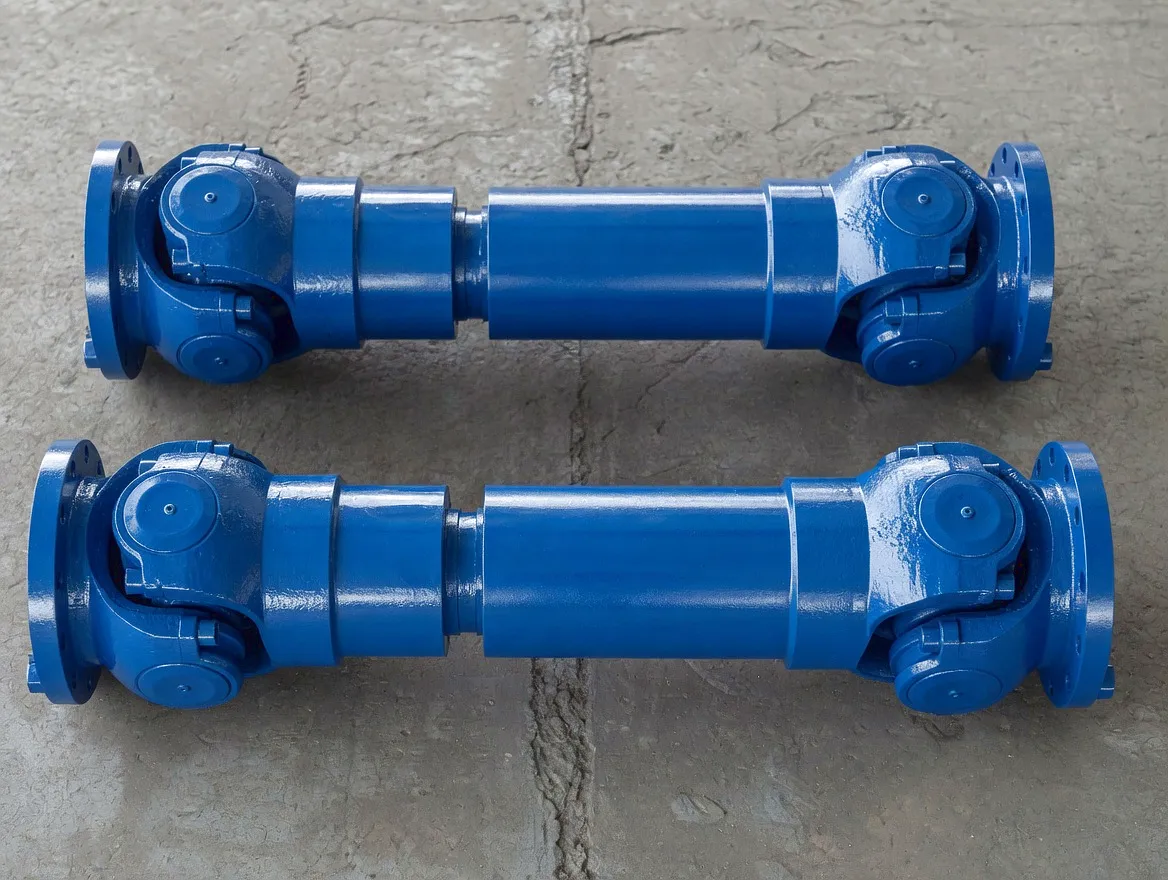
Material Selection and Its Measurable Efficiency Impact
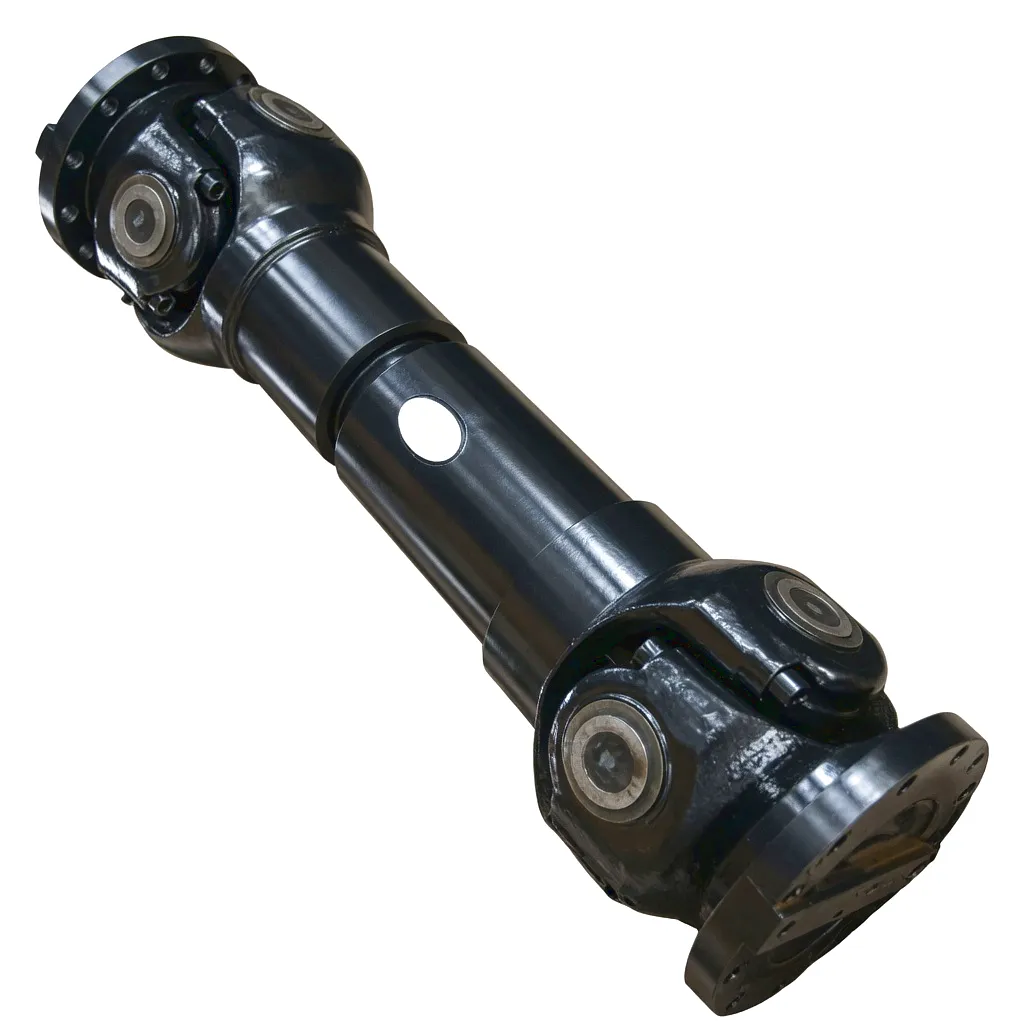 Material choice in a cardan coupling affects efficiency through three quantifiable pathways. The first is torsional stiffness: a stiffer yoke body places the assembly’s torsional resonance frequency higher in the operating speed range, reducing the likelihood of operating near a resonance where apparent losses are amplified by the dynamic magnification factor. The second is trunnion surface quality: a harder, more accurately ground trunnion journal creates a needle roller contact geometry that maintains lower effective friction coefficient over a longer service interval before wear-induced surface roughness begins to increase μ. The third is mass: a lighter yoke body (achievable by selecting higher-strength alloy steel and reducing section sizes while maintaining structural adequacy) reduces centrifugal loads on the trunnion bearing assemblies at operating speed, which directly reduces the mean bearing reaction force and therefore the friction torque contribution.
Standard industrial cardan couplings use C45 medium-carbon steel yoke bodies — a pragmatic choice that offers adequate fatigue strength, good machinability, and proven performance across a broad application range. For higher-demand applications, 42CrMo4 chrome-molybdenum alloy steel forged yokes provide tensile strengths of 900–1,100 MPa after quench-and-temper treatment, enabling reduced cross-sections that lower centrifugal mass without sacrificing torque capacity. The trunnion cross — the highest-stressed component in the assembly — is precision-machined from case-hardening grades such as 20MnCr5 or 16MnCr5, carburised to a case depth of 0.8–1.2 mm, and quench-hardened to achieve surface hardness of 58–64 HRC. This combination of hard surface (for wear resistance and precise bearing contact geometry) and tough core (for fatigue resistance under cyclic bending from the oscillating bearing loads) is the design decision that most directly determines the effective friction coefficient μ in service, and therefore the efficiency slope against operating angle.
Core Technical Advantages of an Ever Power Cardan Coupling
Verified High Transmission Efficiency
At operating angles up to 10°, Ever Power cardan couplings consistently deliver transmission efficiencies above 99.5%, validated through loaded test-rig measurement rather than theoretical calculation alone. Precision-ground trunnion journals, pre-selected needle roller assemblies matched to each specific journal diameter, and dynamically balanced yoke bodies together minimise every measurable loss contribution.
Exceptional Torque and Angle Range
Standard catalogue assemblies span 100 N·m to 500,000 N·m and operating angles from 0° to 45° in double-cardan configuration. Fully bespoke designs extend torque capacity to 2,000,000 N·m for the most demanding applications including large rolling mill spindle drives and heavy marine propulsion systems supplied to UK-based contractors.
Long Service Life by Design
Carburised and precision-ground trunnion crosses combined with dimensionally matched needle roller bearing kits deliver bearing L10 service lives exceeding 20,000 operating hours under typical industrial load cycles. Lifetime-lubricated sealed bearing cup options eliminate routine regreasing requirements in difficult-to-access installations.
Dynamic Balancing for High-Speed Operation
All Ever Power cardan shaft assemblies for operation above 1,500 rpm are dynamically balanced to ISO 1940 G2.5 as standard, with G1.0 precision grade available for sensitive high-speed installations. Proper balancing directly reduces cyclic bearing load fluctuation and extends trunnion service life, particularly in long-span intermediate shafts where centrifugal bow would otherwise introduce secondary bending loads at speed.
Temperature and Environment Compatibility
Standard seals maintain performance from −20°C to +100°C, with high-temperature variants rated to +150°C for furnace-adjacent applications. Marine-grade variants with stainless bearing cup hardware and fluoroelastomer seals serve North Sea offshore platforms and coastal installations. These are not marketing designations — they represent validated seal compound and grease combinations tested at the rated extremes.
Full Customisation and Interchangeability
Flanged, splined, keyed, and shrink-disc end configurations are standard across the Ever Power range. Telescopic intermediate shafts accommodate axial displacement without compromising torque capacity. Drop-in replacements dimensionally compatible with OEM designs are available for retrofit programmes on legacy equipment, eliminating the need for machinery modification and simplifying the procurement and installation process for UK maintenance teams.
Product Technical and Performance Specifications
| Parameter | Standard Range | High-Performance / Custom | Unit / Standard |
|---|---|---|---|
| Torque Capacity | 100 – 500,000 | Up to 2,000,000 | N·m |
| Operating Angle (single joint) | 0° – 25° | Up to 30° | Degrees (°) |
| Operating Angle (double joint) | 0° – 40° | Up to 45° | Degrees (°) |
| Rotational Speed | Up to 3,000 | Up to 6,000 (balanced) | rpm |
| Yoke Body Material | C45 forged steel | 42CrMo4 alloy steel, Q&T | EN / DIN standard |
| Trunnion Cross Material | 20MnCr5, carburised | 16MnCr5 + induction hardened | EN 10084 |
| Surface Hardness (trunnion) | 58 – 62 HRC | 62 – 64 HRC | Rockwell C scale |
| Bore Diameter | 20 – 300 mm | Custom up to 600 mm | mm |
| Balance Grade | ISO 1940 G6.3 | ISO 1940 G1.0 | ISO 1940-1 |
| Temperature Range | −20°C to +100°C | −40°C to +150°C | °C |
| Transmission Efficiency | > 99.0% at β ≤ 10° | > 99.5% (precision grade) | % |
| Surface Treatment | Phosphating + painting | Chrome plating / zinc-nickel / PVD | — |
| Quality Certification | ISO 9001:2015 | EN 10204 3.1 material cert. | International standard |
Industrial Application Scenarios Across the UK and International Markets
The cardan coupling is unusual among mechanical components in the breadth of sectors it serves. Its combination of angular flexibility, high continuous torque capacity, and the ability to accommodate shaft misalignment makes it indispensable from cold rolling mills to offshore nacelles to pharmaceutical mixing lines. Applying the efficiency mathematics correctly requires understanding which application scenario applies, because the dominant loss mechanism, the acceptable velocity variation, and the appropriate joint configuration all depend on the application context.
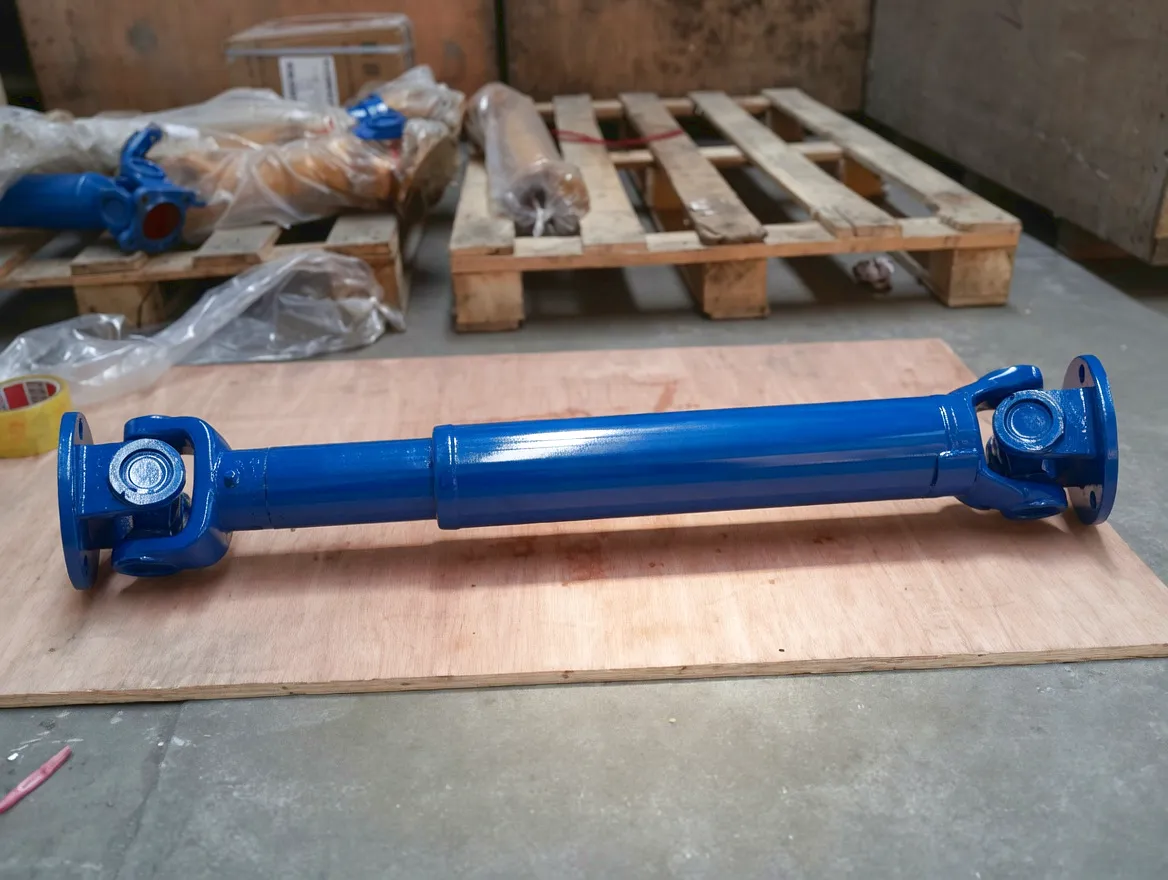
Ever Power: Precision Cardan Coupling Manufacturing and Custom Engineering
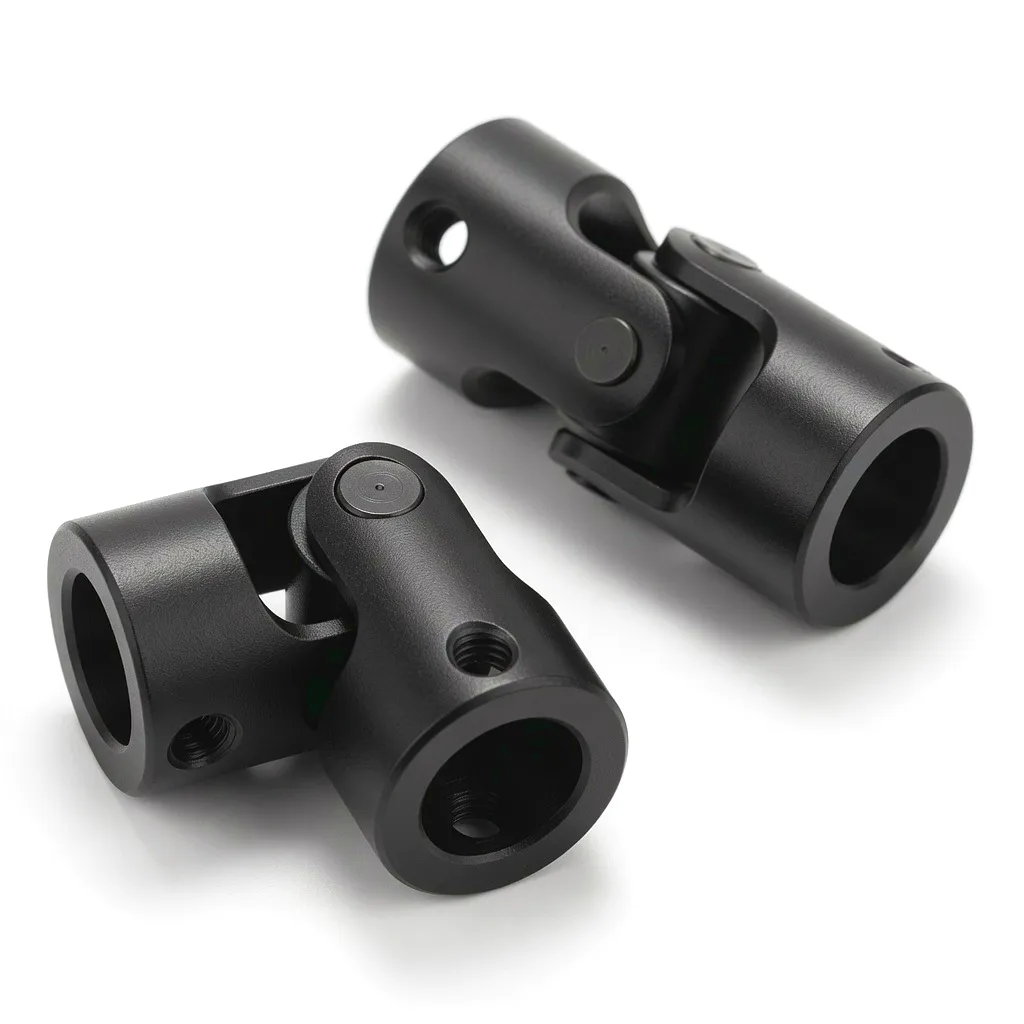 Ever Power has established a well-documented reputation as a specialist designer and manufacturer of cardan couplings for demanding industrial applications, with a supply chain that extends fully to the UK market through dedicated export logistics, in-country technical liaisons, and documented short lead times. The manufacturing operation runs an integrated production chain — from forge shop and bar stock receipt, through CNC turning and milling of yoke bodies and trunnion crosses, to precision cylindrical grinding, controlled-atmosphere heat treatment, bearing assembly, dynamic balancing to ISO 1940, and final dimensional and visual inspection. Every stage is governed under ISO 9001:2015 quality management, with process capability data maintained for all critical dimensions across the full production run.
The area where Ever Power most clearly differentiates from commodity cardan coupling suppliers is the depth of its customisation capability. Standard catalogue products are comprehensive, but the most costly industrial drivetrain problems — the ones that generate the largest unplanned maintenance bills and the most significant energy losses — are invariably the non-standard ones. Our engineering team works directly with UK plant engineers, mechanical contractors, and procurement specialists to develop fully bespoke solutions: non-standard flange bolt circle diameters, unusual shaft-to-shaft centre distances, specialised sealing arrangements for hostile environments, and hybrid configurations that combine telescopic intermediate shafts with phased double-cardan joint arrangements. All custom designs are delivered with full 3D CAD models, engineering calculation sets including efficiency and bearing life calculations, and where required, finite element stress analysis on critical yoke and trunnion components.
UK customers receive standard configuration lead times of 3–6 weeks and fully bespoke assembly lead times of 6–10 weeks, with every delivery accompanied by a comprehensive documentation pack: dimensional drawings with tolerances, material test certificates to EN 10204 3.1, dynamic balance records showing residual unbalance values per plane, and a factory acceptance test report signed by quality assurance. Technical enquiries receive a same-business-day response from our engineering team, and pre-order application reviews — including efficiency and bearing L10 life calculations for the specific application — are provided at no charge.