
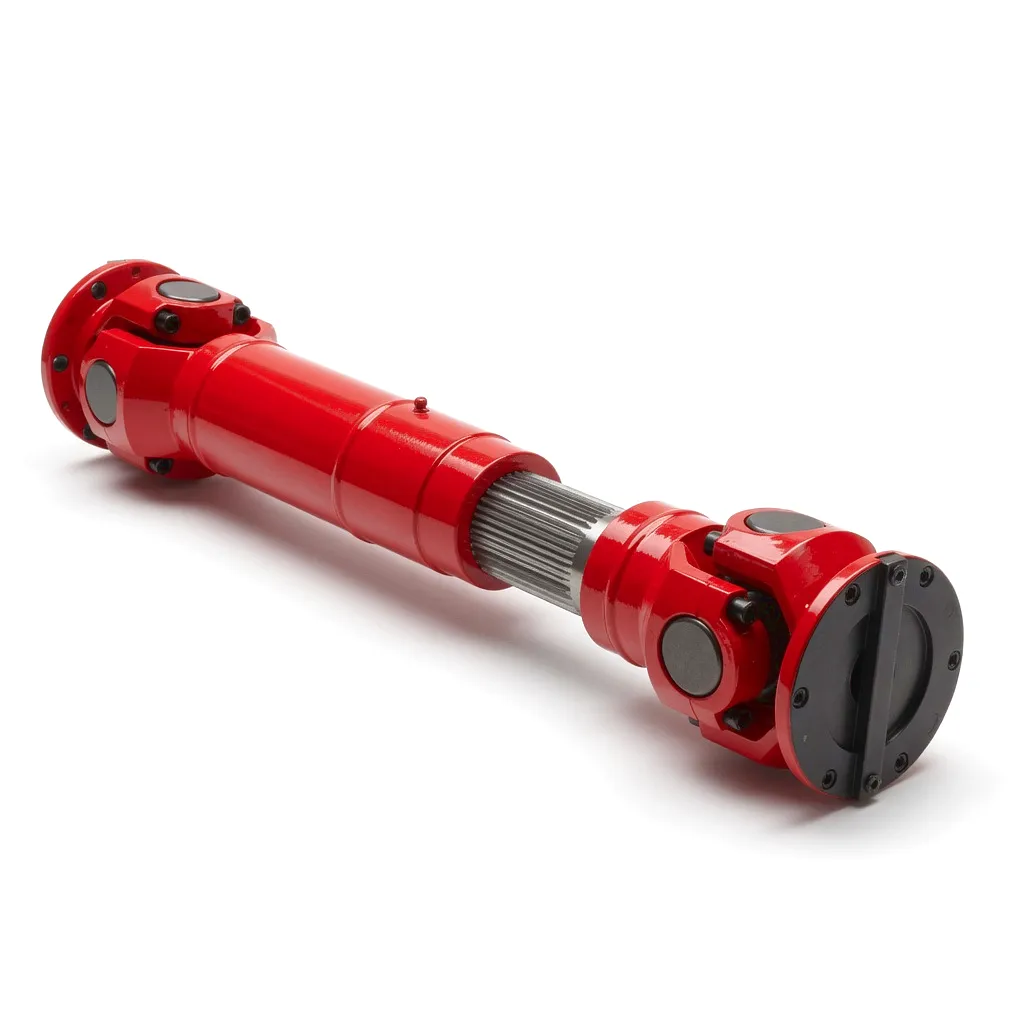
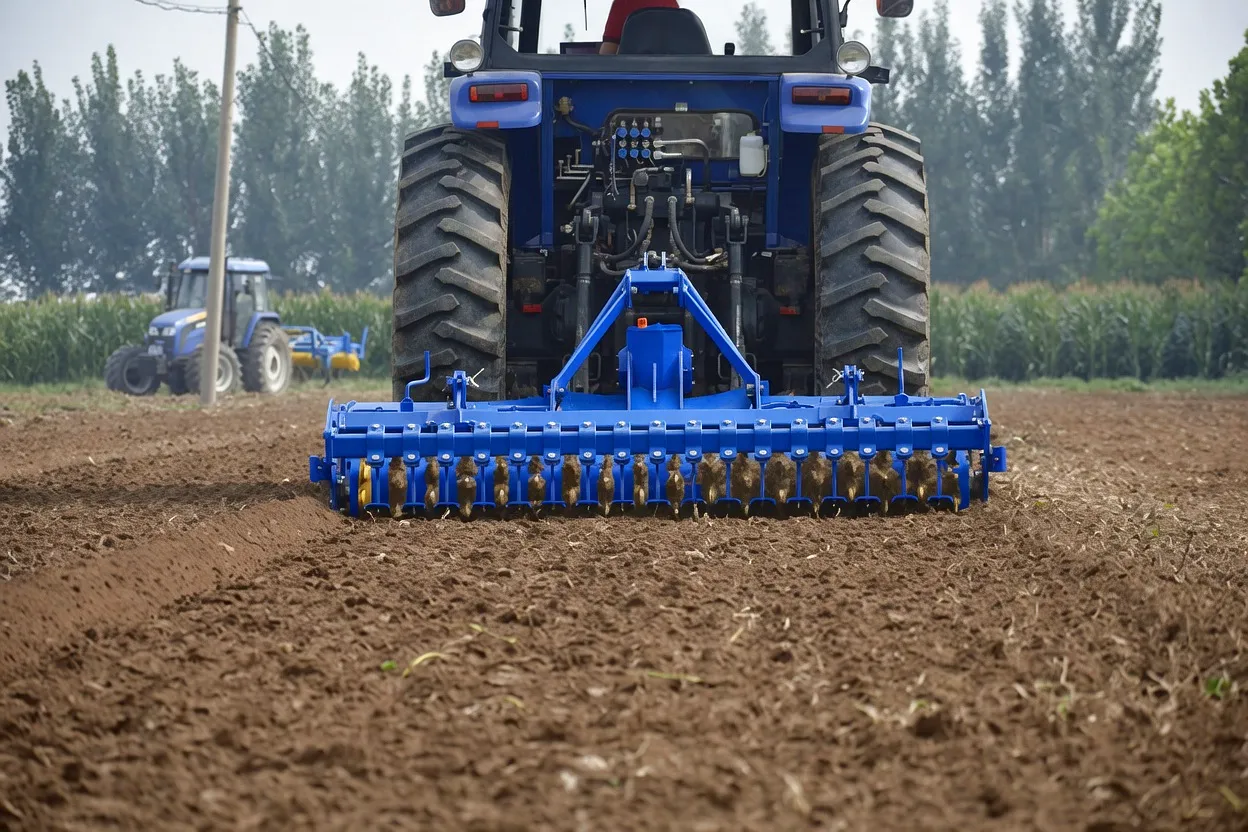
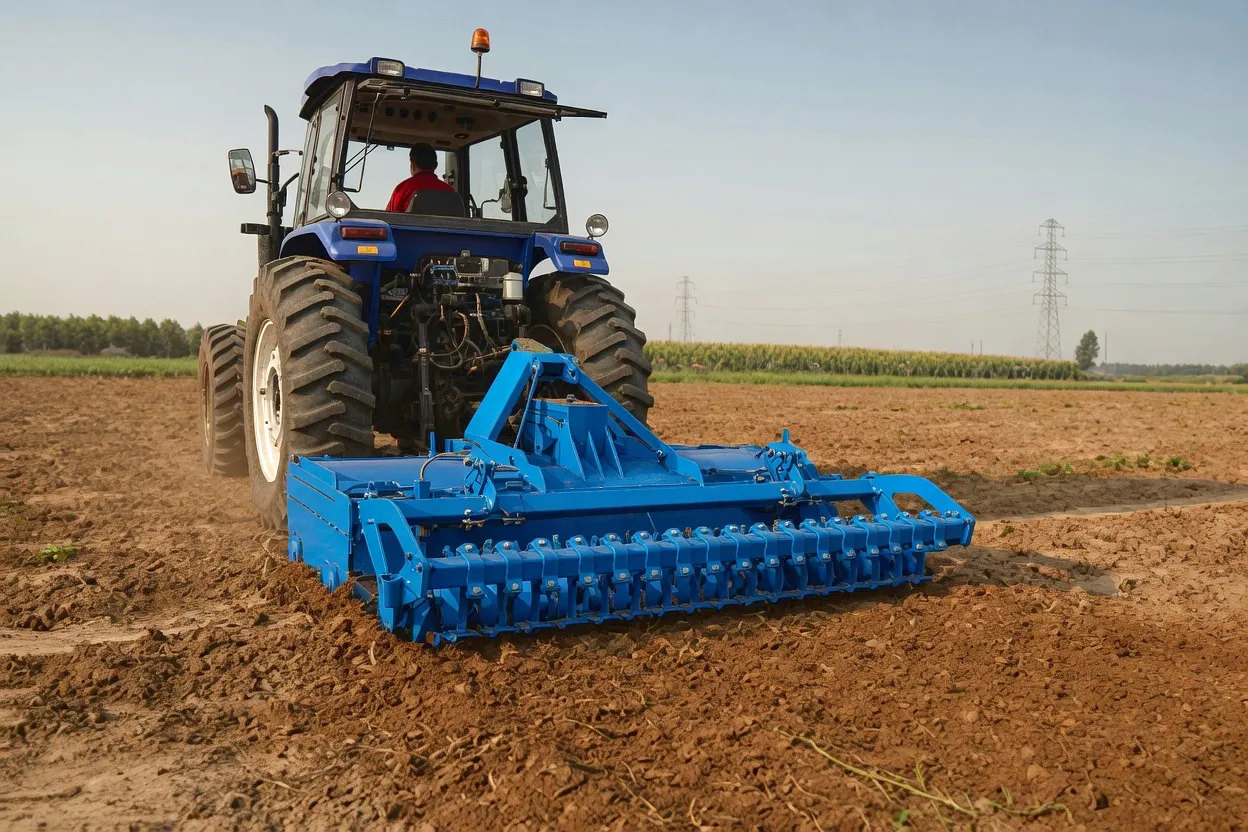
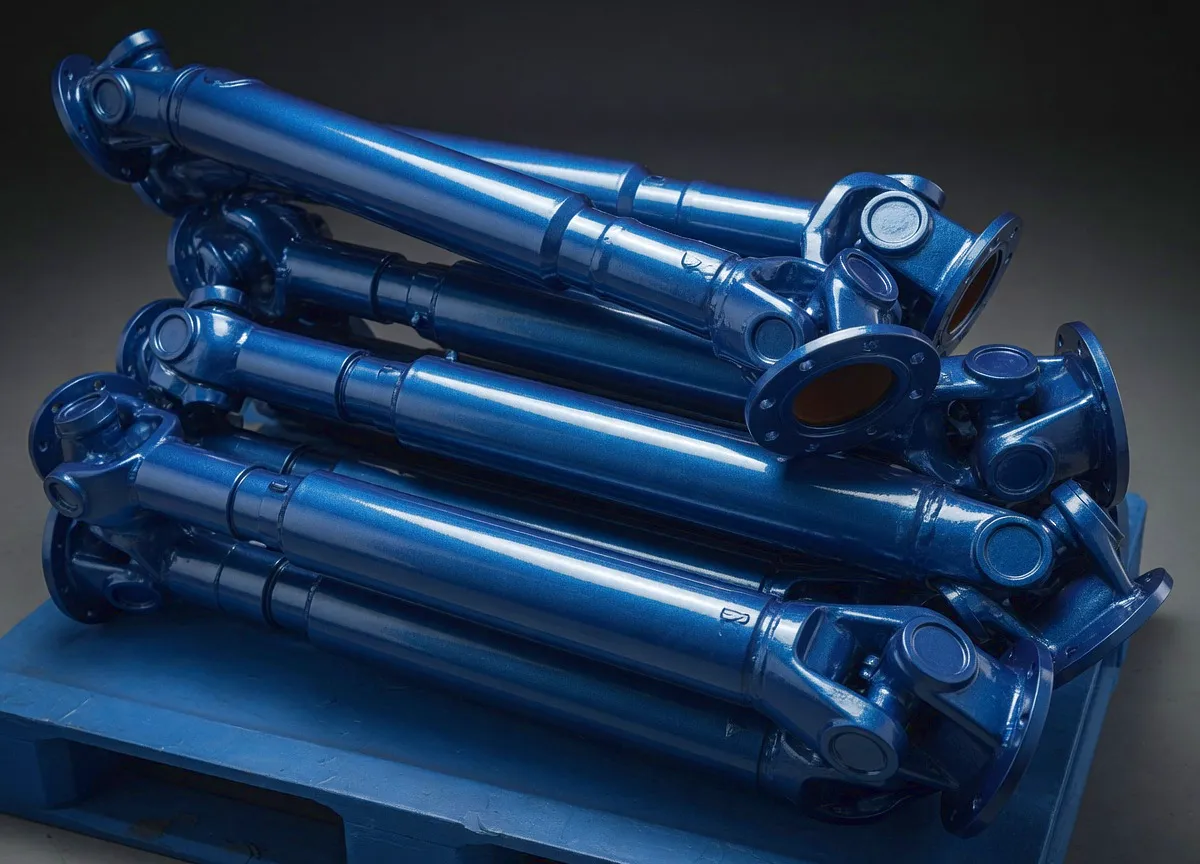
 Walk onto any working farm in Yorkshire, Norfolk, or the Scottish Borders during spring land preparation and you will see it: a tractor linked to a rotary tiller, churning through heavy clay or compacted loam, the driveshaft spinning hard between PTO stub and implement gearbox. That short section of rotating steel — the cardan coupling PTO driveshaft — is the single most mechanically stressed component in the entire tillage system. It absorbs angular misalignment at every bump, transmits shock loads when the rotor strikes a buried stone, and must do both continuously at rotational speeds up to 1,000 rpm, season after season.
The cardan coupling — also called a universal joint shaft, Hooke’s joint coupling, or simply a PTO shaft — is not glamorous engineering. It rarely appears in procurement catalogues beside high-spec hydraulic pumps or precision seed meters. Yet it is the reason those other systems stay productive. A failed driveshaft joint on a 200-hectare arable holding in Lincolnshire does not just stop the tiller; it halts the entire spring programme, triggers emergency sourcing costs, and may mean missed drilling windows that cut yields for the entire season. This guide was written to help UK agricultural engineers, farm machinery dealers, and procurement managers understand exactly what separates a reliable cardan coupling from one that will let you down in a muddy field at 7 a.m.
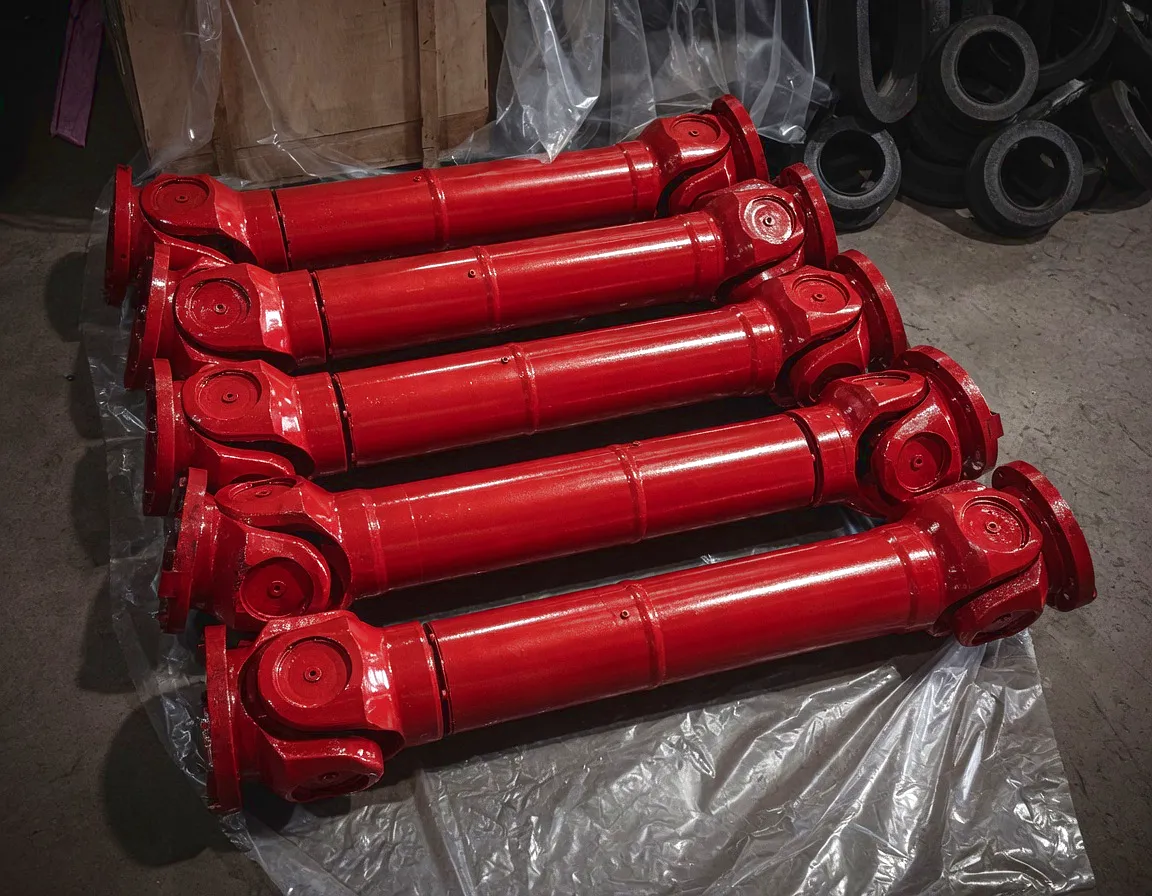
Need a custom cardan coupling for your rotary tiller or PTO application? Our engineers respond within 24 hours.
What Exactly Is a Cardan Coupling — and Why Does It Matter for Rotary Tillers?
A cardan coupling is a mechanical device that transmits rotational torque between two shafts whose axes are not perfectly aligned. Named after the Italian mathematician Gerolamo Cardano — though the practical engineering owes at least as much to Robert Hooke — the design uses a cross-shaped centre piece (the spider or trunnion) mounted inside two yokes. This configuration allows the driven shaft to continue rotating smoothly even when the input and output shafts form an angle, typically up to 35–40 degrees in agricultural versions and up to 90 degrees in specialised heavy-duty units.
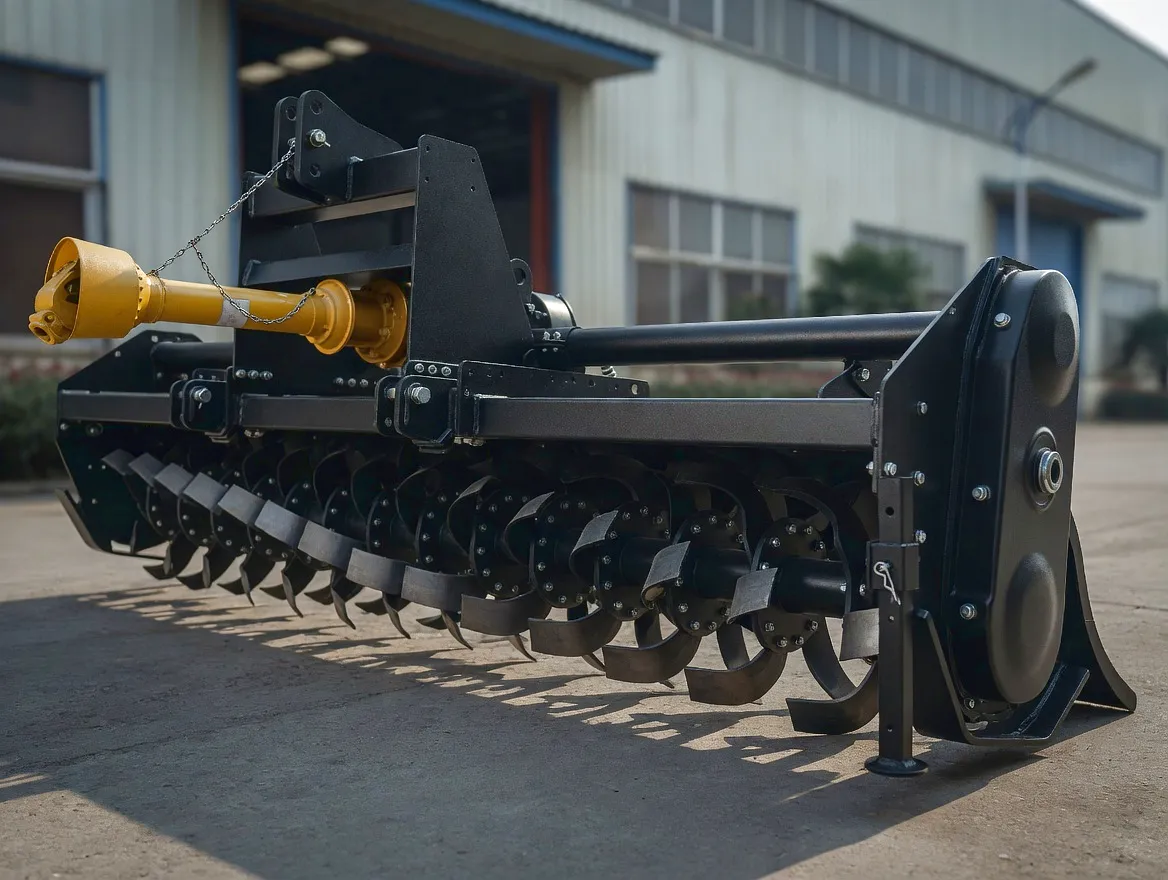
For a rotary tiller attached to a tractor PTO, this angular capability is not a luxury — it is a functional requirement. The implement hitches and unhitches at the three-point linkage, rises and falls over furrows and field margins, and pivots sideways on headlands. Throughout all of this movement, the cardan coupling must keep torque flowing without transmitting destructive angular impulses back into the tractor gearbox or forward into the tiller rotor gearbox. A properly specified PTO driveshaft absorbs those angular variations silently; an under-rated one cracks yokes, shears spiders, or strips the telescoping profile within months.
Torque Capacity
Handles shock torque multiples of 3–5× rated nominal torque during stone strikes
Angular Range
Wide-angle joints operate up to 40° for full three-point linkage travel
Overload Protection
Integrated shear bolt or friction clutch protects both tractor and implement gearbox
Telescoping Profile
Splined or lemon/star profile tubes allow axial length variation without torque loss
The Engineering Behind PTO Cardan Couplings: Materials, Construction & Operating Principles
Why build quality separates a 200-hour failure from a 2,000-hour workhorse
Cross/Spider Assembly
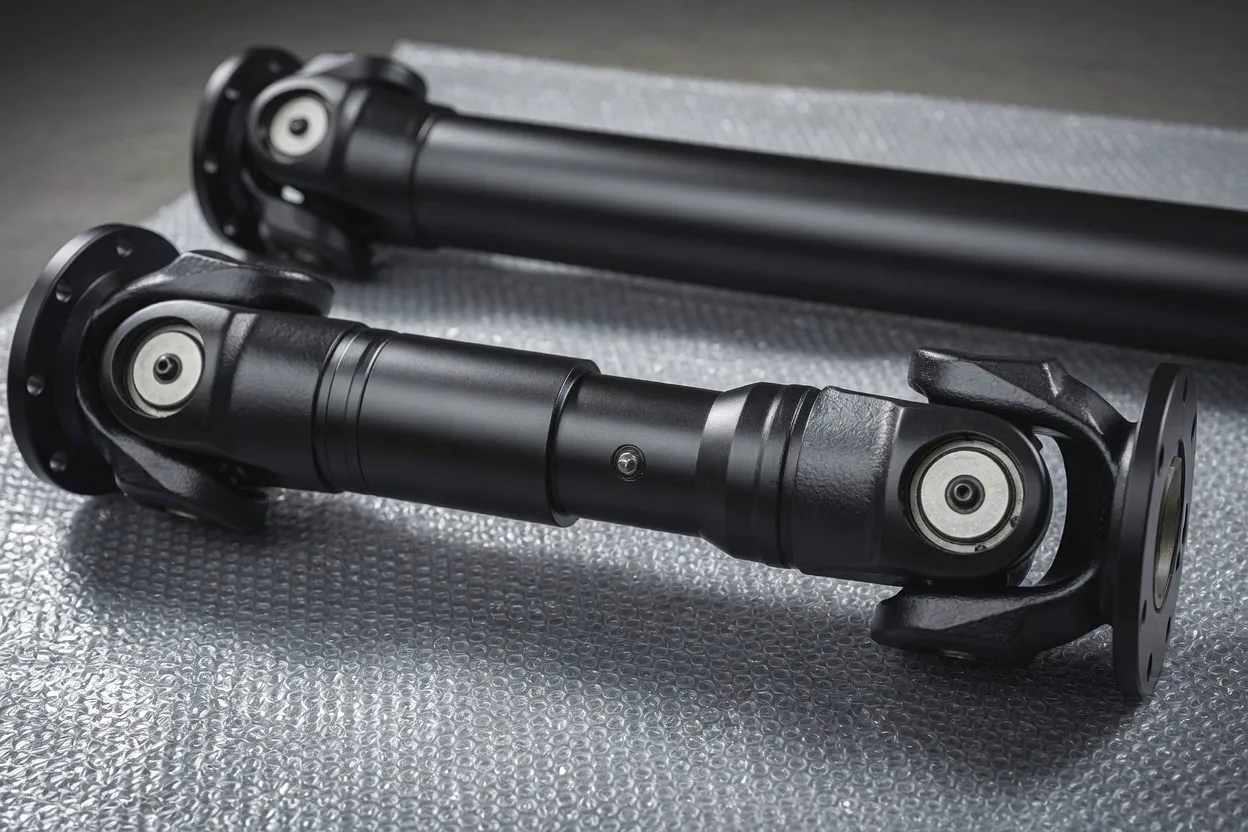
The trunnion cross — the heart of every cardan coupling — is forged from case-hardened alloy steel (typically 20CrMnTi or 20Cr2Ni4A grade), then precision ground to tight journal tolerances. Needle roller bearings seat into each arm journal and are sealed against ingress with multi-lip seals. This bearing arrangement is what allows smooth rotation at angles that would destroy a plain-bushed joint within weeks. In agricultural-grade units, the needle rollers are pre-packed with NLGI-2 lithium complex grease and sealed for extended re-greasing intervals — typically every 50 operating hours under heavy tillage conditions. The forging process eliminates internal voids and ensures fatigue strength that meets DIN 808 and ISO 8789 standards, which are referenced in most UK equipment procurement specifications.
Telescoping Tube Profile
Between the two universal joint ends lies a telescoping tube that accommodates the axial length change as the tractor’s three-point linkage rises and falls. The most common profiles for heavy rotary tiller service are the lemon (two-lobe) and star (six-lobe) cross-sections, both machined from seamless cold-drawn steel tube. The star profile provides significantly greater torque capacity than the lemon profile at the same outer diameter, making it preferred for wide tillers with high rotor mass. An outer plastic safety guard (conforming to EN ISO 5674 for agricultural PTO shafts) covers the rotating assembly and is secured by a retention chain that prevents the guard from rotating with the shaft. In the UK, operation without this guard is a violation of PUWER (Provision and Use of Work Equipment Regulations) 1998, making guard integrity a legal requirement rather than merely good practice.
Overload Protection Devices
British clay soils, particularly in the East Midlands and the Vale of York, are notorious for concealing large flint cobbles and brick fragments in fields that were once mediaeval settlements. When a 120-kg rotor blade assembly travelling at 300 rpm strikes an immovable obstruction, the energy released in milliseconds can destroy an unprotected gearbox. That is why properly specified rotary tiller PTO shafts incorporate either a shear bolt clutch or a friction-plate torque limiter. Shear bolt designs (typically rated between 400 and 1,200 Nm) are low-cost and simple to reset, requiring only a replacement shear bolt; friction clutches are more expensive but disengage and re-engage automatically without operator intervention. For high-output tillers working intensively, automatic friction clutches represent a significant reduction in downtime cost despite their higher initial price.
Technical Performance Parameters: Agricultural PTO Cardan Coupling Range
Standard range specifications — custom dimensions and torque ratings available on request
| Series / Profile | Nominal Torque (Nm) | Peak Torque (Nm) | Max Speed (rpm) | Max Angle (°) | PTO Bore Options (mm) | Protection |
|---|---|---|---|---|---|---|
| S2 Lemon | 340 | 1,020 | 1,000 | 25° | 35 / 38 | Shear bolt |
| S4 Star | 680 | 2,040 | 1,000 | 30° | 35 / 38 / 45 | Shear bolt / Friction |
| S6 Star HD | 1,250 | 3,750 | 1,000 | 35° | 45 / 50 | Friction clutch |
| WA Wide-Angle | 900 | 2,700 | 540 | 40° | 38 / 45 | Friction clutch |
| Custom / OEM | 200 – 6,000+ | On request | To spec | To spec | Any standard / bespoke | Any |
All values based on standard operating temperature 0–60°C. Consult our engineering team for extreme-temperature or high-speed applications.
7 Reasons Agricultural Engineers Across the UK Specify Our Cardan Couplings
From Lincolnshire arable farms to West Country market garden operations — here is what makes the difference in the field
Where Cardan Couplings Are Used in Agricultural PTO Applications
The rotary tiller PTO driveshaft is the most common agricultural cardan coupling application — but it sits within a much broader family of PTO power transmission uses
| Application | Typical PTO Speed | Key Coupling Demand | Preferred Series |
|---|---|---|---|
| Rotary Tiller (Rotavator) | 540 / 1,000 rpm | High shock torque, stone strikes, wide angle at headland | S4 Star / S6 HD + Friction clutch |
| Slurry Tanker Pump | 540 rpm | Sustained torque, wide angle during spreading manoeuvres | WA Wide-Angle |
| Mower / Flail | 540 / 1,000 rpm | Stone strike protection, sustained speed | S4 Star + Shear bolt |
| Grain Auger / Conveyor | 540 rpm | Moderate torque, low angle variation | S2 Lemon / S4 Star |
| Subsoiler with PTO | 1,000 rpm | Very high sustained torque, vibration absorption | S6 HD + Friction clutch |
How to Select the Right Cardan Coupling for Your Rotary Tiller — A Practical Guide
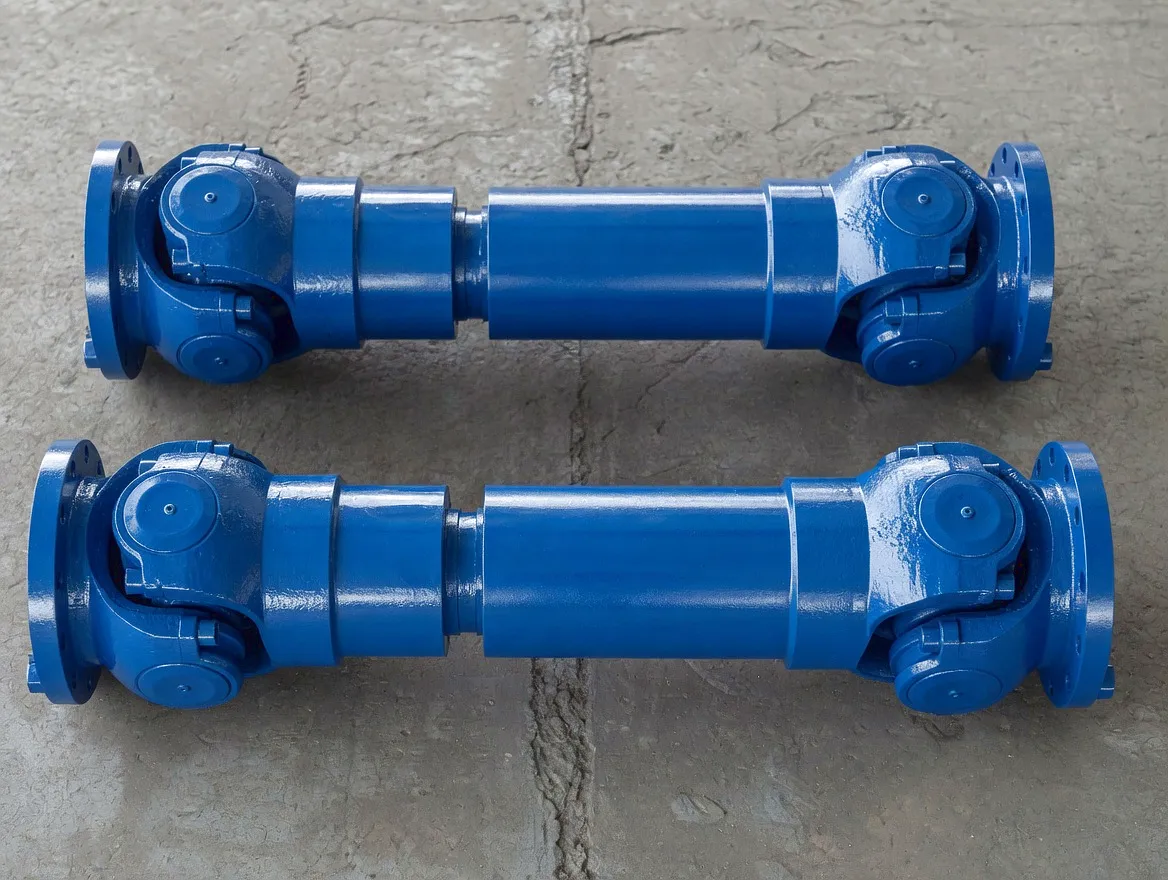
Selecting a PTO cardan coupling is not simply a matter of matching the bore size. The single most common and costly mistake made by purchasers — whether farm managers buying a replacement shaft or implement designers specifying a new machine — is choosing a coupling based on the tractor PTO bore alone, ignoring torque capacity, working angle, and telescoping length requirements. The following selection process is based on the same methodology our application engineers use when advising customers across the UK agricultural equipment market.
Customer Success: Real Results from UK & European Agricultural Operations
How agricultural businesses across Britain and Europe have reduced downtime and cut costs by upgrading their PTO driveshafts
Arable Farm Machinery Dealer
Hadley Farm Supplies has operated as an agricultural machinery dealer across the Lincolnshire Fens since 2004, supplying replacement parts for rotary tillers, subsoilers, and cultivation equipment to arable farms ranging from 80 to 1,200 hectares. Their previous PTO driveshaft supplier consistently delivered 10–14 week lead times on non-standard lengths, forcing Hadley to hold an expensive buffer stock or turn away orders during the spring rush. After switching to our S4 Star and S6 HD range as their primary cardan coupling source, average lead time dropped to 6 working days for standard lines, and a bespoke shaft service means custom specifications ship in under three weeks. In the first year, Hadley increased their shaft sales revenue by 34% while reducing their stocked inventory value by £12,000 through better supply reliability. Their workshop manager, speaking at a local NAAC meeting in early 2025, cited the technical support line as the differentiating factor: “When a farmer rings on a Tuesday wanting a shaft for a machine I’ve never heard of, I can get a confirmed specification and quote within the day. That is what keeps them coming back to us.”
“We run a 300-hectare mixed arable operation in Norfolk and we’ve been through three brands of PTO shaft on our Kuhn tiller. The S6 HD with friction clutch has now done two full seasons — spring and autumn — without a single joint or tube failure. We had a serious stone strike last October that would have wrecked the gearbox on the old shaft. The clutch slipped, we reset it in two minutes, and carried on. That shaft paid for itself in the first use.”
Farm Manager, Whitfield Arable Ltd — Norfolk, England
“I ordered a custom-length shaft for a compact tractor and specialist vineyard tiller we use on steep Devon slopes. The standard bore options did not fit our Italian implement perfectly, so I emailed the technical team with drawings. They came back with a confirmed specification and a competitive price for 25 units within two days. Quality when it arrived was genuinely impressive — much better-finished yokes and seals than the OEM parts we’d been paying nearly double for.”
Equipment Procurement, Connolly Vineyards & Orchards — Devon, England
“As a Scottish dealer serving hill farmers and croft operations from Perthshire to the Western Isles, lead times are critical for us. Remote farms cannot wait weeks for a shaft. Ever Power’s ability to ship standard lines within the week, combined with real technical knowledge about which shaft suits which tractor-implement combination, makes them genuinely different from the typical catalogue suppliers. We’ve made them our primary cardan coupling and PTO shaft source across all our product lines.”
Director, Highland Agricultural Factors — Perth, Scotland
Ever Power: Manufacturing Capability & Custom Design Service
Ever Power Transmission manufactures agricultural and industrial cardan couplings in a modern production facility equipped with CNC turning and grinding centres, dedicated forging supply chains, heat treatment lines, and full-dimensional inspection capability including CMM verification. The factory produces over 800 distinct part numbers across PTO shaft, industrial driveshaft, and steering shaft categories, with a combined annual output exceeding 600,000 units. This scale allows us to hold deep buffer stock of the most common agricultural PTO shaft configurations — including standard 35 mm, 38 mm, and 45 mm bore variants in both 540 rpm and 1,000 rpm versions — while also offering economically viable production runs for custom specifications.
Our product customisation service is available to implement OEMs, specialist dealers, and farm machinery rebuilders across the United Kingdom. Custom options include: non-standard overall shaft lengths (any length within structural limits), bespoke telescoping profiles (outer tube, inner tube, or both), modified shear bolt torque values (from 300 Nm to 2,500 Nm), custom bore diameters or spline configurations to match non-standard tractors or implements, branded guard colours and screen-printed part numbers, and serialised component marking for fleet maintenance programmes. Our engineering team will review your technical drawing, sample component, or dimensional specification and confirm a production-ready design within 3 working days. Minimum order for custom variants is 20 pieces; prototyping quantities of 5 pieces are available for design verification prior to production commitment.
Manufacturing Highlights
- ✓18+ years of application engineering experience in cardan couplings
- ✓800+ standard part references; custom tooling for bespoke shafts
- ✓CE-marked guards supplied as standard on all agricultural units
- ✓MOQ 20 pcs for custom variants; 5-pc prototyping available
- ✓Standard orders ship to UK in 5–10 working days
- ✓CMM dimensional inspection & material certification available
Maintenance Schedules & UK Safety Compliance for PTO Driveshafts
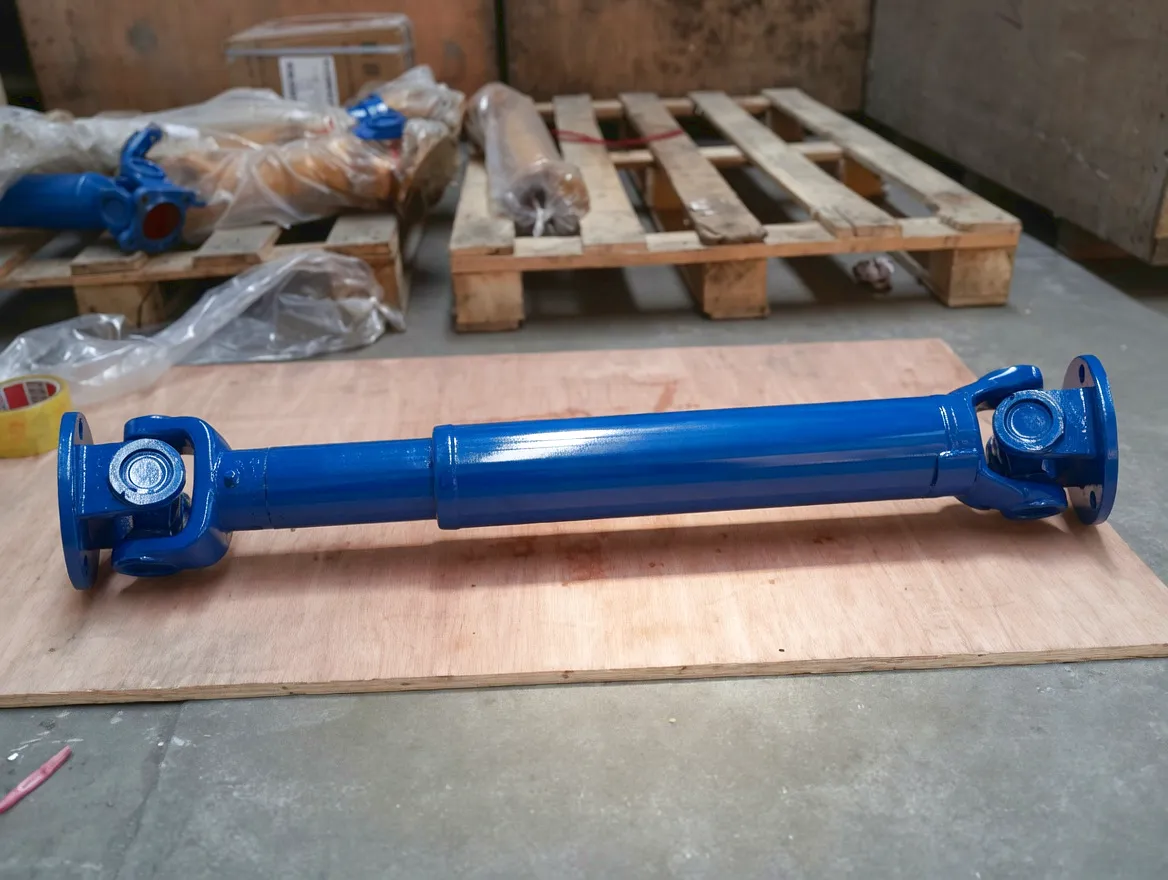
Proper maintenance of a cardan coupling driveshaft is not complicated, but it is time-sensitive. The most common cause of in-season failure in UK conditions is not manufacturing defect — it is neglected lubrication in a wet spring followed by a tough autumn campaign. Moisture and soil ingress past worn or damaged seals strip the grease film from needle roller journals, and once metal-to-metal contact begins, a journal failure can happen within hours of operation. The following maintenance protocol is based on what the HSE recommends for agricultural PTO equipment maintenance and what our engineering team has validated through field feedback across the UK.
Every 50 Hours
Re-grease all nipples on cross joints and telescoping tube with NLGI-2 lithium complex grease until fresh grease emerges from seal lips. Inspect guard for cracks or security of retention chain.
Pre-Season (Annual)
Check radial play in cross joint needle bearings — replace the cross kit if play exceeds 0.5 mm. Inspect telescoping profile for corrosion pitting. Verify shear bolt rating and replace any bolts that show shear marks, rust, or thread damage.
Post-Season Storage
Fully retract telescoping tube, clean and re-grease before storage. Disconnect from tractor and implement before pressure-washing nearby equipment — high-pressure water will destroy seals and flush grease from bearings faster than any normal field use.
UK Legal Requirement
Under PUWER 1998, all rotating PTO shafts on UK farms must be guarded. The HSE’s AIS8 guidance states that a PTO shaft guard in poor condition is still a legal violation. Inspect guard condition before every working season and replace any cracked or missing guard sections immediately.
Frequently Asked Questions
Questions from UK farmers, machinery dealers, and agricultural engineers — answered by our application team
Ready to Source the Right Cardan Coupling for Your Rotary Tiller Operation?
Our application engineers serve agricultural equipment buyers, farm machinery dealers, and implement OEMs throughout England, Scotland, Wales, and Northern Ireland. Send us your specification and receive a detailed technical recommendation and competitive quote within 24 hours.
© Ever Power Transmission — Cardan Coupling & PTO Shaft Specialists | Serving UK Agricultural & Industrial Markets | [email protected] | edit by gzl