What Angular Misalignment Actually Means in Practice
How a Cardan Coupling Transmits Torque Through an Angle
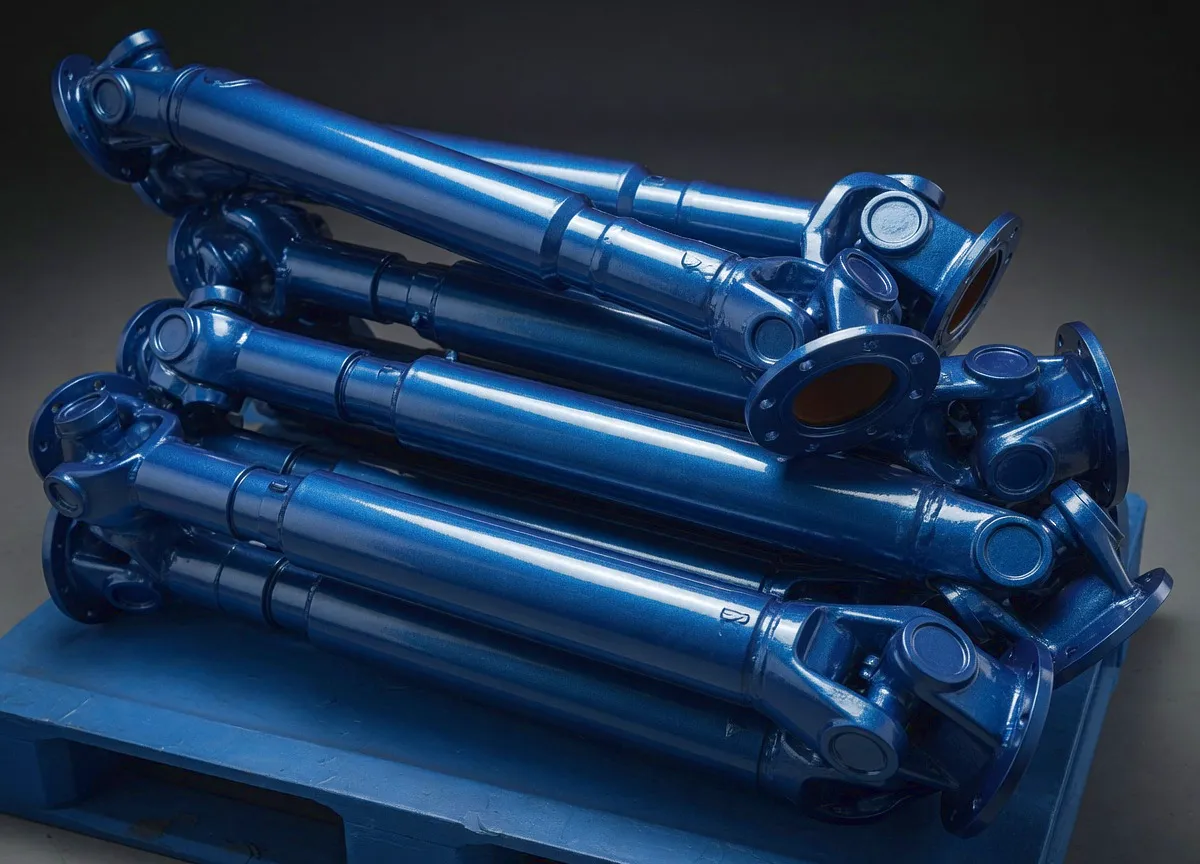
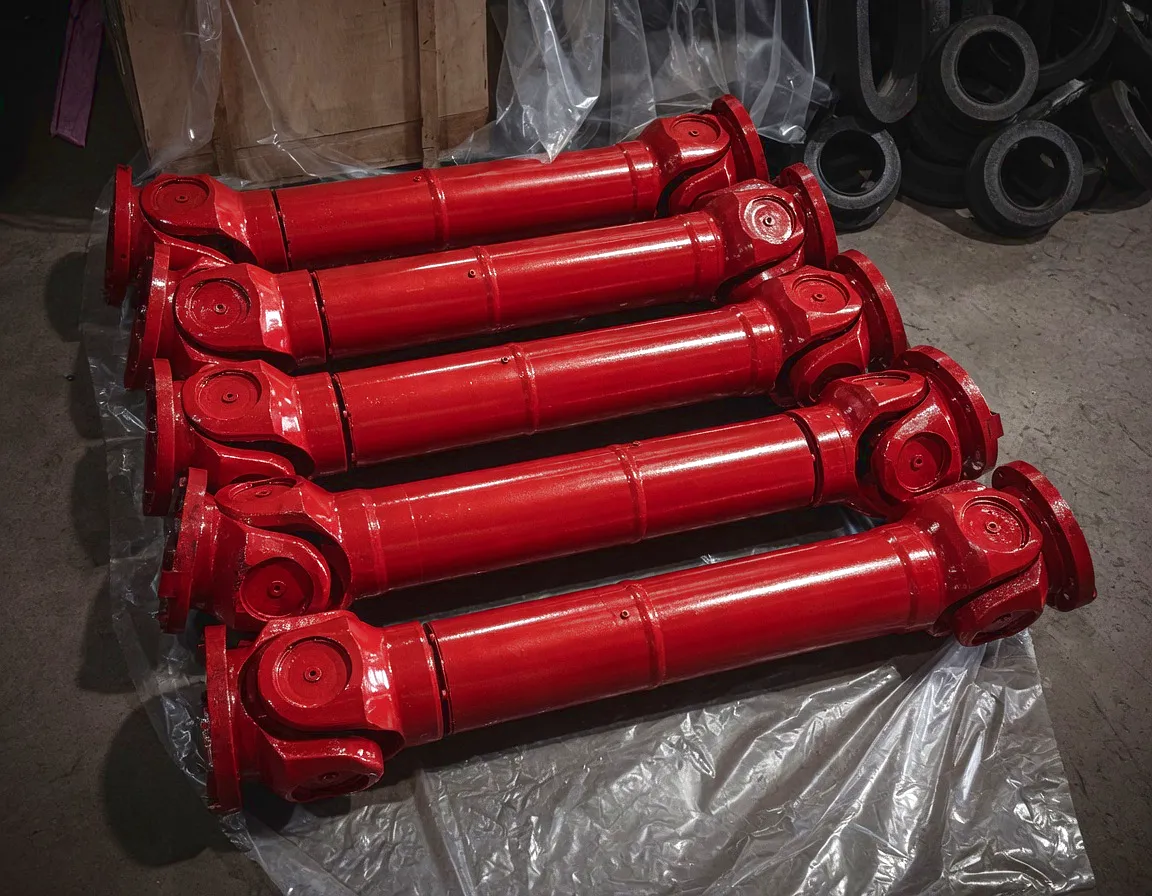
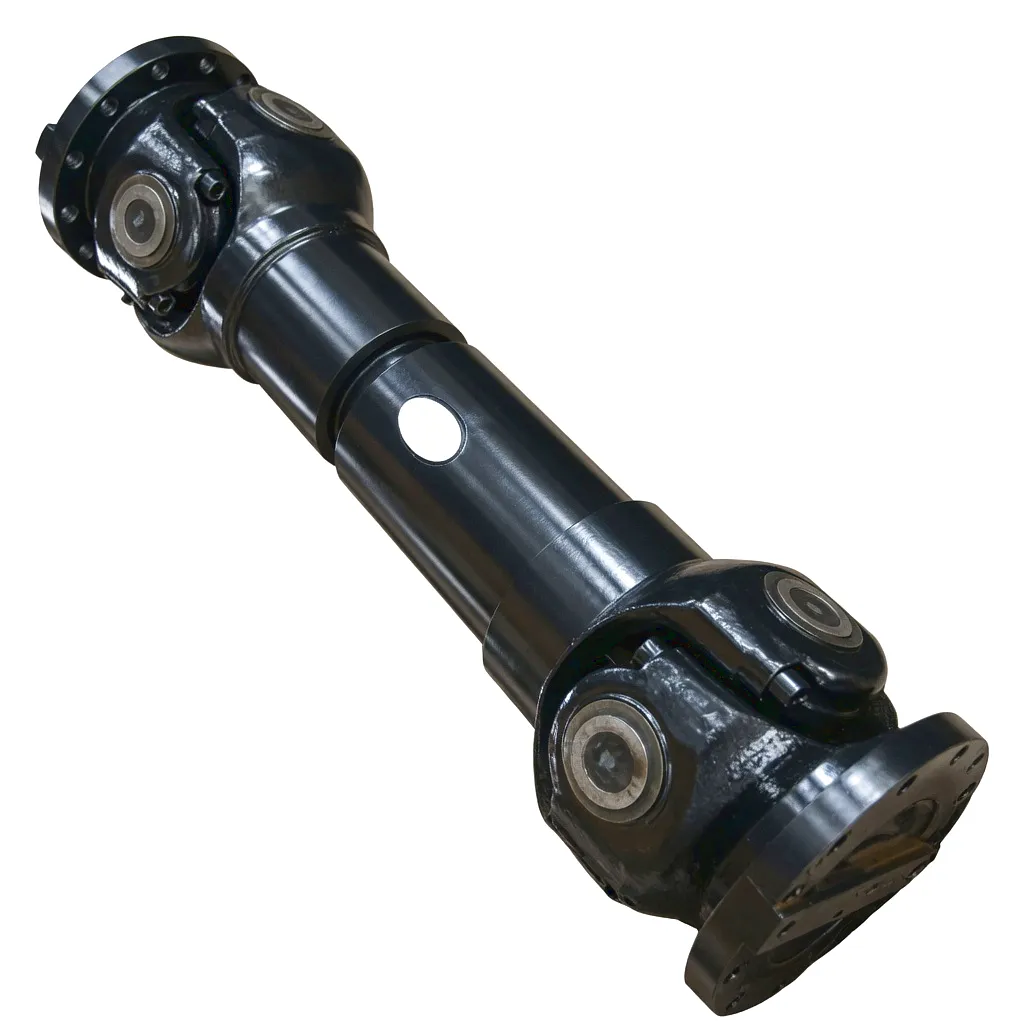
The operating principle of a cardan coupling rests on the Hooke’s joint (universal joint) mechanism, first described theoretically by Robert Hooke in the seventeenth century and refined through centuries of mechanical engineering into the precision-ground, heat-treated components used in modern industrial drivetrains. At its core, the assembly comprises two yokes — one attached to the driving shaft, one to the driven shaft — connected through a cross-shaped intermediate element (the spider or trunnion cross), whose four bearing journals allow each yoke to pivot freely in orthogonal planes. This arrangement allows angular movement in any plane while maintaining continuous torque transmission, making it fundamentally different from both flexible disc couplings and elastomeric jaw couplings that accommodate misalignment through material deformation rather than geometric pivot action.
The kinematic characteristic most critical to engineering performance is the velocity ratio between input and output shafts. When a single Hooke’s joint operates at an angle, the output shaft rotates at a velocity that oscillates twice per revolution above and below the input velocity. The magnitude of this velocity variation increases with the operating angle according to: output angular velocity = input angular velocity multiplied by (cos[angle] / (1 − sin²[angle] × sin²[rotation angle])). At small angles below about 3 degrees, this variation is negligible for most applications. At 10 degrees, the velocity fluctuation becomes perceptible and begins to impose cyclic loads on connected machinery. At 15 to 20 degrees — approaching the upper operational limit of most standard cardan couplings — the velocity variation is substantial and must be compensated through a double-joint (double-cardan or constant-velocity) arrangement to eliminate the second-order oscillation entirely.
Single Cardan Joint
Typically rated up to 15°–25° operating angle. Output velocity fluctuates cyclically; best suited for slow-speed, moderate-load applications where velocity uniformity is not critical.
Double Cardan Joint
Uses two Hooke’s joints with a centring mechanism to cancel velocity variation, delivering near-constant velocity output across angles up to 50° in specialised designs. Required where angular velocity uniformity is critical.
Telescoping Cardan Shaft
Combines angular and axial displacement capability through splined sliding section. Used wherever equipment must adjust its running length dynamically during operation, such as in rolling mill stands.
Angular Misalignment Limits: Engineering Boundaries That Matter
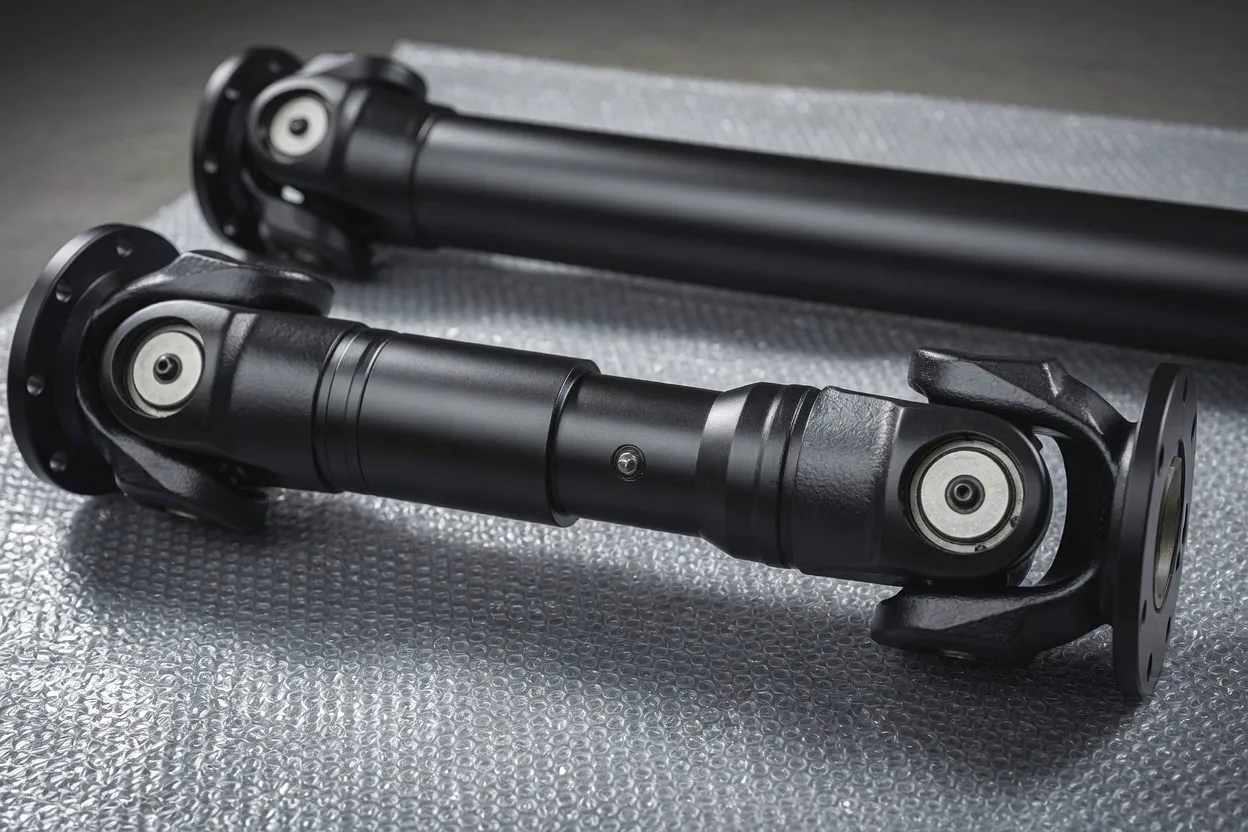
Product Technical and Performance Parameters
| Parameter | Light Duty Series | Standard Industrial Series | Heavy Duty Series | Heavy-Duty Double Cardan |
|---|---|---|---|---|
| Nominal Torque (Nm) | 50 – 500 | 500 – 8,000 | 8,000 – 150,000 | 2,000 – 80,000 |
| Max Operating Angle | Up to 8° | Up to 15° | Up to 12° | Up to 35° |
| Max Articulation Angle | 25° | 35° | 30° | 50° |
| Max Speed (RPM) | Up to 3,000 | Up to 1,500 | Up to 800 | Up to 2,000 |
| Primary Material | C45 Steel / GGG40 | 42CrMo4 Alloy Steel | 34CrNiMo6 / Forged Steel | 34CrNiMo6 Forged |
| Surface Treatment | Zinc Plating / Paint | Induction Hardened + Paint | Carburised + Shot-blasted | Induction Hardened |
| Bore Diameter Range (mm) | 10 – 80 | 25 – 250 | 80 – 600 | 40 – 400 |
| Lubrication Type | Grease (Sealed or Repack) | Grease / Centralised Oil | Forced Oil Circulation | Grease / Forced Oil |
| Dynamic Balance Grade | G6.3 | G2.5 | G2.5 / G1.0 (optional) | G1.0 |
The Real Effects of Exceeding Angular Misalignment Limits
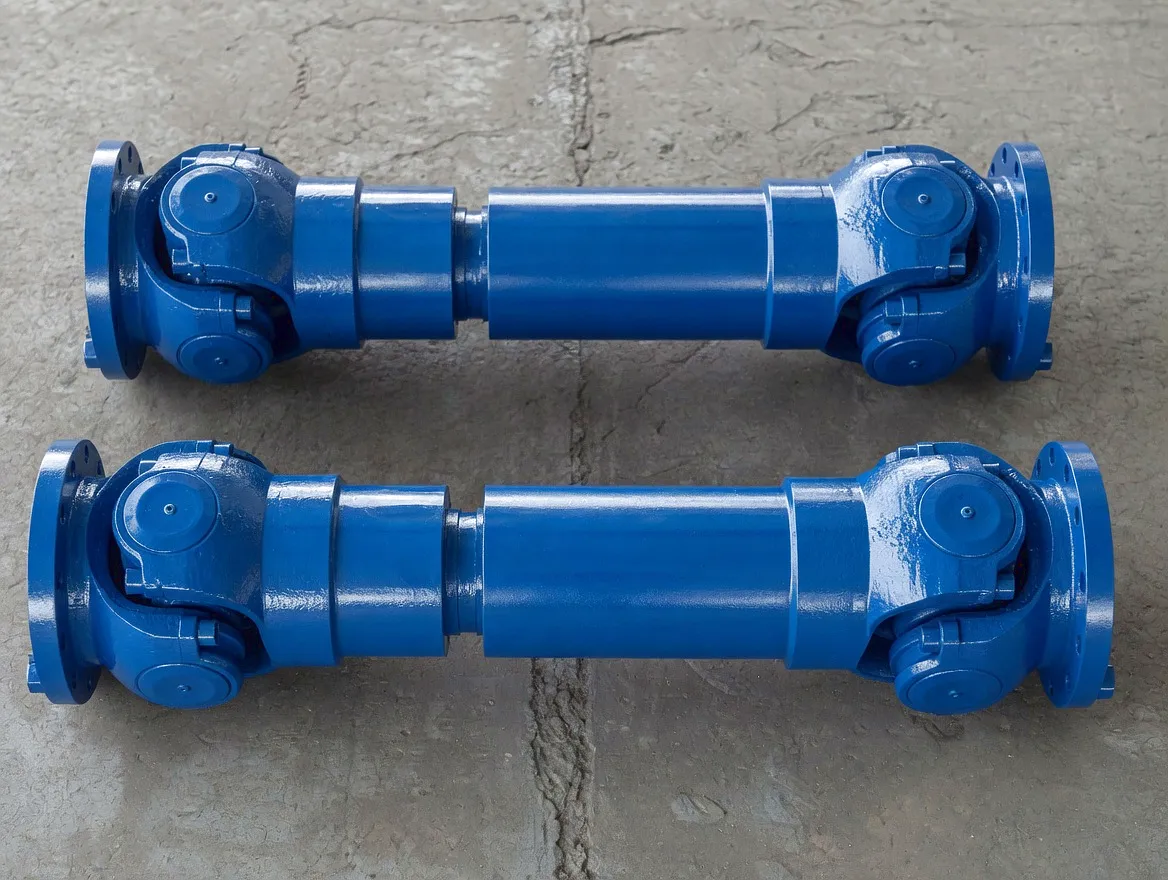
Bearing Fatigue
Needle bearing lifespan drops exponentially; early pitting and spalling develop within thousands rather than millions of cycles.
Torsional Resonance
Velocity non-uniformity excites torsional vibration modes, risking keyway fatigue, gear tooth damage, and shaft cracking.
Heat Generation
Increased friction at over-angle joints raises lubricant temperatures, breaking down grease structure and accelerating wear.
Cross-Journal Wear
Trunnion cross journals and cups sustain fretting corrosion and abrasive wear, causing play, imbalance, and eventual fracture.
Core Materials and Their Role in Managing Angular Loads
Engineering Solutions for Angular Misalignment Management
The engineering toolkit for managing angular misalignment in cardan coupling applications has expanded significantly over the past two decades. For applications where misalignment is fixed and known — such as a permanently inclined drive to a conveyor system — the solution is purely one of correct specification: selecting a coupling series with adequate angular rating for the design angle, with an appropriate safety margin to account for manufacturing tolerances and operational drift. However, for applications where misalignment varies during operation, or where the consequences of angular overload are particularly severe, more sophisticated solutions are required, and these are where modern precision cardan coupling design demonstrates its engineering depth.
Double-Cardan Constant-Velocity Arrangement
Two Hooke’s joints phased at equal and opposite angles with a centring ball-and-socket mechanism cancel each other’s velocity variation, producing constant-velocity output at operating angles up to 35°, and in specialised designs up to 50°. This arrangement is the standard solution for high-speed, high-precision drivetrains where velocity uniformity is non-negotiable, including test-bench drive systems and precision machine tool spindle drives.
Phase Angle Optimisation
Even with a single Hooke’s joint, the phase relationship between the input and output yoke affects the timing of velocity peaks relative to load peaks in the connected machinery. For some applications, careful phasing of yoke orientation can align velocity peaks with low-load intervals in the machine cycle, reducing the effective dynamic load amplification without requiring a more expensive double-cardan arrangement.
Intermediate Shaft Length Optimisation
The operating angle of a cardan shaft assembly is directly related to its length and the lateral offset between shaft centrelines. Increasing the intermediate shaft length reduces the operating angle for a given offset, often bringing an over-angle installation back within acceptable limits without modifying the machinery geometry. This is frequently the most cost-effective solution in retrofit situations.
Lubrication quality and regreasing intervals also play a significant role in how well a cardan coupling tolerates its operating angle over time. At high operating angles, lubricant is continuously displaced from the loaded needle bearing zone and must be replenished more frequently. For UK facilities operating in abrasive environments — such as quarrying operations in the Peak District or cement processing in the Thames Valley — sealing effectiveness against contamination ingress becomes equally critical. Modern sealed cardan couplings with nitrile or PTFE lip seals, combined with high-viscosity lithium-complex or polyurea greases, can dramatically extend regreasing intervals and reduce maintenance burden in demanding environments.
Industrial Application Scenarios Across the UK
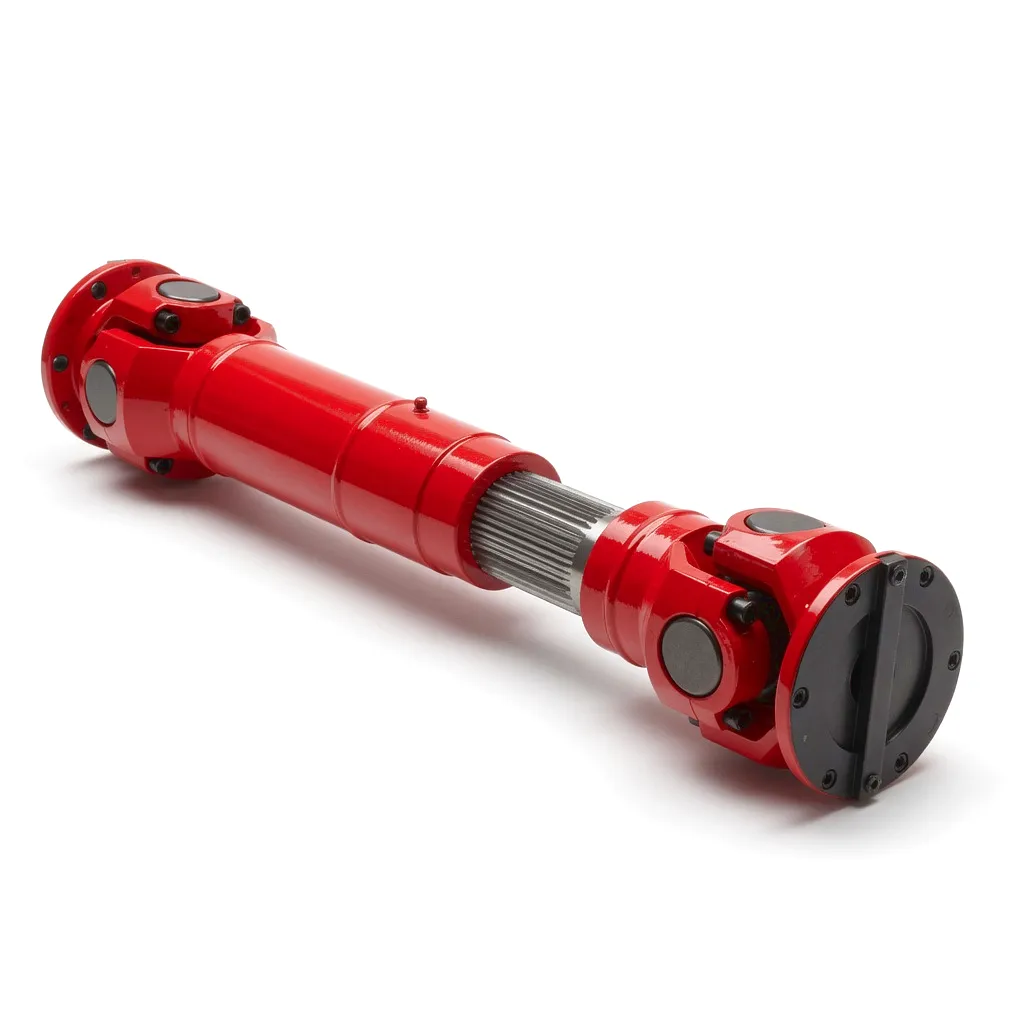
Paper & Packaging
Dryers, calendar stacks, and winder drives. Angular misalignment compensation allows press-roll arrangements to be adjusted without drivetrain realignment.
Mining & Quarrying
Conveyor head drives, crusher drives, and dragline machinery — all demanding high angular tolerance under severe shock and contamination conditions.
Agriculture & Forestry
PTO drivelines between tractors and implements require up to 45° angular accommodation during field manoeuvres, making cardan joints the only viable solution.
Marine & Offshore
Shaft line misalignment in UK shipbuilding (Clyde, Tyne, Belfast) due to hull deflection and installation tolerance is managed through cardan coupling arrangements on main and auxiliary propulsion shafting.
Power Generation
Wind turbine main shaft and generator drive couplings in the UK’s growing onshore and offshore wind sector use precision cardan shafts to absorb rotor deflections and foundation settlement.
Core Technical Advantages of Modern Cardan Couplings
High Angular Capacity
Accommodates angular misalignment that would destroy any other coupling type, enabling machinery designs that rigid coupling constraints would make impossible.
High Torque Density
Forged alloy steel construction achieves extremely high torque-to-weight ratios. Heavy-duty cardan shafts transmit torques exceeding 150,000 Nm at compact diameters compared to alternatives.
Axial Displacement Tolerance
Telescoping splined sections allow shaft length variation during operation, accommodating thermal growth, equipment positioning changes, and structural deflections simultaneously.
Maintainability
Trunnion cross assemblies are designed as replaceable cartridges. Field-level service of needle bearings and seals is possible without removing the entire coupling from the drivetrain.
Wide Speed and Torque Range
Available from miniature precision series at sub-100 Nm to heavy industrial series exceeding 150,000 Nm, covering virtually every industrial drive application from instrumentation to primary metals processing.
Long Proven Service Life
When correctly specified and maintained, industrial cardan coupling assemblies routinely achieve service lives measured in decades in continuous heavy-duty service — a performance record that alternative coupling technologies cannot match.
Ever Power: Precision Manufacturing and Custom Engineering
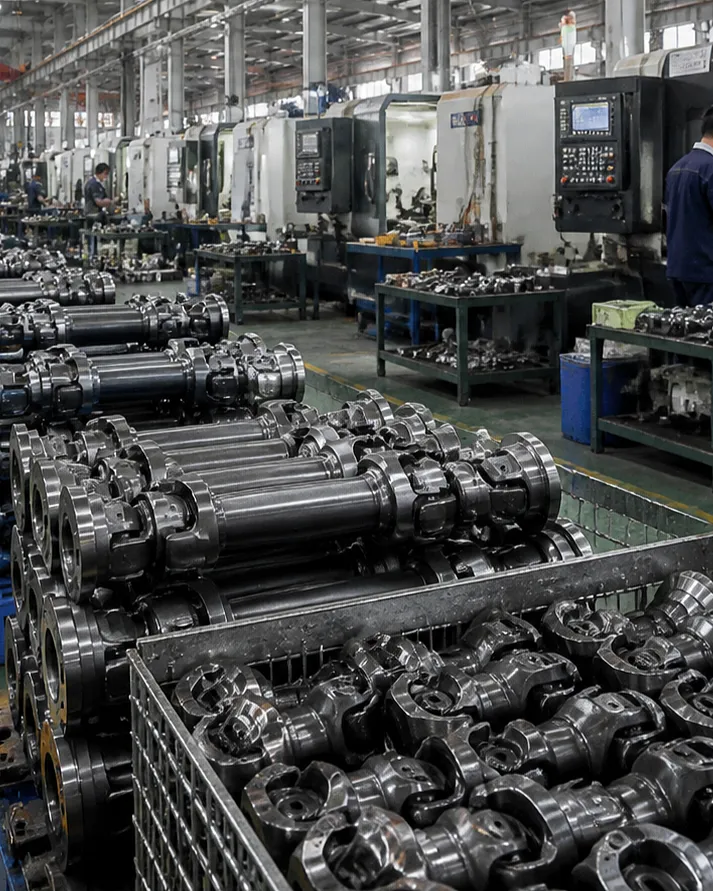
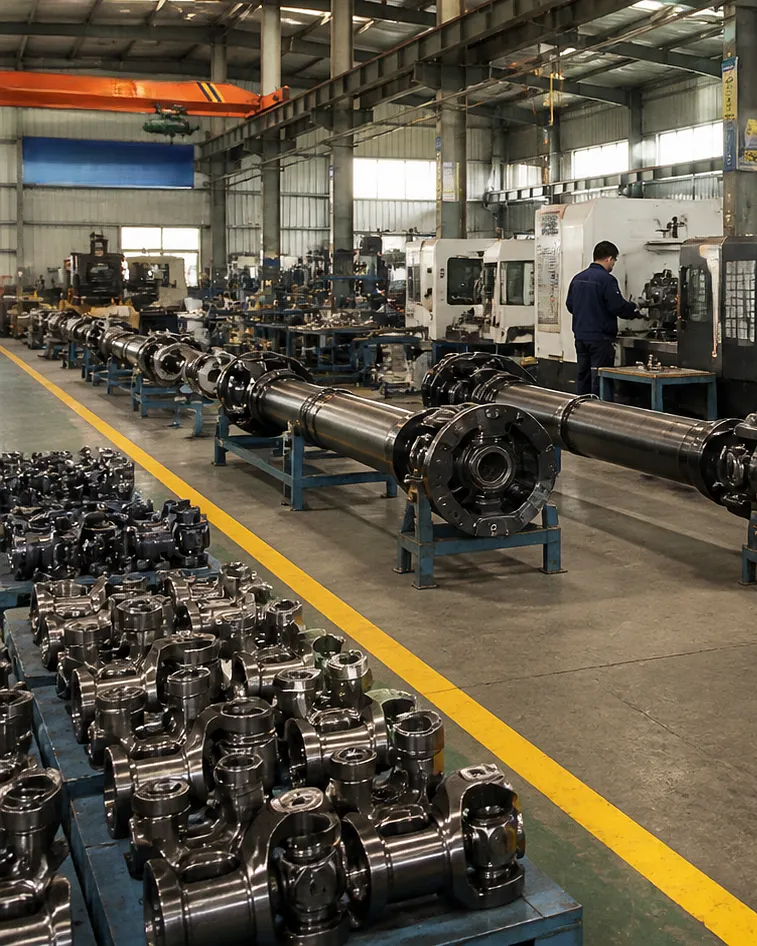
Ever Power’s manufacturing operations are built around the singular premise that no two industrial applications are identical, and that the highest-performing cardan couplings are those engineered precisely for their specific duty — not catalogue items derated to fit. Our manufacturing site operates CNC turning centres with live tooling capable of holding bore concentricities within 0.01 mm, vertical machining centres for yoke body profiling, and dedicated cylindrical grinding machines for trunnion cross journal finishing to surface roughness values below Ra 0.4 µm. These precision capabilities translate directly into the bearing life and velocity uniformity that demanding applications in the UK’s steel, automotive, and energy sectors require.
Ever Power’s customisation capabilities extend well beyond dimensional modification of standard designs. Our engineering team regularly develops bespoke cardan coupling configurations for clients with unusual geometric constraints — including non-standard yoke orientations, integrated torque limiters or torque-sensing flanges, special bore configurations for splined or keyed connections, and flange patterns to match customer-specific bolt circle diameters. Material upgrades for corrosive or high-temperature environments — such as stainless steel trunnion crosses, high-temperature synthetic grease pre-fill, and ceramic-coated bearing surfaces — are all available as specified options within our engineering customisation programme.
Our supply chain capabilities are specifically structured to serve UK-based procurement teams with the responsiveness that planned and emergency maintenance situations demand. Standard sizes from our catalogue range are held in finished goods inventory for despatch within 2 working days. Custom-engineered assemblies, depending on complexity, carry lead times of 3 to 6 weeks from approved drawing — competitive with any European manufacturer and substantially faster than many Asian suppliers whose actual delivery performance frequently diverges from quoted lead times. Our quality documentation package, including material certificates, dimensional inspection reports, and dynamic balance test records, is provided as standard with every shipment and formatted to be compatible with UK-standard engineering management systems.
Customer Success: Sheffield Cold Rolling Mill Drivetrain Upgrade
★★★★★
“We had been chasing a persistent coupling failure problem for over two years. Ever Power’s engineering team identified the root cause — operating angle exceedance — within days, and their double-cardan solution has been running without issue for over two years now. The quality of both the product and the technical support was well above what we expected from an overseas supplier.”
— David H., Maintenance Director, Cold Rolling Facility, Sheffield, UK
★★★★★
“The custom bore specification and non-standard flange pattern Ever Power produced for our retrofit project were machined to tolerances that our metrology team verified independently. Dimensional accuracy was spot-on, and the delivery arrived in Birmingham exactly within the promised timeframe. We will be placing repeat orders.”
— Sarah T., Procurement Manager, Automotive Press Line, Birmingham, UK
★★★★★
“Ever Power supplied cardan shafts for our aggregate conveyor drives at our quarry site in Derbyshire. The sealed grease lubrication design has dramatically reduced our maintenance visits in what is a very abrasive and dusty environment. Seal integrity at our operating angles is genuinely impressive — something previous suppliers consistently failed to deliver.”
— Mark B., Engineering Manager, Aggregate Processing, Derbyshire, UK
Ever Power Coupling Product Range
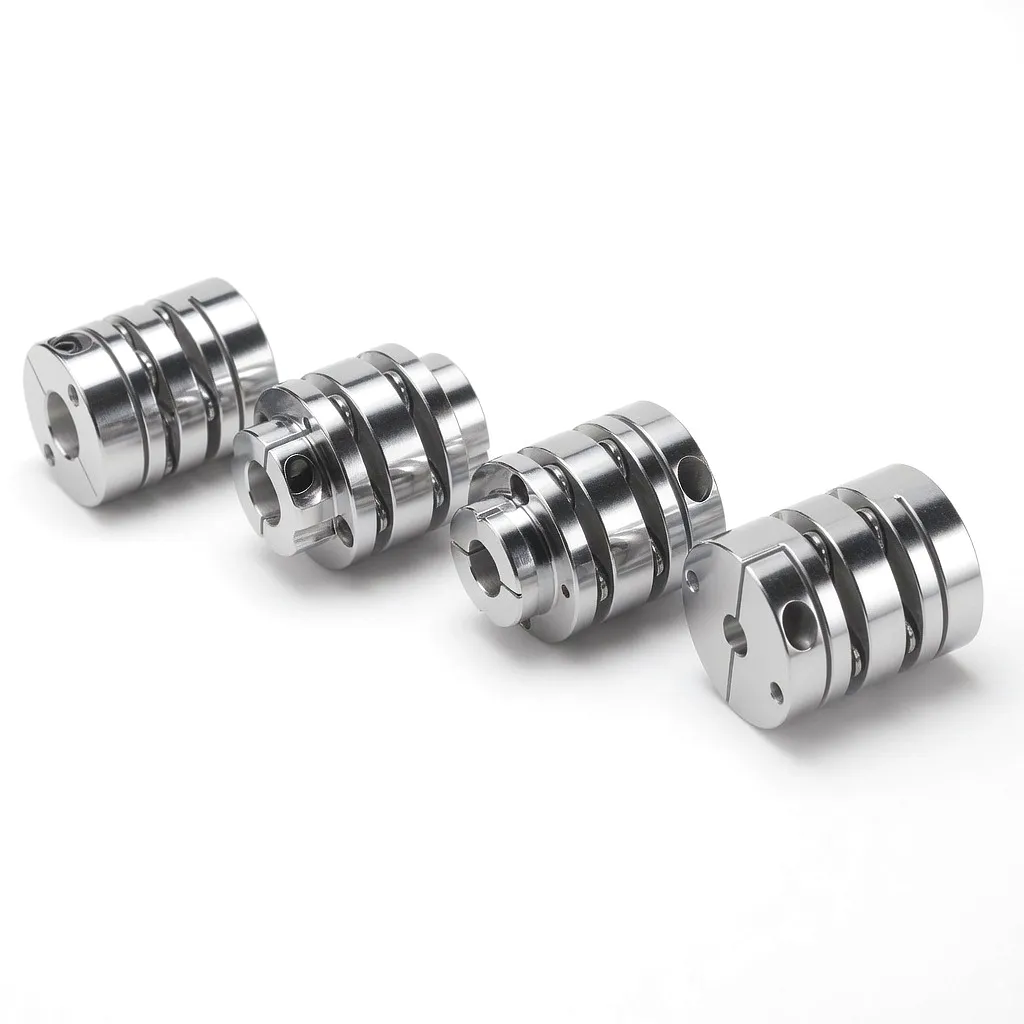
Disc Coupling
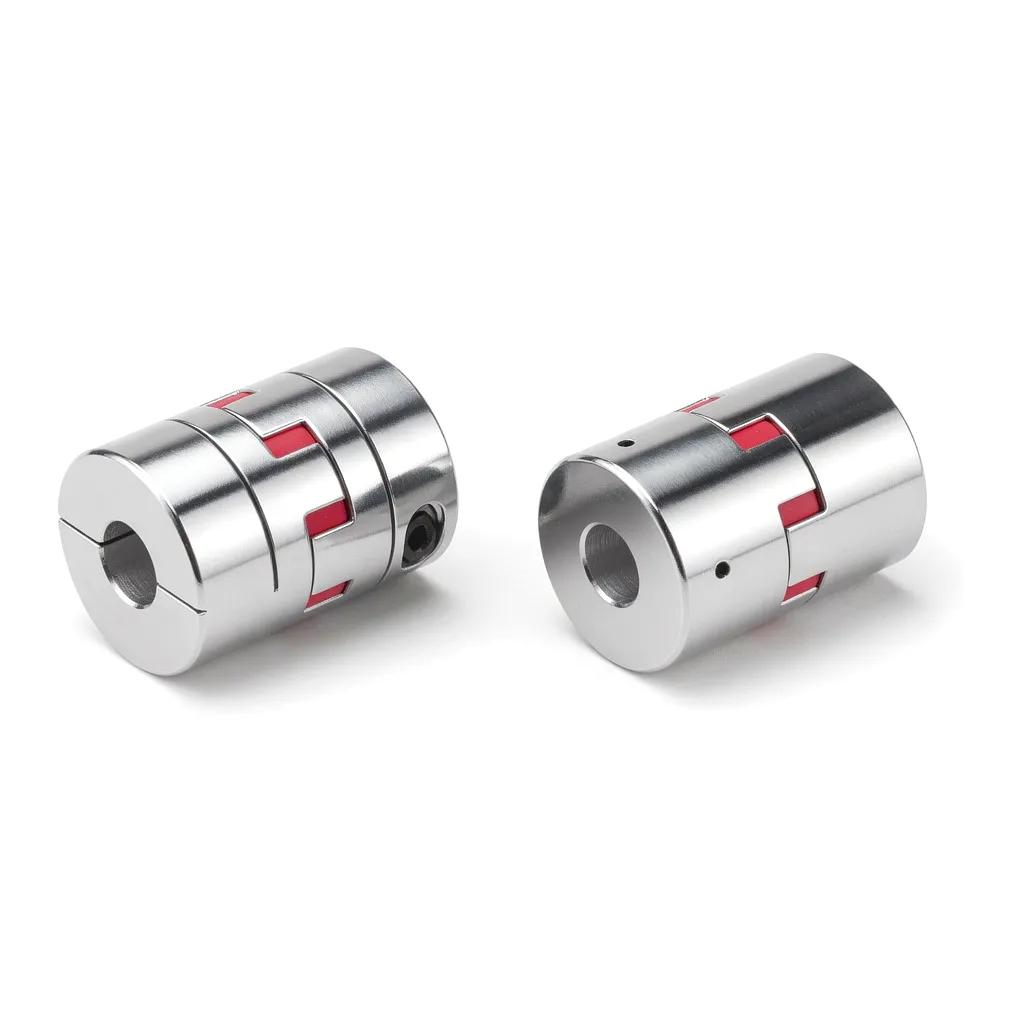
Jaw Flexible Coupling
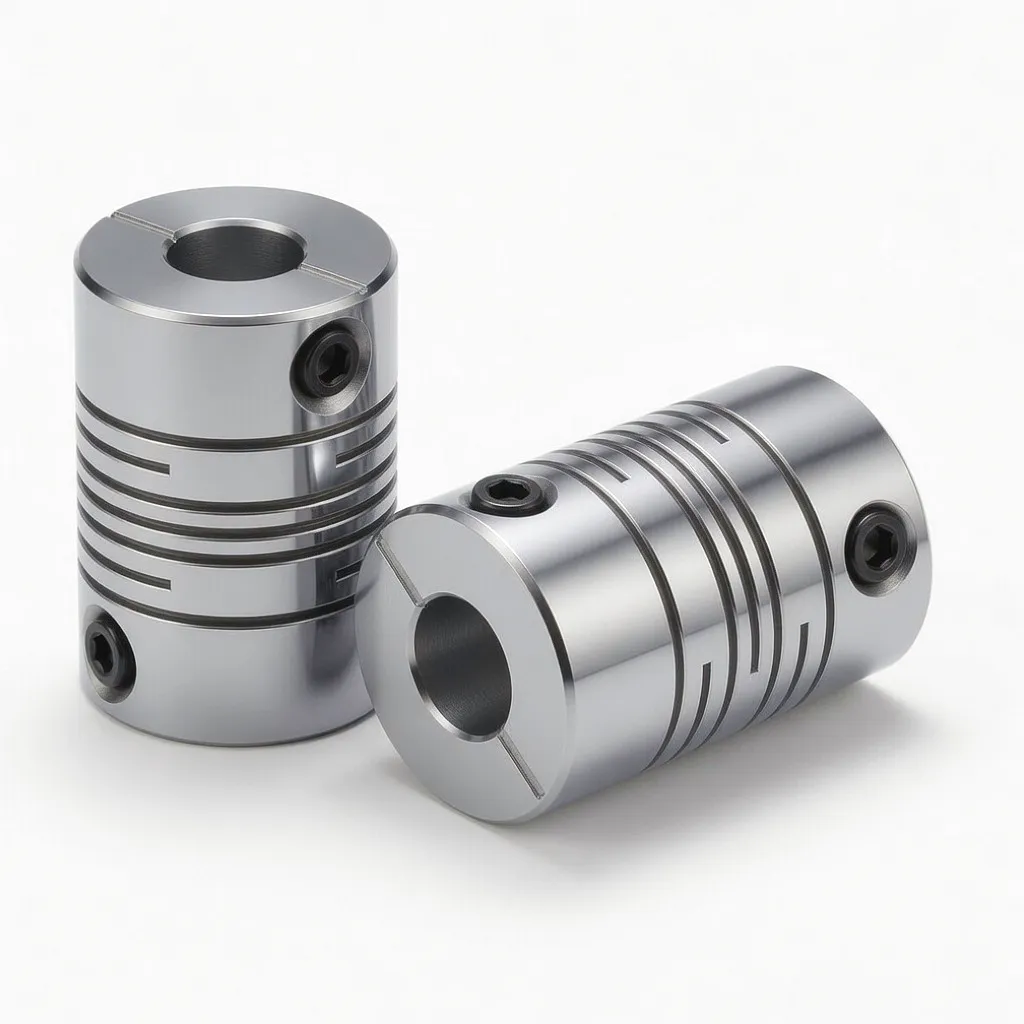
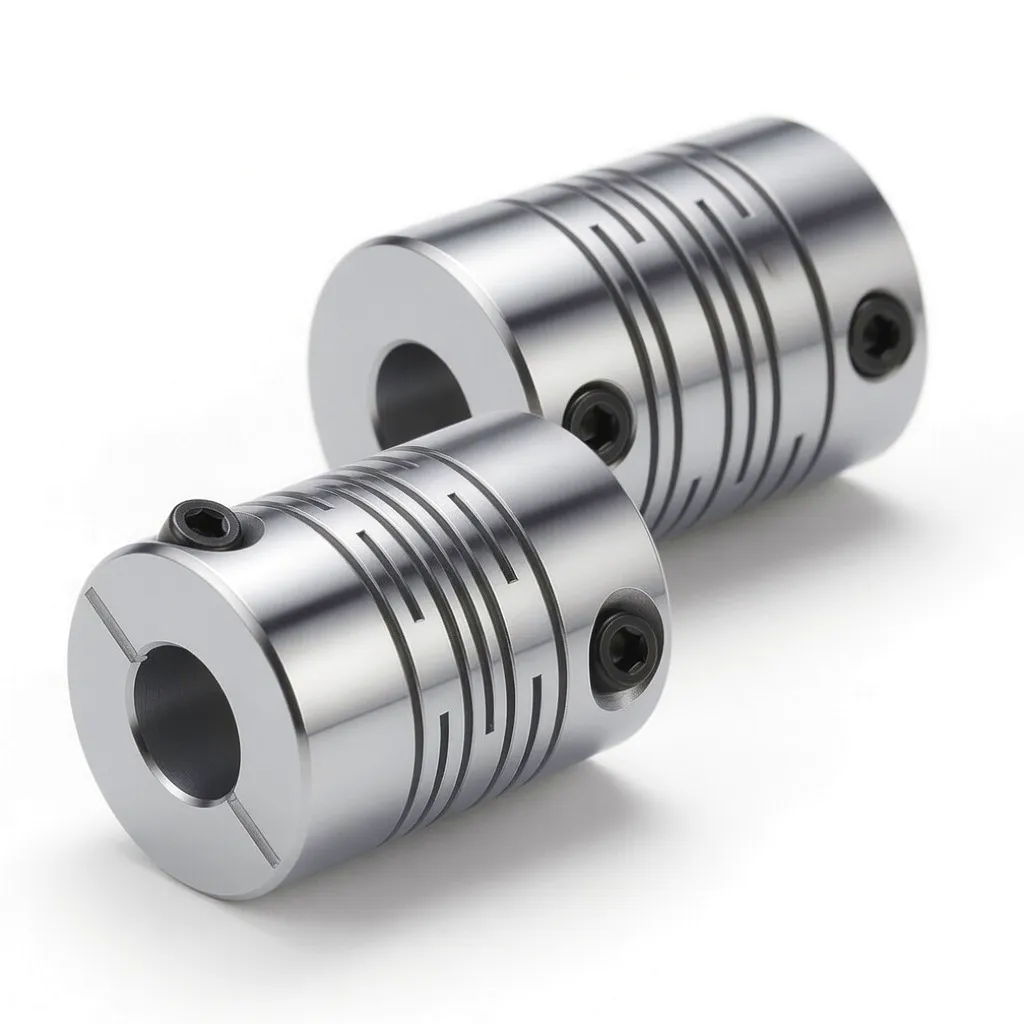
Beam Coupling
Beam Coupling Variant
Frequently Asked Questions
What is the maximum angular misalignment that a standard industrial cardan coupling can handle in continuous operation?
For most standard industrial cardan coupling series, the maximum continuous operating angle is typically between 10° and 15° at rated torque. This limit decreases as torque and speed increase together. When constant-velocity output is required, or when the misalignment exceeds this range, a double-cardan arrangement should be specified, which can extend the continuous operating angle to 35° and above in specialised heavy-duty designs.
How do I find a reliable cardan coupling supplier in the UK who can provide custom-machined components with short lead times?
The most reliable route is to work with a manufacturer that holds finished-goods stock for standard sizes and has in-house CNC machining for custom bore and flange specifications. Ever Power maintains warehouse stock for despatch within 2 working days on standard items, and our engineering team can turn around custom drawings and quotations within 48 hours for most project requirements.
What happens to the lifespan of a cardan coupling when it is consistently operated above its rated angular misalignment limit?
Bearing life degrades geometrically — not linearly — with increasing angle beyond the rated limit. A coupling operating at 120% of its rated angle may experience bearing life reductions of 40% to 60%. The failure mode is typically accelerated needle bearing fatigue, manifesting as spalling, heat generation, and progressively increasing rotational play. The associated torsional vibration from the increased velocity non-uniformity also imposes additional fatigue cycles on connected shafting and gearboxes.
How much does a custom-designed double-cardan shaft assembly typically cost for a heavy industrial application in the UK, and what factors affect the price?
Pricing for custom double-cardan assemblies for industrial applications varies considerably depending on torque rating, bore size, material specification, and balance grade required. For a general industrial double-cardan shaft in the 5,000 to 20,000 Nm torque range, budget pricing typically falls in the £1,200 to £4,500 range for standard materials. Heavy-duty assemblies above 50,000 Nm with premium material specifications can reach £8,000 to £25,000. Contact Ever Power at [email protected] for a precise quote based on your specific technical requirements.
Which industries in Sheffield and Birmingham most commonly use cardan couplings, and what angular misalignment ranges are typical in those applications?
Steel rolling and forging operations in Sheffield typically require cardan shafts with operating angles between 3° and 18°, depending on roll pass design and product gauge range. Automotive press and transfer line applications in Birmingham generally operate at lower angles of 2° to 8°, but prioritise velocity uniformity and long maintenance intervals. Both sectors benefit significantly from double-cardan or high-specification single-cardan designs tailored to their specific duty cycle.
When should I choose a double-cardan coupling over a single Hooke’s joint design, and what is the price difference I should expect between these two options?
A double-cardan arrangement is necessary when your application requires constant-velocity output — typically when operating angles exceed 8° to 10° in precision or high-speed drivetrains, or when the connected machinery is sensitive to cyclic velocity variation. The price premium for a double-cardan over a comparable single-joint design typically ranges from 35% to 80%, depending on the centring mechanism complexity. For applications that genuinely need constant-velocity output, this premium is almost always justified by the elimination of drivetrain vibration issues and extended connected component life.
Where can I get a fast quote for cardan coupling components from a supplier who understands UK engineering standards and can deliver to a facility in the north of England?
Ever Power’s technical sales team responds to UK procurement enquiries within 24 hours and is experienced in working to BS and DIN engineering standards alongside customer-specific requirements. Shipments to northern England — including Sheffield, Leeds, Manchester, and Newcastle — are typically delivered within 3 to 5 working days for stocked items. Send your enquiry with shaft dimensions, torque requirements, and operating angle details to [email protected] for a fast, specific response from our engineering team.
Ever Power · Global B2B Supply
Ready to Solve Your Angular Misalignment Challenge?
Our engineering team is ready to review your application parameters and recommend the optimal cardan coupling configuration for your specific duty, angle, and budget requirements.
edit by gzl